Career Assessment in India — Discover the Right Career With Science, Not Guesswork
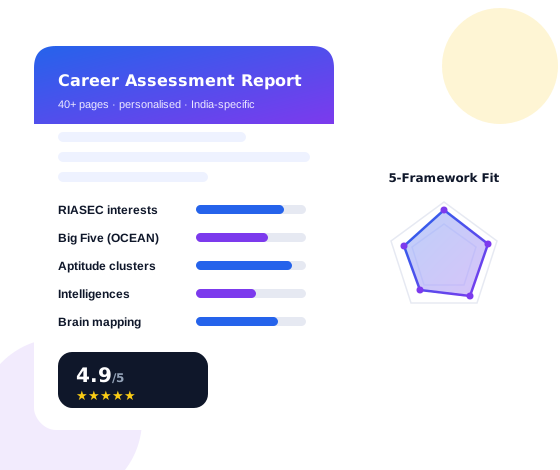
CCO's career assessment combines five scientifically validated frameworks — RIASEC, Big Five personality, Multiple Intelligences, aptitude testing, and brain mapping — interpreted 1:1 by a certified career counsellor and delivered as a 40+ page personalised career roadmap. Take your first step towards a career decision made with evidence.
What Is a Career Assessment?
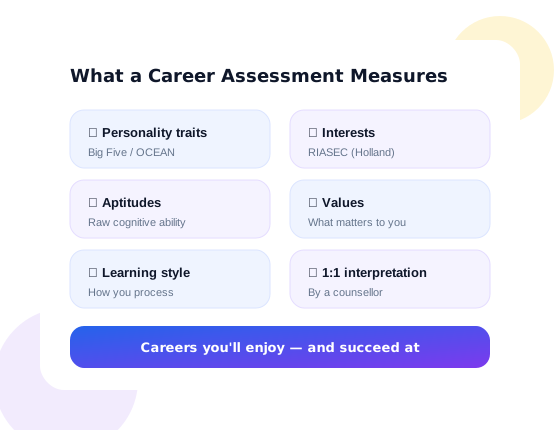
A career assessment is a set of scientifically validated tests that measure a person's personality traits, interests, aptitudes, values, and learning style to identify careers where they are most likely to enjoy the work and succeed at it. Unlike a short "career quiz" you'd find on a lifestyle website, a proper career assessment combines multiple psychometric frameworks (RIASEC, Big Five, Multiple Intelligences, aptitude clusters), takes 60–90 minutes to complete, and requires expert interpretation to translate the data into real-world career recommendations.
At CCO, a career assessment is not a stand-alone test — it's the diagnostic foundation of a full career counselling process. The assessment measures who the student is; the 1:1 session translates that into what they should do about it. That combination is what separates a career assessment that changes decisions from one that just produces a PDF.
Why Every Student Needs a Career Assessment Before Choosing a Career
Most Indian students make career decisions based on three inputs: what their parents want, what their friends are doing, and what their marks look like. All three are wrong tools for the job. Here's what a proper career assessment adds.
It removes bias from the decision.
Family opinions, coaching-class marketing, and social pressure all pull students toward whatever's currently fashionable. A career assessment gives you objective data — not opinion — about which careers actually fit.
It reveals careers you didn't know existed.
Most parents can name 20–30 careers off the top of their head. There are 500+ viable career paths in India today across technology, design, healthcare, media, business, sustainability, sports, psychology, and the creative economy. A good career assessment surfaces the ones that match — including many you've never heard of.
It separates natural strength from trained skill.
A student scoring 95% in physics might be great at the subject but wrong for the career. A career assessment measures underlying aptitude (raw ability), not marks (learned performance). Those two things diverge more often than parents expect.
It anchors career decisions to stable traits, not passing interests.
A 15-year-old who wants to be a YouTuber this month might want to be a chef next month. Career assessments measure things that don't change much — personality, aptitude patterns, cognitive style — which is why the recommendations hold up over years.
It gives parents evidence to work with.
Career decisions that end in arguments almost always start with opinion vs opinion. Once there's a scientific career assessment report on the table, the conversation shifts from "I feel" to "here's what the data shows." Parent-child conflict drops dramatically.
It's cheap insurance against a wrong decision.
A wrong 4-year degree costs ₹5–15 lakh in tuition and 2–3 years of career delay. A comprehensive career assessment costs ₹5,000–₹7,500. The maths writes itself.
Types of Career Assessment — Which One Fits Your Situation?
Career assessments aren't monolithic. Different tests measure different things. CCO offers focused assessments for specific decision points, plus a comprehensive combined assessment for full career discovery.
Psychometric Career Assessment
The most comprehensive option — combines personality (Big Five), interests (RIASEC), aptitudes, multiple intelligences, and brain mapping into a single 40+ page report. Best for students facing major decisions (stream, course, career direction) or professionals planning a switch.
Take a Psychometric Career Assessment →Career Aptitude Test
Measures raw cognitive abilities: numerical reasoning, verbal reasoning, abstract reasoning, spatial reasoning, mechanical reasoning, and clerical speed. Answers the question "What is this person naturally good at?" — separate from interests or personality.
Take a Career Aptitude Test →Stream Selection Test
A focused Class 10 assessment that directly answers the Science / Commerce / Arts question. Combines interests, aptitude, and personality with the specific subject-combination logic Indian boards use.
Take a Stream Selection Test →Personality & Interest Assessment
Combines RIASEC (Holland Code) with Big Five (OCEAN) to build a personality-plus-interest profile. Useful when a student is exploring careers early (Class 8–9) or as a refresh for working professionals evaluating a change.
Take a Personality & Interest Assessment →Sample Career Report
Want to see what a completed career assessment report actually looks like before you commit? Preview a full anonymised CCO career report.
View a Sample Career Report →Not sure which one?
Take the free demo assessment, or book a free call and we'll help you pick the right track for your situation.
Start free →The Scientific Frameworks Inside CCO's Career Assessment
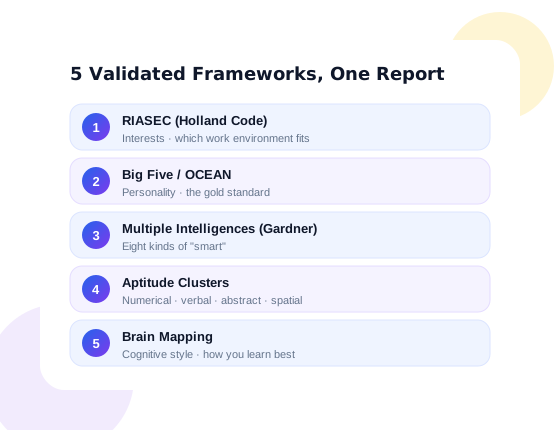
Every career assessment is only as reliable as the frameworks it uses. CCO combines the five most validated instruments in career psychology — each measuring something a single test can't capture alone.
Framework 1: RIASEC (Holland Code)
What it measures: The type of work environment where you'll naturally thrive.
Developed by: Psychologist John Holland in 1959; used by career centres worldwide.
How it works: Places every person on six dimensions — Realistic (hands-on, practical), Investigative (analytical, scientific), Artistic (creative, expressive), Social (helping, teaching), Enterprising (leading, persuading), Conventional (organising, detail-oriented). Most people are a mix of 2–3 dominant orientations.
Why we use it: The most researched and predictive career-interest model in psychology.
Framework 2: Big Five / OCEAN Personality Model
What it measures: The five core dimensions of personality that predict long-term career fit.
Developed by: Decades of factor-analytic research; considered the gold standard in personality science.
How it works: Rates five traits — Openness (curiosity), Conscientiousness (discipline), Extraversion (social energy), Agreeableness (cooperation), Neuroticism (emotional volatility).
Why we use it: Unlike MBTI (which many career psychologists have moved away from), the Big Five is statistically stable and empirically predictive of job performance and satisfaction.
Framework 3: Multiple Intelligences (Gardner)
What it measures: The eight distinct kinds of "smart."
Developed by: Harvard psychologist Howard Gardner in 1983.
How it works: Maps eight intelligences — linguistic, logical-mathematical, spatial, kinaesthetic, musical, interpersonal, intrapersonal, and naturalistic. A student who scores average on school marks may be exceptional in spatial or interpersonal intelligence — which points directly to careers in design, therapy, or leadership.
Why we use it: Rescues capable students from being misjudged by school marks alone.
Framework 4: Aptitude Clusters
What it measures: Raw cognitive ability — the ceiling of what a person can do with training.
Developed by: Multiple standardised instruments (DAT, DBDA, DAT-5).
How it works: Measures numerical, verbal, abstract, spatial, mechanical, and clerical reasoning independently. Someone with strong spatial + mechanical aptitude has raw talent for engineering; strong verbal + abstract points to law or research.
Why we use it: Aptitude is what training can amplify; without it, no amount of coaching produces results.
Framework 5: Brain Mapping
What it measures: Left-brain / right-brain / whole-brain dominance and cognitive style.
How it works: Analyses how the brain prefers to process information — analytical vs holistic, sequential vs random, verbal vs visual. Influences how a student studies, which work environments they'll be productive in, and how they'll respond to different learning demands.
Why we use it: A dimension most career assessments in India skip — but which explains why some students burn out in careers that look like a "match" on paper.
= One 40+ page career assessment report
Combined, these five frameworks produce a 40+ page career assessment report that pinpoints not just which careers fit, but why — with specific recommendations for streams, courses, entrance exams, and colleges mapped to the Indian ecosystem.
Career Assessment Types Compared
| Assessment Type | What It Measures | Best For | Duration | Included at CCO |
|---|---|---|---|---|
| Psychometric | Personality + interests + aptitudes + intelligences (combined) | Full career discovery | 60–90 min | ✓ (Basic & Advanced) |
| Brain Mapping | Cognitive style / brain dominance | Understanding how you learn best | 20–30 min | ✓ (Pro & Advanced) |
| Aptitude Test | Numerical, verbal, abstract, spatial reasoning | Identifying natural cognitive strengths | 45–60 min | ✓ (within Psychometric) |
| Interest Inventory (RIASEC) | Career environment preferences | Early career exploration | 15–20 min | ✓ (within Psychometric) |
| Personality Test (Big Five) | Long-term fit with work traits | Understanding stable traits | 20–30 min | ✓ (within Psychometric) |
| MBTI / 16 Personalities | Personality "type" | Self-reflection (limited career predictive value) | 15 min | Not used — see below |
| Free online quizzes | Varies — usually shallow | Casual curiosity, not decisions | 5 min | Not comparable |
A note on MBTI: while MBTI is popular, decades of research show it's less statistically reliable than the Big Five for career prediction. CCO uses the Big Five for exactly this reason.
How the CCO Career Assessment Works — Step by Step
The full CCO career assessment process — from booking to interpretation — typically takes 10–14 days.
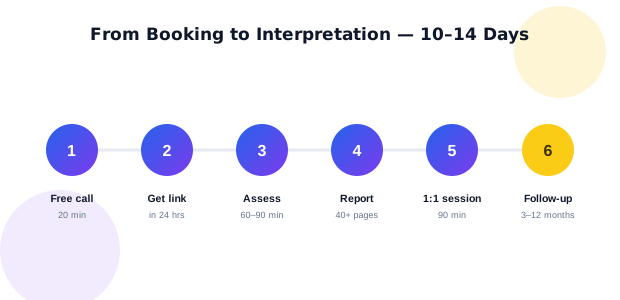
Step 1 — Book a Free 20-Minute Discovery Call
We understand where the student is stuck, which decisions are coming up, and which of our assessment tracks fits best. No cost, no commitment.
Step 2 — Receive Your Personalised Assessment Link
Within 24 hours of your discovery call, you receive a secure link to your career assessment. The assessment is entirely online and works on laptop, tablet, or phone.
Step 3 — Complete the Assessment (60–90 minutes)
The student completes the assessment at home, at their own pace. There's no time limit and no right or wrong answers — just honest responses. Most students finish in a single sitting; parents can help clarify questions but shouldn't answer them.
Step 4 — Your Report Is Generated
Within 48 hours, your 40+ page personalised career report is generated and shared. The report includes scored results, career recommendations, subject/stream/exam guidance, and an action plan.
Step 5 — 90-Minute 1:1 Interpretation Session
This is what turns a report into a decision. Founder-counsellor Varun Vohra walks the family through the results, explains what the data means, explores 4–6 career possibilities that fit, and pressure-tests the top options against the student's own instincts.
Step 6 — 3–12 Months of Follow-Up Support
Career decisions rarely end at the session. You get 3–12 months of WhatsApp + email follow-up (depending on plan) for questions as they arise.
Inside Your 40+ Page CCO Career Assessment Report
Most career assessment reports in India are 8–15 pages of generic template. CCO's report is 40+ pages and personalised to the individual student. Here's exactly what's inside.
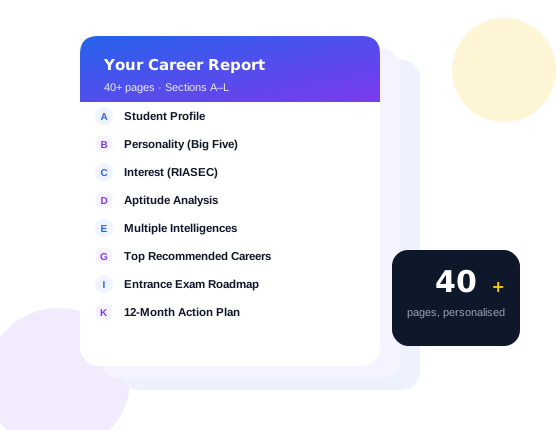
Section A — Student Profile
Cover page, student background, assessment date, plan level.
Section B — Personality Profile (Big Five / OCEAN)
Scored profile across all five dimensions, with a plain-language interpretation of what each score means for career fit.
Section C — Career Interest Orientation (RIASEC)
Six-code Holland profile with primary, secondary, and tertiary orientations mapped to hundreds of Indian career paths.
Section D — Aptitude Analysis
Percentile-scored breakdown across numerical, verbal, abstract, spatial, mechanical, and clerical reasoning — with interpretation of which careers each pattern favours.
Section E — Multiple Intelligences Map
Visual profile of the student's dominant intelligences and specific implications for career, subject, and learning-style fit.
Section F — Brain-Dominance Profile (Pro & Advanced plans)
Cognitive style analysis: analytical vs holistic, sequential vs random, verbal vs visual — with specific study-strategy recommendations.
Section G — Top Recommended Careers
6+ careers ranked by fit, each with: role description, average salary in India, required education, entrance exams, top Indian colleges, growth outlook.
Section H — Subject / Stream Recommendation (for school students)
Specific stream choice (Science / Commerce / Arts) or subject combination, with reasoning tied to the assessment data.
Section I — Entrance Exam Roadmap
Which entrance exams to target (JEE, NEET, CUET, CLAT, NIFT, NID, IPMAT, etc.) based on career recommendations, with timing and preparation strategy.
Section J — College Shortlist Criteria
The specific colleges and universities that fit the recommended path — with backup options.
Section K — 12-Month Action Plan
Month-by-month checklist: what to do in the next 3, 6, and 12 months to move toward the recommended career.
Section L — Follow-Up Resources
Recommended books, courses, internships, and communities for deeper exploration.
Career Assessment vs Career Counselling — What's the Difference?
Many families use these terms interchangeably. They're related but not the same, and the distinction matters when comparing providers.
| Career Assessment | Career Counselling | |
|---|---|---|
| What it is | A diagnostic tool (tests + report) | A full guidance process (assessment + interpretation + roadmap + follow-up) |
| Duration | 60–90 minutes (test) + report | Multi-session, spread over weeks |
| Output | Report | Report + personalised roadmap + expert conversation + follow-up support |
| Who runs it | Software + psychometrician | Certified career counsellor (human) |
| Cost (India) | ₹500 – ₹3,000 stand-alone | ₹5,000 – ₹25,000+ full program |
| Best for | Self-exploration, second opinion | Real career decisions (stream, course, career direction) |
| CCO's approach | Included in every counselling plan | Assessment is Step 1 of counselling |
The short version: A career assessment gives you data. Career counselling turns that data into a decision. Assessment without interpretation is like getting a blood report without a doctor — technically informative, practically useless.
At CCO, we don't sell career assessments as a standalone product because we don't think they should be one. Every assessment is bundled with the 1:1 interpretation session that turns it into action.
Are Free Online Career Assessment Tests Reliable?
Short answer: for casual self-reflection, sometimes yes. For real career decisions, no.
Here's what a typical "free career test" actually is: a 10–15 question quiz, taking 5 minutes, producing a generic result that would fit millions of users equally well. The frameworks are usually diluted versions of RIASEC or MBTI. There's no aptitude testing, no personality science, no expert interpretation, and no India-specific career mapping.
Where free tests are actually useful:
- Early-stage curiosity ("Am I more introverted or extraverted?")
- Sanity-checking a paid assessment result
- Getting a rough RIASEC code before committing to a full assessment
Where free tests fail:
- Deciding between Science and Commerce in Class 10
- Choosing a course after Class 12
- Planning a career switch at 28
- Anything with financial or time consequences
If you want to try one, 16Personalities.com (MBTI-based) and Truity's Holland Code test are two of the more reputable free options. Just don't confuse "free tests taken on my phone in 10 minutes" with "career assessment good enough to bet ₹15 lakh of college tuition on."
Or — try CCO's free demo assessment to see what a proper career assessment feels like before committing.
Which Career Assessment Fits Which Age?
Different life stages call for different depths of assessment. Here's how to match the tool to the moment.
Class 8–9 (Age 13–15) Focus: Interest exploration
At this age, the goal isn't to pick a career yet — it's to help the student discover their natural interests and aptitudes before high-stakes decisions arrive. A Personality & Interest Assessment is ideal.
Class 10 (Age 15–16) Focus: Stream selection
The single most consequential academic decision most Indian students make. Requires an assessment that combines interests + aptitudes + subject-fit logic. A Stream Selection Test is purpose-built for this window.
Class 11–12 (Age 16–18) Focus: Career + course + entrance exam
Time to translate strengths into specific career pathways and entrance exam targets. Requires a full Psychometric Career Assessment.
After 12th / Undergraduate (Age 17–22) Focus: Course + college + specialisation
Same full assessment, now applied to college shortlisting, honours specialisations, and internship direction.
Graduates (Age 21–25) Focus: Job clarity or higher-studies decision
Assessment now weighs on real work-world traits and values, not just school-age interests. Full psychometric + brain mapping.
Working professionals (Age 25+) Focus: Career switch, values, strengths
The Big Five plus values-based assessment becomes more relevant than school-age aptitude testing. Full psychometric is still valuable — but interpretation is critical.
How Much Does a Career Assessment Cost in India?
Career assessment pricing in India ranges from free to ₹15,000+ depending on scope, scientific rigor, and whether expert interpretation is included.
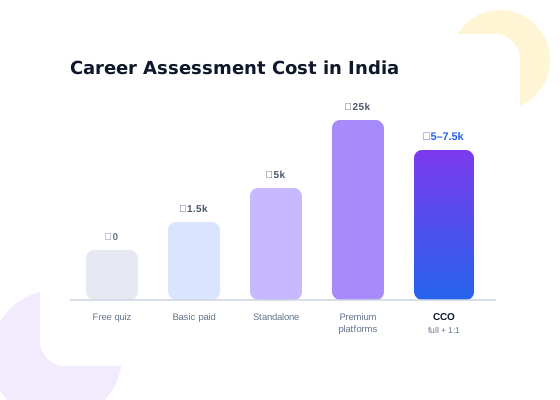
| Option | Price Range | What You Get |
|---|---|---|
| Free online career quiz | ₹0 | 5-minute quiz, generic result, no interpretation |
| Basic paid online assessment | ₹500 – ₹1,500 | Longer test, PDF report, no expert interpretation |
| School-provided assessment | Included in school fees | Group test, brief report, minimal 1:1 time |
| Standalone psychometric test | ₹2,000 – ₹5,000 | Full report, sometimes counselor call |
| Premium platforms (Mindler, iDreamCareer) | ₹8,000 – ₹25,000 | Full assessment + multi-session counselling |
| CCO | ₹5,000 – ₹7,500 | Full assessment + brain mapping + founder-led 1:1 + 40+ page report + follow-up |
CCO's career assessment is bundled with counselling because a standalone assessment without expert interpretation delivers 20–30% of the value at 40–50% of the cost — poor economics for a decision this important.
Basic
- Psychometric Test
- 2 counselling sessions
- 3 months support
- Personalised career roadmap
- College & university guidance
Pro
- Brain Mapping Test
- 3 counselling sessions
- 6 months support
- Career roadmap
- College/university guidance
- Certifications & internships guidance
- 6 months portal access
Advanced
- Brain Mapping + Psychometric Test
- 4 counselling sessions
- 1 year support
- Career roadmap
- College/university guidance
- Certifications & internships guidance
- 1 year portal access
Every plan includes: complete report · brain-mapping profile · WhatsApp + email support · session recording · zero hidden charges.
How to Choose the Right Career Assessment — Buyer's Checklist
If you're evaluating career assessment options — CCO or otherwise — use this checklist.
✅ Does it combine multiple frameworks?
A career assessment based on a single framework (only personality, or only RIASEC) is incomplete. Look for at least three frameworks combined.
✅ Is it scientifically validated?
Ask which specific frameworks the assessment uses. Legitimate assessments will tell you (RIASEC, Big Five, DAT, Gardner MI, etc.). Vague answers ("proprietary AI algorithm") often mean thin science.
✅ Is expert interpretation included?
A report without a human interpreter is just data. Real decisions require someone qualified to explain what the data means for this specific student.
✅ Is the report personalised or template?
Ask to see a sample report. If two students would receive nearly identical reports with just the name changed, the assessment isn't personalised.
✅ Is it India-specific?
Many assessments are US-frameworks translated into English — meaning career recommendations, salary data, and college suggestions are irrelevant. A good assessment maps to the Indian ecosystem (CBSE / ICSE / State boards, JEE / NEET / CUET, Indian college landscape, Indian salary bands).
✅ Is pricing transparent?
If you have to enquire before hearing the price, factor that friction into your evaluation.
✅ Is follow-up included?
The decisions made after an assessment often need clarification weeks later. Look for at least 3 months of included follow-up.
What Students & Parents Say About the CCO Career Assessment
"The assessment result surprised us. My son's marks made me think he was a science student. His report showed high artistic and social interests, low mechanical aptitude, strong verbal reasoning. Turned out humanities was the right stream — he's now in his second year of BA Psychology and topping his batch."
"I've taken three online career tests before. This was the first one that felt like it actually understood me — probably because it's built on real psychometric science, not a Buzzfeed quiz."
"As a parent, what I appreciated was the depth of the report. It wasn't just 'your daughter should be a doctor.' It explained which type of medicine (research vs practice vs public health), which colleges, which entrance exams, and why."
Career Assessment — Frequently Asked Questions
Q1. What is a career assessment, exactly?
A career assessment is a set of scientifically validated tests that measure personality, interests, aptitudes, and learning style to identify careers a person is likely to enjoy and succeed at. CCO's career assessment combines five frameworks — RIASEC, Big Five (OCEAN), Multiple Intelligences, aptitude clusters, and brain mapping — into a single 40+ page report.
Q2. How long does a career assessment take?
The CCO career assessment takes 60–90 minutes to complete online. The full process — booking, assessment, report generation, 1:1 interpretation session, and roadmap delivery — takes 10–14 days end-to-end.
Q3. Does the student need to prepare for the assessment?
No preparation is needed. There are no right or wrong answers, no subject-related questions, and no memorisation required. The student just needs to answer honestly based on how they think and feel.
Q4. Is the CCO career assessment done online?
Yes — 100% online. The assessment works on laptop, tablet, or mobile. The 1:1 interpretation session happens over video call. Families anywhere in India (or abroad) can complete the full career assessment from home.
Q5. Can a career assessment really predict the right career?
A career assessment doesn't "predict" a specific career — it identifies careers where the student's personality, interests, and aptitudes align well. That's a much more useful output. Because it's based on stable traits (not passing preferences), the recommendations hold up over years.
Q6. What is the difference between a psychometric test and a career assessment?
A psychometric test is one type of assessment (measuring personality, aptitude, or interests). A career assessment is broader — it combines psychometric testing with career mapping, expert interpretation, and actionable recommendations. Every career assessment includes psychometric testing; not every psychometric test is a career assessment.
Q7. Are free online career assessment tests reliable?
For casual curiosity, they're fine. For real decisions (stream, course, career change), no. Free tests are usually 5–10 minutes long, use diluted frameworks, produce generic results, and offer no expert interpretation. Compare that to a proper career assessment that takes 60–90 minutes and includes a 1:1 session.
Q8. What age is best for a career assessment?
The earliest useful window is Class 8 (age 13–14) for interest exploration. The most consequential window is Class 10 (age 15–16) for stream selection. Career assessments are also valuable at any age — including for graduates, working professionals, and mid-career switchers.
Q9. What frameworks does the CCO career assessment use?
Five: RIASEC (Holland Code) for interests, Big Five / OCEAN for personality, Gardner's Multiple Intelligences, aptitude clusters (numerical, verbal, abstract, spatial, mechanical, clerical), and brain-mapping / cognitive style analysis. Each framework measures something the others can't.
Q10. Do parents attend the interpretation session?
Yes — we strongly encourage it. In our experience, career assessments that involve parents in the interpretation session produce far better long-term outcomes than sessions where only the student attends.
Q11. What if my child's assessment result doesn't match what they want to do?
That's actually one of the most valuable outcomes — because the mismatch is now visible and discussable. In our interpretation sessions, we don't tell the student to abandon their preferred career; we explore why the assessment shows a mismatch, and whether the preferred career is still viable with some adjustments. Sometimes it is. Sometimes rethinking is the right move.
Q12. How is the CCO career assessment different from Mindler, iDreamCareer, or CareerGuide's assessments?
Two main differences: (1) CCO's career assessment combines psychometric + brain mapping, whereas most competitor assessments are psychometric-only. (2) The 1:1 interpretation is always done by the founder, not an assigned junior counsellor. (3) Every plan includes at least 3 months of follow-up support — most competitor plans charge separately for follow-up sessions.
Ready to Trade Career Guesswork for Career Evidence?
Career decisions get made once and shape decades. A scientific career assessment — combined with expert 1:1 interpretation — is the single fastest way to move from confusion to clarity.
Free 20-minute discovery call. Free demo assessment. No sales pressure. No hidden fees.
Take the Free Demo Assessment → · View a Sample Career Report → · Compare Pricing Plans →
Trade career guesswork for career evidence.
Free demo assessment · free 20-min call · no hidden fees.