CUET Counselling Guidance in India — Subject Selection, College Shortlisting & Counselling Round Strategy
CUET is the single most consequential admission decision for 250+ central, state, and participating universities in India — with more moving parts than any other Indian entrance exam. CCO's CUET counselling guidance helps students and parents make the right decisions at every step: which CUET subjects to attempt, which universities to target, how to strategise choice-filling across multiple counselling rounds, and how to make the final choice when multiple offers arrive.
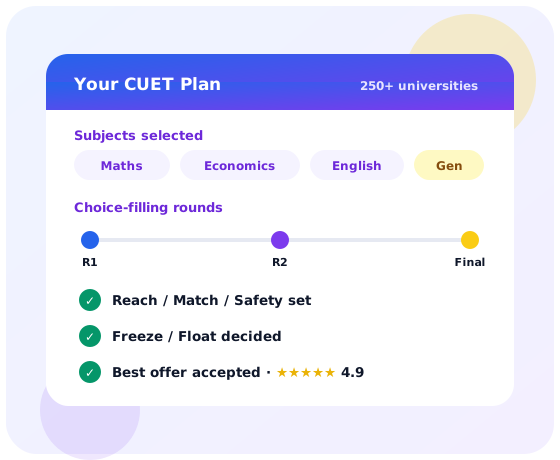
What Is CUET Counselling Guidance?
CUET counselling guidance is structured 1:1 advisory support for students and parents navigating India's Common University Entrance Test (CUET) — the standardised admission exam introduced by the National Testing Agency (NTA) in 2022. Unlike coaching institutes (which prepare you for the exam) or general career counselling (which helps decide what to pursue), CUET counselling guidance specifically helps with the decisions CUET creates: which subjects to attempt, which universities and courses to target, how to fill preferences across multiple counselling rounds, and how to make the final choice when multiple admits arrive.
At CCO, CUET counselling guidance is delivered end-to-end across the entire CUET cycle — from initial subject selection (typically January–February) through counselling rounds (typically July–August) and final admission decisions. Every family gets founder-led sessions, transparent pricing, and 3–12 months of follow-up support through the CUET cycle.
Why CUET Has Become the Most Complex Admission Decision in India
CUET has made undergraduate admissions dramatically more complicated than they were pre-2022. Six factors are behind that complexity.
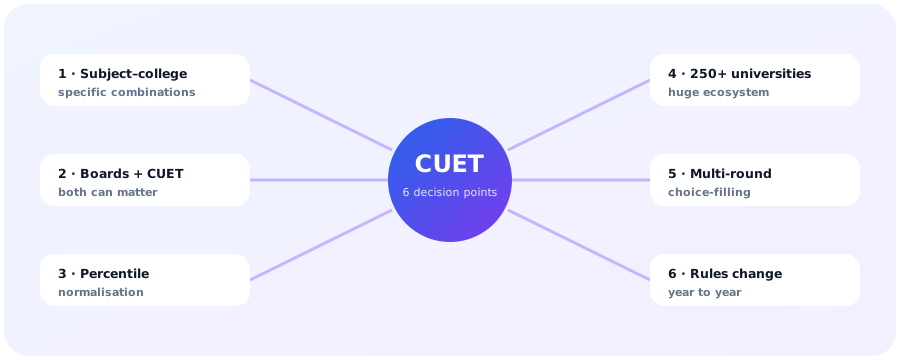
1. Subject-college interaction is highly specific.
Different central universities want different subject combinations for the same course. Delhi University's BA (H) Economics wants specific subject combinations. JNU wants others. BHU wants yet others. Getting subject selection wrong at the CUET registration stage closes doors that reopen only after a full year.
2. Boards + CUET both matter.
Some universities weight Class 12 board marks alongside CUET scores. Others go pure CUET. The mix varies by college and course. Families ignoring boards during Class 12 to focus only on CUET lose eligibility for specific colleges. Families ignoring CUET focus lose broader college access.
3. Multiple sessions, percentile normalisation.
CUET runs across multiple exam sessions over several weeks — each attempt scored, then normalised into a percentile. Understanding how sessions affect final percentile is a non-trivial decision most families make blind.
4. 250+ participating universities.
Central universities (DU, JNU, BHU, Jamia, Allahabad, HCU, TISS, EFLU, Aligarh Muslim, and more), state universities that opted in, and participating private universities — the ecosystem is enormous. Choosing which universities to prioritise is a decision most families don't have the information to make well.
5. Multi-round counselling with complex choice-filling.
CUET counselling rounds typically involve 3–5 rounds of choice-filling, upgrades, freezes, and withdrawals. Every round has strategic implications — a wrong choice-filling decision in Round 1 can prevent access to a better admit in Round 3.
6. Rules change year to year.
NTA has revised CUET's structure, number of subjects, session format, and normalisation methodology multiple times since 2022. Advice from a year ago is often already stale. Current, informed CUET counselling has real value.
Structured CUET counselling guidance exists because this exam has too many high-stakes decision points for families to navigate on WhatsApp forwards and coaching-institute newsletters.
The 8 Major CUET Decisions CCO's Counselling Guidance Handles
Every CUET aspirant faces a subset of these 8 decisions. CCO structures the counselling around wherever the family is stuck.
Decision 1: Which CUET subjects to attempt?
Domain subjects, languages, and the General Test. Choosing the right combination is critical — some universities require specific combinations, others don't. Getting this wrong at registration closes downstream options.
Decision 2: How many CUET subjects to attempt?
CUET rules allow multiple domain subjects. But every additional subject is more prep time in an already crowded Class 12. Choosing between "attempt many for optionality" and "attempt fewer for score maximisation" is a real strategic choice.
Decision 3: Board marks vs CUET score — how to balance prep time?
For some careers (Economics honours at top DU colleges, some Journalism programs, hospitality management), both matter. For others, CUET dominates. Getting the balance wrong hurts final outcomes.
Decision 4: Which universities to target?
250+ universities participate. Realistically, families should target 8–15 based on the student's profile. Deciding which 8–15 requires understanding cutoffs, course quality, location, and career alignment — for each.
Decision 5: Which courses to prioritise?
Same student may qualify for BA Economics (H) at one college and BCom (H) at another — very different careers downstream. Course selection is often more important than college brand at this stage.
Decision 6: Choice-filling strategy for Round 1.
The first round is where most families make the biggest mistakes — either underambitious (accepting a mid-tier admit that closes future rounds) or overambitious (leaving all rounds without a safety admit).
Decision 7: Freeze vs Float vs Upgrade decisions.
After Round 1 results, students face three choices: freeze (accept the current admit), float (accept but stay open to upgrades in later rounds), or withdraw (reject and try next round). Each has strategic implications.
Decision 8: Which final offer to accept when multiple arrive?
By late July, students often have offers from multiple universities. Choosing between DU vs JNU vs a private university vs an offer that came through direct-admission requires structured comparison, not gut feel.
CUET Subject Selection — How to Choose the Right Combination
Subject selection is the highest-leverage CUET decision. Get this right at registration, and every downstream option is preserved. Get it wrong, and specific colleges become impossible regardless of your score.
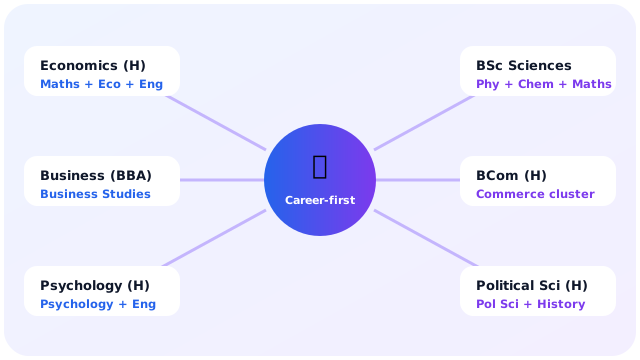
Framework: match subjects to your target careers, not to what feels safe.
Here's the mapping between career direction and recommended CUET subject combinations.
| Target Career | Recommended CUET Subjects | Why |
|---|---|---|
| Economics (H) at top colleges | Mathematics + Economics + English + General Test | Most top colleges require Maths + Economics for BA Economics (H) |
| Business (BBA, BMS) | Mathematics + Business Studies + English + General Test | Business Studies is often required; Maths preferred for quantitative BBA programs |
| Political Science / Sociology / History (H) | English + Political Science + History + General Test | Domain subjects showing genuine interest; English mandatory |
| English (H) | English + one Humanities subject + General Test + language subject | English (H) requires strong English CUET score |
| Psychology (H) | Psychology + English + Biology / General Test + language | Psychology as domain subject; biology helpful for cognitive science pathways |
| BSc / Pure Sciences | Physics + Chemistry + Mathematics + Biology (choose 3) + English | Core science subjects matched to specialisation |
| BCom (H) / General | Accountancy + Business Studies + Economics + Mathematics + English | Full commerce cluster |
| Journalism / Mass Communication | English + Political Science + Sociology / History + General Test | Media programs value humanities depth |
| Law (5-year integrated at CUET colleges) | English + Political Science + Logical Reasoning (if offered) + General Test | Law programs prefer strong verbal + reasoning |
| Design programs (BDes at CUET colleges) | English + relevant art / drawing subject + General Test | Some CUET-affiliated design programs |
| Liberal Arts (via CUET at some universities) | English + 2 interest-based subjects + General Test | Flexibility is the point of liberal arts |
Important: Choose based on your target careers first, then optimise for scoring.
Attempting a subject just because "it's easier to score in" — while not matching your target careers — closes college doors you actually want.
Also important: attempt the language subject appropriate for your college targets.
DU, JNU, Jamia, and BHU all have specific language requirements for many courses. Check your target universities' language requirements before finalising.
CUET Choice-Filling Strategy — The 3-Tier Framework
Once CUET results are announced, the choice-filling window opens. This is where structured CUET counselling adds the most value — because every choice you enter has strategic implications across all rounds.
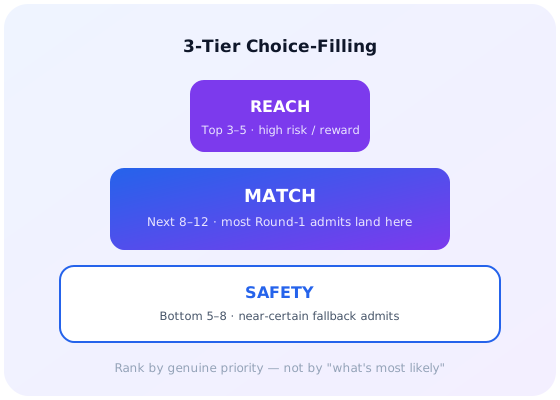
Use the 3-tier framework: Reach, Match, Safety.
Reach choices (top 3–5 preferences):
Universities and courses you'd love to attend but where your CUET percentile is at the lower end of typical cutoffs. High risk, high reward. If you get in, brilliant. If not, you have Match choices below.
Match choices (next 8–12 preferences):
Universities and courses where your CUET percentile comfortably matches typical cutoffs. Realistic first-round admits. This is where most CCO students end up in Round 1.
Safety choices (bottom 5–8 preferences):
Universities and courses where your CUET percentile is above typical cutoffs. Near-certain admits. Your fallback if Reach and Match don't work out.
Key principle: Round 1 preferences should reflect your genuine priority ranking — not "what's most likely."
If you'd rather freeze on preference #5 than upgrade to preference #3, put preference #5 above preference #3. Because CUET counselling gives you the best admit at or above your accepted preference. If you accept #5, you can still be upgraded to #3 or #4 in later rounds. But you can never be upgraded to #7 or #8.
Freeze vs Float vs Upgrade — the second-round decision:
- Freeze: Accept the current admit, don't participate in further rounds. Choose freeze when the current admit is genuinely your target and further waiting is stressful.
- Float (Accept-and-Stay): Accept the current admit but stay open to upgrades in subsequent rounds. Choose float when the current admit is acceptable but not ideal.
- Withdraw: Reject the current admit entirely and try again in the next round. Choose withdraw only when the current admit is not viable and your CUET percentile makes better admits likely in later rounds. This is high-risk.
Common mistake:
freezing too early because "at least we have something." Every year, students freeze on Round 1 admits they'd have upgraded away from if they'd stayed open. Structured counselling helps you honestly evaluate whether float is worth the anxiety.
How CCO's CUET Counselling Guidance Works — Step by Step
The CUET cycle spans 9–12 months. CCO's guidance runs alongside it, with active support during the two peak windows.
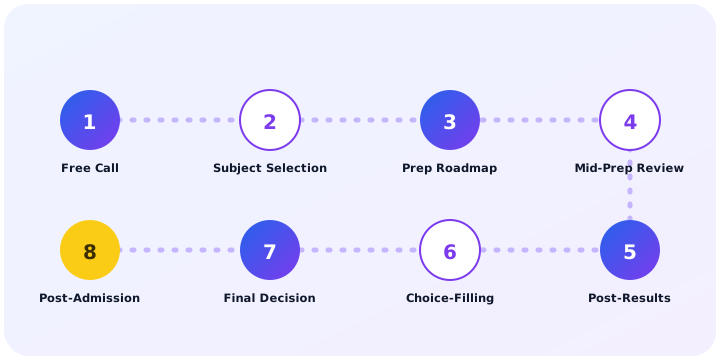
Step 1 — Free 20-Minute Discovery Call
We understand your specific situation: Class 12 stage, board marks (if available), tentative career direction, target universities, and where you're currently stuck.
Step 2 — Subject Selection Strategy Session (typically Nov–Feb)
1:1 session focused on choosing the right CUET subjects for your career goals. Comes with a written recommendation of your specific combination and reasoning.
Step 3 — CUET Preparation Roadmap
Not coaching — but a strategic overview of what to prioritise across the CUET domain subjects, General Test, and language subjects given your specific target universities. Also covers board vs CUET time allocation.
Step 4 — Mid-Prep Review (typically Mar–Apr)
Mid-way check-in: mock test performance review, adjustment of target universities based on realistic scoring, and pre-exam positioning.
Step 5 — Post-Results Session (immediately after CUET results)
Once results arrive, we schedule an urgent session to walk through your CUET percentile → realistic university shortlist → 3-tier choice-filling strategy.
Step 6 — Choice-Filling Support (across all counselling rounds)
Ongoing WhatsApp + email support through Round 1 choice-filling, Round 1 results, Freeze/Float/Withdraw decisions, subsequent rounds, and final admission acceptance.
Step 7 — Final Choice Decision Session (when multiple admits arrive)
When multiple offers are on the table, a dedicated session compares them across course quality, career alignment, cost, location, and long-term ROI.
Step 8 — 3–12 Months Post-Admission Support
Even after admission is confirmed, questions arise — accommodation, orientation, whether to consider switching. CCO stays available.
What's Included in CCO's CUET Counselling Guidance
| Component | Detail |
|---|---|
| Discovery call | Free · 20 min · With founder |
| CUET subject selection strategy | Personalised · Career-aligned |
| Board vs CUET prep balance guidance | Situational |
| Mid-prep review | Mock test analysis + realistic recalibration |
| Post-results shortlist session | Reach / Match / Safety framework |
| Choice-filling strategy | For every counselling round |
| Freeze / Float / Withdraw decisions | Round-by-round |
| Multi-offer final decision session | When 2+ offers arrive |
| Follow-up support | 3–12 months (by plan) |
| Pricing | ₹5,000 – ₹7,500 · Published upfront |
7 Costly CUET Mistakes CCO's Counselling Prevents
Mistake 1 — Choosing "safe" subjects instead of career-aligned subjects.
Attempting subjects because they're "scoring subjects" while ignoring your target careers is the single most common — and most costly — CUET mistake. If your target career needs specific subjects and you don't attempt them, no CUET score fixes that.
Mistake 2 — Underestimating the General Test.
General Test is often treated as an afterthought. But some colleges weight it significantly. Underprepping the General Test costs percentile at critical universities.
Mistake 3 — Ignoring board marks because "only CUET matters."
For CUET-eligible careers like Economics honours or Psychology at top colleges, boards + CUET both matter. Focusing 90% on CUET during Class 12 costs eligibility at specific colleges.
Mistake 4 — Not researching universities and courses early.
Choice-filling is compressed to a few days after results. Families who haven't researched their 15 target universities before results are shortlisting under panic — and typically make weaker choices.
Mistake 5 — Filling Round 1 choices without a 3-tier strategy.
Filling all top choices without Match and Safety layers guarantees drop-year risk. Filling all safe choices without Reach layers underachieves. Structured 3-tier filling matters.
Mistake 6 — Freezing too early on Round 1 admits.
The comfort of "at least we have something" often costs a better upgrade in later rounds. Assess whether the current admit is genuinely your target or just relief.
Mistake 7 — Making the final acceptance decision on gut feel.
When 2–3 offers arrive, families often accept based on college brand or family opinion. Structured comparison across course quality, career alignment, cost, and career ROI produces better outcomes.
How Much Does CUET Counselling Cost in India?
CUET counselling pricing in India varies widely — from free (school-provided, limited depth) to ₹30,000+ (premium bundled with career counselling).
| Provider Type | Typical Price | What You Get |
|---|---|---|
| School career counsellor | Included in fees | Group sessions, general advice |
| Independent CUET consultant | ₹5,000 – ₹15,000 | Subject selection + choice-filling |
| Premium platforms (Mindler, iDreamCareer) | ₹15,000 – ₹30,000 | Multi-session package, often junior counsellor |
| Full career + admission packages | ₹25,000 – ₹50,000+ | End-to-end career + college + CUET |
| CCO | ₹5,000 – ₹7,500 | Founder-led sessions, full CUET cycle support, career + course + college guidance included, 3–12 months follow-up |
CCO delivers CUET counselling at the low end of the market because it's bundled with career counselling — one integrated process instead of a separate expensive "CUET consultant."
Preparing for CUET Alongside JEE or NEET — When It Makes Sense (and When It Doesn't)
Many Indian Class 12 students prepare for multiple entrance exams. Whether that's smart depends on your specific target careers.
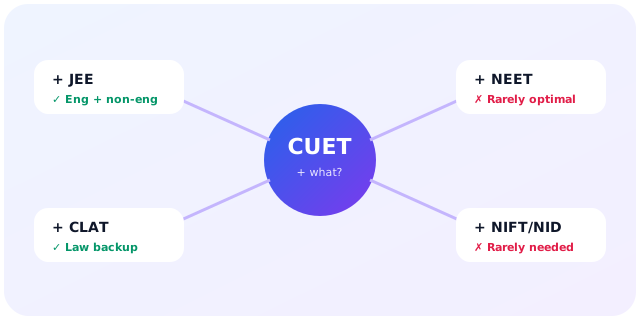
CUET + JEE (Engineering + non-engineering hedging):
Makes sense if you're genuinely interested in both engineering and non-engineering careers (Economics, Business, Design, Liberal Arts). Divides prep time — expect somewhat weaker scores in both compared to focused prep. Best for students with strong PCM aptitude who want non-engineering flexibility.
CUET + NEET (Medicine + non-medicine hedging):
Makes sense less often. NEET requires very focused biology prep; CUET requires broader subject coverage. Most PCB students should focus on NEET; CUET becomes the backup rather than parallel primary.
CUET only (single-focus):
Right for students clearly pointed toward non-engineering, non-medical careers — Economics, Business, Liberal Arts, Psychology, Journalism, Political Science, Design at CUET-affiliated colleges, etc. Focused CUET prep produces stronger CUET scores.
CUET + CLAT (Law dual-prep):
Makes sense for law-track students. CLAT is primary; CUET adds backup access to 5-year integrated LLB programs at central universities.
CUET + NIFT/NID (Design dual-prep):
Rarely needed. NIFT and NID have distinct entrance exams. CUET adds backup access to design at limited central-university programs but shouldn't be primary for design-track students.
Not sure which exam combination fits you?
A free 20-minute call maps your exact CUET (and dual-exam) strategy to your target careers — no guesswork, no sales pitch.
Book Your Free CUET Counselling Call →The right combination depends on career direction — not on "preparing for more is safer." CCO's session helps you pick honestly.
What Families Say About CCO's CUET Counselling Guidance
"We were completely lost in the CUET subject selection stage. Our daughter had strong marks but no clarity on which subjects to attempt. Varun's session showed us the specific combination that would work for her target Economics honours goal at DU. She got in — with a comfortable Round 2 admit at Miranda House."
"The choice-filling session was what saved us. Varun walked us through preferences for Round 1, then again during Round 2 upgrades. My son ended up at his second-preferred college — but with an upgrade path that he'd have missed if we'd frozen too early."
"As a first-generation college aspirant, I had no idea how CUET worked. CCO's sessions across the year helped me understand what to attempt, how to fill preferences, and when to freeze. Everyone in my school was as confused as me. The counselling made the difference."
CUET Counselling Guidance — Frequently Asked Questions
Q1. What is CUET counselling guidance?
CUET counselling guidance is 1:1 advisory support helping Indian Class 12 students and parents make the right decisions at every stage of the CUET cycle — subject selection, university shortlisting, choice-filling strategy, and final admission decisions when multiple offers arrive.
Q2. When should we start CUET counselling?
Ideally October–November of Class 12 — early enough to plan subject selection before CUET registration opens (typically January–February). Second-best window: immediately after CUET results (May-June) to plan choice-filling. If you're already in the counselling-round window, CCO can compress support to under a week.
Q3. Is CUET counselling different from CUET coaching?
Yes. Coaching institutes prepare you for the exam (teaching subjects, mock tests, doubt-solving). CUET counselling helps you make decisions about the exam — which subjects to attempt, which universities to target, how to fill choices, and how to compare final offers. Both are useful but serve different purposes.
Q4. How many CUET subjects should my child attempt?
Depends on target universities and career direction. Attempting too many spreads prep thin; attempting too few may block specific colleges. Typical range is 4–6 domain subjects + General Test + 1 language. CCO's session identifies the specific number and combination for your child's situation.
Q5. Which universities are covered under CUET?
As of 2026, 250+ universities participate — including 45+ central universities (DU, JNU, BHU, Jamia, Allahabad, HCU, TISS, Aligarh Muslim, EFLU, and many more), several state universities, and participating private universities. The list is updated annually by NTA.
Q6. How does CUET choice-filling work?
After CUET results, students fill an ordered preference list of their target university-course combinations. In Round 1, they're allotted the highest preference they qualify for. They can then freeze (accept, exit), float (accept but stay open to upgrades), or withdraw. Subsequent rounds may bring upgrades. Section 5 above explains the strategy.
Q7. What is the freeze/float/withdraw decision?
Freeze: Accept your current admit and exit counselling rounds.
Float: Accept your current admit but stay open to upgrades in later rounds.
Withdraw: Reject the current admit entirely and try again in the next round.
Each has strategic implications — Section 5 covers when each is appropriate.
Q8. Should I prepare for CUET and JEE / NEET together?
Depends on your career direction. CUET + JEE dual-prep works for students genuinely interested in both engineering and non-engineering careers. CUET + NEET dual-prep is rarely optimal — NEET requires focused prep. CUET-only prep is best for students clearly pointed toward non-STEM careers. Section 10 covers this in detail.
Q9. Do board marks matter for CUET admissions?
Yes, for some universities and courses. DU weights boards for specific programs. Some CUET-participating universities have minimum board eligibility requirements. Ignoring boards entirely during Class 12 can cost eligibility for specific colleges.
Q10. Can CCO help with counselling rounds specifically — just the choice-filling part?
Yes. If you've already appeared for CUET and need help only with choice-filling across counselling rounds, CCO can compress the engagement to focused post-results support. Contact us during the counselling window for same-day discovery calls.
Q11. How is CCO's CUET counselling different from Mindler / iDreamCareer / Edumilestones?
Three main differences: (1) CCO is founder-led — every session is with Varun Vohra, not a rotating junior counsellor. (2) Full CUET cycle support (subject selection through final acceptance) is included, not sold as separate services. (3) Transparent pricing published upfront (₹5,000–₹7,500) — competitors typically require an enquiry form before disclosing pricing that often runs ₹15,000+.
Q12. What if the CUET rules change in 2026 or 2027?
NTA has revised CUET's structure multiple times since 2022. CCO's counselling stays current — Varun tracks NTA circulars and updates the counselling approach annually. Guidance you receive is always calibrated to the current year's CUET rules.
Q13. How do I book CUET counselling with CCO?
Click Book Free Call above. Share the student's current class (Class 11 or 12), current subject choices (if made), and stage of CUET cycle. During counselling-round peak season (July-August), we prioritise same-day or next-day booking for time-pressured families.
Get CUET Decisions Right — At Every Stage of the Cycle
Every year, Indian Class 12 families make CUET decisions that either open doors or close them. Wrong subject selection at registration. Ambitious-only Round 1 preferences without safety nets. Freezing too early on mid-tier admits. Making final acceptance decisions on gut feel when multiple offers arrive.
The alternative is straightforward. Structured CUET counselling with a certified counsellor who understands the specific decisions CUET creates — from subject selection through the final acceptance moment. Founder-led. Transparent pricing. Full-cycle support through 3–12 months.
Free 20-min first call. Same-day booking during counselling window. Founder-led throughout.
Prefer to explore first? Take the Free Career Assessment → · View Sample Career Report · See Pricing
Related pages: College Admission Guidance (Pillar) · Career Counselling After 12th · Career Counselling for Class 11 & 12 · DU Admission Guidance · IPU Admission Guidance
CUET decisions open doors — or close them. Get them right.
Free 20-min call · founder-led · same-day booking in peak season.