IPU Admission Guidance in India — IPU CET Strategy, College Selection & Choice-Filling for GGSIPU
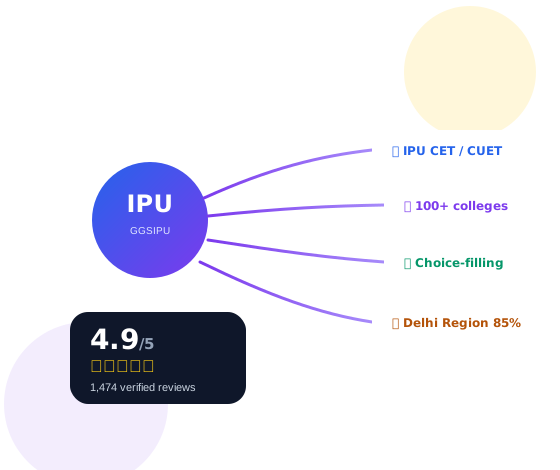
IPU (Guru Gobind Singh Indraprastha University) is Delhi's largest state university — 100+ affiliated colleges, distinct entrance exams (IPU CET + CUET for select courses), 85% Delhi Region reservation, and professional-course-focused programs (BBA, BCA, BBA-LLB, BJMC, B.Tech, BArch, and more). CCO's IPU admission guidance helps aspirants navigate the specific decisions IPU creates: which entrance to prepare for, which affiliated college to target (VIPS, BVP, MSI, MAIT, and dozens of others), how to leverage Delhi Region eligibility, and how to strategise choice-filling across counselling rounds.
What Is IPU Admission Guidance?
IPU admission guidance is structured 1:1 advisory support specifically for students and parents navigating Guru Gobind Singh Indraprastha University (GGSIPU) admissions — including IPU CET (Indraprastha University Common Entrance Test) strategy, course selection across professional programs (BBA, BCA, BJMC, BBA-LLB, B.Tech, BArch, and more), college shortlisting across 100+ affiliated colleges (VIPS, BVP, MSI, MAIT, DIAS, and dozens of others), Delhi Region vs Outside Delhi Region reservation strategy, and multi-round counselling decisions.
At CCO, IPU admission guidance is delivered end-to-end across the entire IPU admissions cycle — from pre-exam course targeting through IPU counselling rounds and final admission acceptance. Every family gets founder-led sessions, transparent pricing, and 3–12 months of follow-up support.
Why IPU Is Different From DU — And Why That Matters for Your Choice
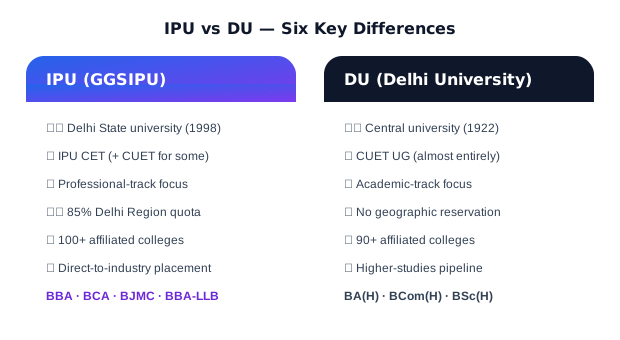
Most Delhi NCR aspirants think of "DU or IPU" as the same decision. It isn't. Six meaningful differences.
1. Different university structures.
DU (Delhi University) is a central university under the Government of India, established in 1922. IPU (GGSIPU) is a Delhi State government university established in 1998. Different governance, different affiliations, different funding structures.
2. Different entrance exams.
DU admissions run through CUET UG almost entirely. IPU accepts multiple entrance exams depending on course — IPU CET for most professional courses, CUET for select courses (like some BBA and BCA programs), CLAT for BALLB, NEET for MBBS/BDS, JEE Main Paper 2 + NATA for BArch. Different exams to prepare for.
3. Different course focus.
DU is primarily academic-track — BA (H), BCom (H), BSc (H), with limited professional courses. IPU is primarily professional-track — BBA, BCA, BBA-LLB, BJMC, B.Tech, BArch, BPT, BOT, BFA. If your career direction is directly professional (management, tech, media, law-integrated), IPU often offers stronger direct pathways.
4. Different reservation structure.
IPU has an 85% Delhi Region + 15% Outside Delhi Region quota system — meaning students from Delhi have significantly better admission odds than students from outside Delhi. DU has no such geographic reservation. This is one of the most impactful — and most misunderstood — differences.
5. Different affiliated college pattern.
DU has 90+ affiliated colleges, all directly under DU. IPU has 100+ affiliated colleges, many of which are private institutions (VIPS, BVP, MSI, MAIT, DIAS, TIPS, etc.) affiliated with IPU. This means IPU colleges have more institutional variety in quality, fees, and culture.
6. Different placement and career alignment.
IPU's professional programs (BBA at VIPS, BCA at MSI, BJMC at USMS, BBA-LLB at various) have stronger direct-to-industry placement networks. DU's Honours degrees often route through higher-studies (MBA, MS) before major career acceleration. Different timelines.
The right question isn't "DU or IPU" — it's "which specific IPU or DU program at which specific college matches my career direction and admission profile?" CCO's session works through that specifically.
The 5 Major IPU Admission Decisions CCO's Guidance Helps With
Every IPU aspirant faces a subset of these five decisions.
Decision 1: Which entrance exam to prepare for (IPU CET, CUET, CLAT, NEET, or JEE)?
IPU accepts different entrances for different courses. Understanding which exam(s) your target IPU program requires is the first-order decision. Preparing for the wrong exam wastes months.
Decision 2: Which IPU course to target?
BBA, BCA, BBA-LLB (5-year integrated), BJMC, BAJMC, B.Tech, BArch, BPT, BOT, BFA, BEM (Event Management), BHMCT (Hotel Management), or one of the other 30+ programs. Each opens different careers.
Decision 3: Which IPU affiliated college?
VIPS, BVP, MSI, MAIT, DIAS, TIPS, IITM Janakpuri, BPIT, GTBIT, and dozens more. Colleges vary meaningfully in fees, placement quality, faculty, and specialisation. The right college for BBA is not the right college for B.Tech.
Decision 4: Are you Delhi Region eligible?
IPU reserves 85% of seats for Delhi Region candidates (typically defined by Class 10 or 12 school being in Delhi). This dramatically affects admission chances. Many families don't know whether they qualify — and this decision has significant strategic implications.
Decision 5: Choice-filling strategy across counselling rounds.
IPU runs multi-round counselling. Preference ordering, freeze/float/withdraw decisions, and quota-specific choice-filling all matter.
Facing one of these decisions?
Talk to a founder-counsellor who knows Delhi NCR admissions specifically.
Talk to a Career Counsellor → 📞 Or call now: +91 93193 36222Delhi Region vs Outside Delhi Region — The Most Impactful IPU Decision Most Families Overlook
Delhi Region eligibility at IPU is worth understanding carefully — because it can change an aspirant's realistic college options dramatically.
How Delhi Region eligibility is typically determined:
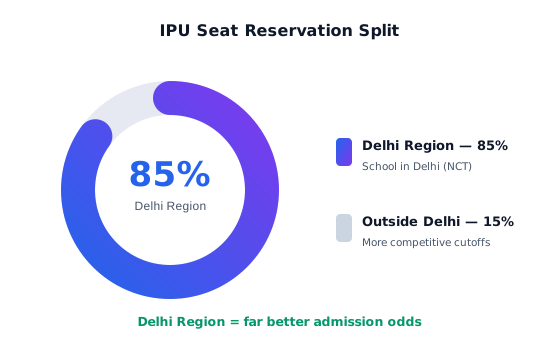
Historically defined by whether the student passed Class 10 or 12 (depending on year and rules) from a school located in Delhi (NCT). Rules can update; verify current criteria annually.
The reservation split:
- Delhi Region: 85% of seats reserved
- Outside Delhi Region: 15% of seats
Why this matters:
For competitive courses (BBA at VIPS, BCA at MSI, BJMC at USMS, BBA-LLB), the cutoff for Delhi Region candidates is often significantly lower than for Outside Delhi Region candidates. A student with an IPU CET rank that gets them into a top college as Delhi Region might not qualify at all as Outside Delhi Region — the practical impact is that dramatic.
Common family situations to think through:
- Family has always lived in Delhi: Straightforward Delhi Region eligible.
- Family moved to Delhi in Class 11 or 12: Depends on where the student did Class 10 (if that's the criterion year) or Class 12. Verify with current rules.
- Family lived in Delhi through Class 10, then moved to Gurgaon or Noida: Depends. Delhi Region eligibility may still hold if Class 10 was in a Delhi school — verify current rules.
- Family in Gurgaon/Noida throughout schooling: Outside Delhi Region. Different cutoff dynamics apply.
- Family in Delhi, but student attended boarding school outside: Outside Delhi Region — schooling location generally matters more than family residence.
How to leverage Delhi Region eligibility:
- Confirm eligibility with current documentation
- If eligible, target more aspirational colleges (VIPS, BVP, MSI's top courses) — the 85% quota makes them realistic
- If not eligible, be strategic about which 15%-quota seats you're competing for — often more competitive than Delhi Region seats at the same college
CCO's guidance covers this specifically for every family we counsel — because families who don't realise they're Delhi Region eligible often self-select out of colleges they could have easily accessed.
Popular IPU Undergraduate Courses — By Career Direction
Different IPU programs suit different career directions. Here's the map.
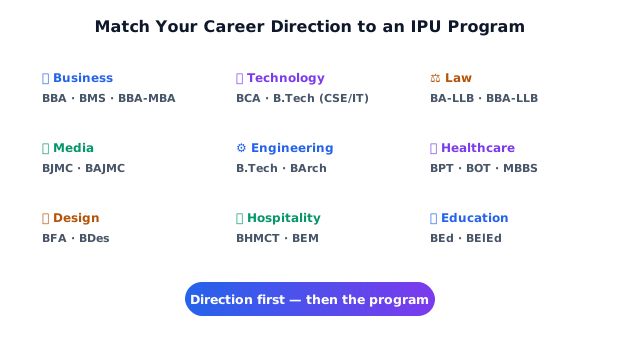
| Career Direction | Recommended IPU Programs | Notes |
|---|---|---|
| Business / Management | BBA · BBA (Global) · BMS · BBA-MBA integrated | BBA at top IPU colleges leads to MBA/analytics tracks |
| Technology / Software | BCA · B.Tech (CSE) · B.Tech (IT) · B.Tech (Electronics) | BCA for direct-industry entry; B.Tech for engineering foundations |
| Law (5-year integrated) | BA LLB · BBA LLB · B.Com LLB | 5-year integrated law at IPU-affiliated law colleges |
| Media / Journalism | BJMC · BAJMC · BA (Journalism) · BA (Mass Communication) | IPU has strong media programs at USMS and affiliated colleges |
| Engineering | B.Tech (Mechanical / Civil / Electrical / etc.) | MSI, MAIT, BPIT, GTBIT for engineering |
| Architecture | BArch | Through JEE Main Paper 2 + NATA |
| Design | BFA · BDes | BFA at IPU colleges; check current-year specifics |
| Physiotherapy | BPT | Growing profession, IPU has established programs |
| Occupational Therapy | BOT | Specialised healthcare pathway |
| Hotel Management | BHMCT | Hotel and hospitality management |
| Event Management | BEM | Specialised program at select colleges |
| Education | BEd · BElEd | For teaching-track careers |
| Medicine | MBBS · BDS | Through NEET, at IPU-affiliated medical colleges |
Choosing the right program requires understanding your career direction — not just picking the "hot" course. CCO's session works through this specifically.
Top IPU Affiliated Colleges — By Course Specialisation
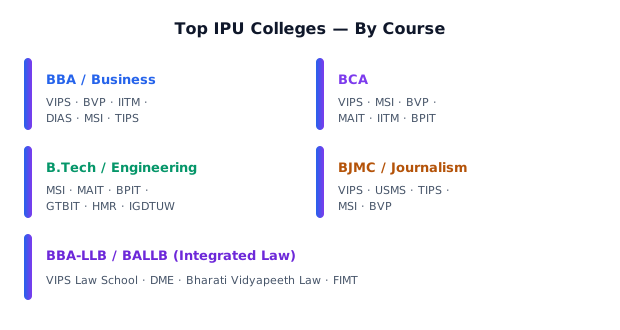
IPU's affiliated colleges have significant quality variation. Here's a course-by-course view of top options. (Specific rankings may shift year to year; verify current-year strength.)
For BBA / Business Programs
- Vivekananda Institute of Professional Studies (VIPS), Pitampura — historically the top IPU BBA college
- Bharati Vidyapeeth (BVP), Paschim Vihar — strong BBA and BBA-LLB
- Institute of Innovation in Technology and Management (IITM), Janakpuri — strong BBA
- Maharaja Surajmal Institute (MSI) — BBA options
- Delhi Institute of Advanced Studies (DIAS) — strong management focus
- Trinity Institute of Professional Studies (TIPS) — professional business programs
For BCA
- VIPS — historically top BCA program
- Maharaja Surajmal Institute (MSI) — strong BCA
- Bharati Vidyapeeth (BVP) — BCA offerings
- Maharaja Agrasen Institute of Technology (MAIT) — technology focus
- IITM Janakpuri — BCA and computer applications
- Bhagwan Parshuram Institute of Technology (BPIT) — technology focus
For B.Tech / Engineering
- Maharaja Surajmal Institute of Technology (MSI) — one of the top IPU engineering colleges
- Maharaja Agrasen Institute of Technology (MAIT) — strong engineering
- Bhagwan Parshuram Institute of Technology (BPIT) — engineering focus
- Guru Tegh Bahadur Institute of Technology (GTBIT) — engineering
- HMR Institute of Technology & Management — engineering
- Indira Gandhi Delhi Technical University for Women (IGDTUW) — women's technical university (affiliated context)
For BJMC / Journalism
- VIPS — strong media programs
- University School of Mass Communication (USMS) — IPU's own school
- Trinity Institute of Professional Studies (TIPS) — media programs
- MSI — journalism offerings
- BVP — journalism programs
For BBA-LLB / BALLB (Integrated Law)
- VIPS Law School — established law programs
- Delhi Metropolitan Education (DME) — law programs
- Bharati Vidyapeeth Law — 5-year integrated law
- Fairfield Institute of Management & Technology (FIMT) — law-integrated programs
For BArch
- School of Planning and Architecture programs at IPU-affiliated context
- BPIT — architecture programs
- Verify current-year architecture college affiliations
For BFA / Design
- College of Art (through IPU affiliations) — verify current status
- VIPS — creative program offerings
Building your actual college shortlist requires evaluating: course quality at the specific college, current fees, historical placement outcomes, campus culture, commute considerations, and Delhi Region vs Outside Delhi Region cutoff realities. CCO's session builds this specifically for your situation.
IPU CET vs CUET — Which Entrance to Prepare For?
This is one of the most common IPU-specific questions. Depends on which IPU programs you're targeting.
Take IPU CET if targeting:
- BBA, BBA (LLB), BBA (Global) at most IPU colleges
- BCA at most IPU colleges
- B.Tech (through JEE Main is common, but check current IPU acceptance)
- BJMC, BAJMC
- BFA, BEM (Event Management), BHMCT
- BEd, BElEd
- Most specialised professional programs at IPU
Take CUET if targeting:
- Some BBA and BCA programs (IPU has started accepting CUET for select programs — verify current-year specifics)
- BA (H), BCom (H), BSc (H) at any IPU-affiliated academic-track program
- Cross-university flexibility (CUET works at DU, JNU, Jamia, BHU, and many others)
Take both if:
- Your target IPU program accepts both, and you want maximum flexibility
- You want both IPU and DU options open (DU requires CUET; some IPU requires IPU CET)
Take CLAT if:
- Targeting 5-year integrated law (BA-LLB, BBA-LLB, BCom-LLB)
- Preferred over IPU CET for BALLB at many IPU-affiliated law colleges
Take NEET if:
- Targeting MBBS or BDS at IPU-affiliated medical colleges
Take JEE Main + NATA if:
- Targeting BArch at IPU-affiliated architecture programs
The "which entrance" decision drives everything else — including which class prep to invest in for the 12–18 months before applications. Get this right early.
How CCO's IPU Admission Guidance Works — Step by Step
Standard 10–14 day process. During peak IPU admission season (May–August), compressible to under a week.
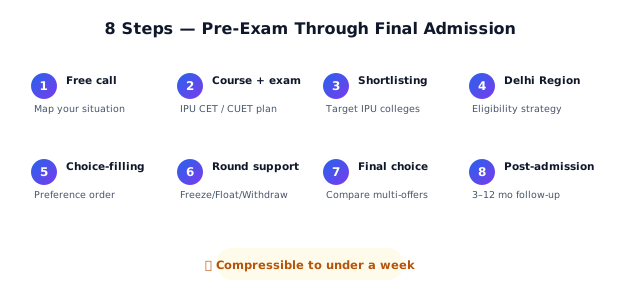
Step 1 — Free 20-Minute Discovery Call
We understand your specific situation: Class 12 board, marks, entrance exams appeared for (IPU CET, CUET, or others), Delhi Region eligibility status, and target IPU programs.
Step 2 — IPU Course + Entrance Exam Strategy Session
1:1 session confirming which IPU program fits your career direction and which entrance exam(s) to prepare for.
Step 3 — IPU College Shortlisting
Detailed session building your target IPU college list based on entrance exam rank/score projections (pre-results) or actuals (post-results), Delhi Region eligibility, course preferences, and fees considerations.
Step 4 — Delhi Region Strategy Assessment
Specific evaluation of whether Delhi Region eligibility applies and how to leverage it in college targeting.
Step 5 — IPU Choice-Filling Strategy
Preference ordering for IPU counselling rounds with Reach / Match / Safety layering.
Step 6 — Round-by-Round Counselling Support
Live support through IPU counselling rounds — including Freeze / Float / Withdraw decisions.
Step 7 — Final Choice Session (If Multiple Offers)
When you have multiple admits (IPU + DU + private universities + abroad), a dedicated comparison session.
Step 8 — Post-Admission Support
Even after final admission, follow-up support for orientation, hostel, or academic switching decisions.
What's Included in CCO's IPU Admission Guidance
| Component | Detail |
|---|---|
| Discovery call | Free · 20 min · With founder |
| IPU course selection | Career direction → specific program |
| Entrance exam strategy | IPU CET / CUET / CLAT / NEET / JEE decisions |
| Delhi Region eligibility assessment | Critical strategic factor |
| IPU college shortlisting | Reach / Match / Safety framework |
| Course-college fit analysis | Which college for which course |
| Choice-filling strategy | Preference ordering and safety layers |
| Round-by-round support | Freeze / Float / Withdraw decisions |
| Multi-offer final decision | When multiple admits arrive |
| Follow-up support | 3–12 months (by plan) |
| Pricing | ₹5,000 – ₹7,500 · Published upfront |
Basic
- Psychometric Test
- 2 counselling sessions
- 3 months support
- Personalised career roadmap
- College & university guidance
Pro
- Brain Mapping Test
- 3 counselling sessions
- 6 months support
- Career roadmap
- College/university guidance
- Certifications & internships guidance
- 6 months portal access
Advanced
- Brain Mapping + Psychometric Test
- 4 counselling sessions
- 1 year support
- Career roadmap
- College/university guidance
- Certifications & internships guidance
- 1 year portal access
7 Costly IPU Admission Mistakes CCO's Guidance Prevents
Mistake 1 — Assuming DU is "always better" than IPU.
For many career directions — particularly professional-track (BBA, BCA, BJMC, BBA-LLB), IPU programs at top colleges offer stronger direct-to-industry outcomes than DU academic-track degrees. The right answer depends on career direction, not brand assumption.
Mistake 2 — Missing Delhi Region eligibility.
Families who've lived in Delhi throughout schooling but don't realise they qualify for Delhi Region reservation. This significantly limits their realistic college options unnecessarily.
Mistake 3 — Choosing the wrong entrance exam.
Preparing for CUET when the target IPU program requires IPU CET. Or preparing for IPU CET when the target program actually accepts CUET as well. Either way, months of prep waste.
Mistake 4 — Not researching individual IPU colleges.
Assuming "any IPU BBA is the same as any other IPU BBA." College quality varies enormously — VIPS, BVP, MSI, MAIT, DIAS all offer BBA, but the placement outcomes, fees, and cultures differ meaningfully.
Mistake 5 — Ignoring fees differences between IPU colleges.
Some IPU colleges are private institutions with fees ₹1.5 lakh+ per year. Others are lower-fee options. Not evaluating fees against ROI is a mistake.
Mistake 6 — Underfilling IPU counselling preferences.
Not filling enough preferences to guarantee a safety admit — leading to dropping out of counselling entirely.
Mistake 7 — Freezing too early in IPU counselling.
Same pattern as DU — freezing on Round 1 admits when Round 2 upgrades were realistic.
Avoid these — with a strategy
A founder-led session catches the mistakes that cost Delhi NCR families a seat or a year.
Talk to a Career Counsellor → 📞 Or call now: +91 93193 36222What IPU Families Say About CCO's Admission Guidance
"We were confused between DU and IPU for our daughter's BBA. Varun's session showed that BBA at VIPS Pitampura would give her much stronger direct-to-industry placement outcomes than a mid-tier DU commerce college. She's now in her second year at VIPS, doing brilliantly. We'd have made the wrong choice without the guidance."
"The Delhi Region assessment was the game-changer. My son had been in a Delhi school through Class 10, then moved to Noida for Class 11-12. I assumed we'd lost Delhi Region eligibility. Varun helped us understand we still qualified — and that changed his realistic college list dramatically. He got into BCA at MSI, which we'd assumed was out of reach."
"As a BJMC aspirant, I was going to just apply to DU journalism programs. Varun's session helped me see that BJMC at VIPS or USMS would actually be a stronger fit for my career interests — with better internship pipelines. I ended up at USMS through IPU CET and have already interned at a major national daily in first year."
IPU Admission Guidance — Frequently Asked Questions
Q1. What is IPU admission guidance?
IPU admission guidance is 1:1 advisory support specifically for GGSIPU (Guru Gobind Singh Indraprastha University) admissions — including IPU CET strategy, course selection across 30+ professional programs, college shortlisting across 100+ affiliated colleges, Delhi Region eligibility strategy, and multi-round counselling decisions.
Q2. What's the difference between IPU CET and CUET?
IPU CET is IPU's own entrance exam for most professional programs (BBA, BCA, BJMC, and others). CUET is the national entrance for 250+ universities including DU. IPU accepts CUET for select programs. Which exam you need depends on which specific IPU programs you're targeting.
Q3. Should I apply to DU or IPU?
It depends on career direction. DU strengths: BA (H), BCom (H), BSc (H), academic-track courses, higher-studies pipeline. IPU strengths: BBA, BCA, BJMC, BBA-LLB, B.Tech, professional courses, direct-industry placement. Many Delhi NCR aspirants apply to both. CCO's session helps you decide the specific college-program targets for your situation.
Q4. What is Delhi Region eligibility at IPU?
IPU reserves 85% of its seats for candidates from the Delhi Region (typically defined by schooling location — Class 10 or 12 school being in Delhi NCT). This dramatically affects cutoffs. Delhi Region candidates have significantly better admission odds than Outside Delhi Region candidates. Verify current-year eligibility criteria.
Q5. Which are the best IPU colleges for BBA?
Historically top: VIPS Pitampura, BVP, IITM Janakpuri, DIAS. "Best" varies by specific specialisation, campus preference, and fees tolerance. CCO's session builds a personalised shortlist.
Q6. Which are the best IPU colleges for BCA?
Historically top: VIPS, MSI, BVP, MAIT, IITM, BPIT. Course quality and placement outcomes differ meaningfully — course-college combination matters.
Q7. Which are the best IPU colleges for B.Tech?
Historically top: MSI, MAIT, BPIT, GTBIT, HMR, IGDTUW (women). Engineering colleges vary significantly by branch (CSE, IT, ECE, Mechanical). Course-college fit matters especially for engineering.
Q8. What is IPU counselling?
IPU counselling is the process by which students who've cleared IPU CET (or eligible CUET) select their preferred college-program combinations from available seats. Multi-round system with freeze/float/withdraw options — similar structure to DU CSAS but with IPU-specific dynamics.
Q9. Should I take IPU CET or CUET or both?
Depends on your target IPU programs and cross-university flexibility needs. IPU CET is essential for most professional IPU programs. CUET is essential for DU and gives access to select IPU programs plus 250+ other universities. Section 7 above covers the decision framework.
Q10. What is the fee structure at IPU affiliated colleges?
Varies significantly. Government/aided colleges have lower fees (₹30,000–₹1 lakh/year). Private affiliated colleges range from ₹1 lakh to ₹3 lakh+/year. Some professional programs (BBA-LLB, B.Tech at private colleges) can be higher. Verify current-year fees at your specific target colleges.
Q11. Is CCO's IPU counselling different from Mindler / iDreamCareer / Edumilestones?
Three main differences: (1) CCO is founder-led — every session is with Varun Vohra directly, with deep knowledge of Delhi NCR admissions specifically. (2) Full IPU cycle support (from pre-CET planning through final acceptance) is included, not sold as separate services. (3) Transparent pricing published upfront (₹5,000–₹7,500) — competitors typically require an enquiry form.
Q12. What if my IPU CET score is lower than expected?
More options than families realise. Includes lower-tier IPU affiliated colleges (still stronger than many private university alternatives for professional courses), CUET-based alternate paths (DU, JNU, other central universities), private university direct admission options, or drop-year considerations. Structured counselling evaluates all realistically.
Q13. How do I book IPU admission counselling with CCO?
Click Book Free Call above. Share your Class 12 board, entrance exams taken/planned (IPU CET, CUET, etc.), Delhi Region status (if known), and target IPU programs. During peak counselling window (June–August), we prioritise same-day or next-day booking.
Navigate IPU Admissions With Strategy — Not Confusion Between DU and IPU
Every year, Delhi NCR aspirants and their families make IPU admission decisions on incomplete information — assuming DU is always better, missing Delhi Region eligibility they'd have qualified for, choosing the wrong entrance exam to prepare for, or selecting IPU colleges without understanding the meaningful quality differences between them.
The alternative is straightforward. Structured IPU admission guidance with a certified counsellor who understands the specific decisions IPU creates — from entrance exam strategy through final college choice. Founder-led. Transparent pricing. Full-cycle support through 3–12 months.
Free 20-min first call. Same-day booking during counselling window. Founder-led throughout.
Prefer to explore first? Take the Free Career Assessment → · View Sample Career Report · See Pricing
Related pages: College Admission Guidance (Pillar) · DU Admission Guidance · CUET Counselling Guidance · Career Counselling After 12th · Private University Admission Guidance
Book Your Free IPU Counselling Call
IPU CET strategy, college shortlisting across 100+ affiliated colleges, Delhi Region strategy and choice-filling — with 3–12 months of follow-up support. Same-day booking during the counselling window.