Psychometric Career Assessment in India — Scientifically Validated Testing With Founder-Led 1:1 Interpretation
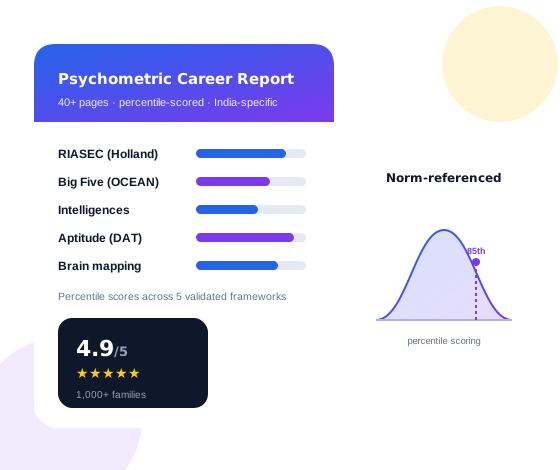
CCO's psychometric career assessment combines RIASEC (Holland Code), Big Five (OCEAN), Multiple Intelligences, aptitude clusters, and brain mapping into a single validated 5-framework test — interpreted 1:1 by a certified career counsellor and delivered as a 40+ page personalised career roadmap mapped to Indian career pathways. Because a career decision made on gut feel is a career decision made without evidence.
What Is a Psychometric Career Assessment?
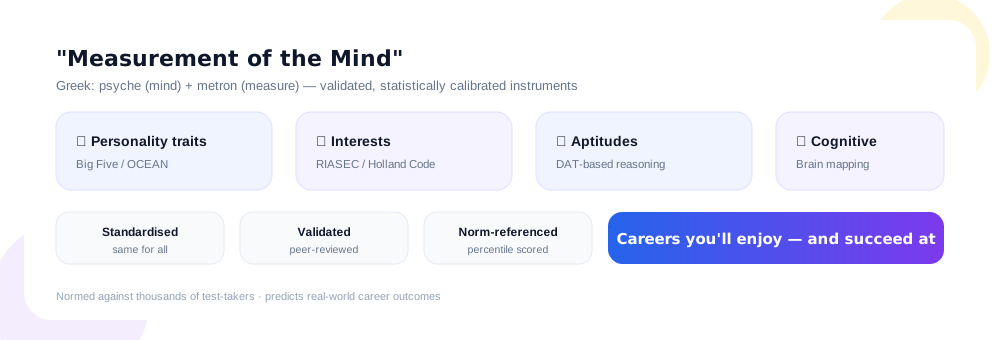
A psychometric career assessment is a scientifically validated set of tests that measures a person's personality traits, interests, aptitudes, and cognitive patterns using standardised, statistically calibrated instruments — designed to predict which careers a person is likely to enjoy and succeed at. The word "psychometric" literally means "measurement of the mind" (Greek: psyche = mind, metron = measure). Unlike casual "career quizzes" or personality tests you'd find on lifestyle websites, a proper psychometric career assessment uses instruments developed over decades of peer-reviewed research, normed against thousands of test-takers, and validated for their ability to predict real-world career outcomes.
At CCO, the psychometric career assessment combines five scientifically validated frameworks — RIASEC (Holland Code) for career interests, Big Five (OCEAN) for personality, Gardner's Multiple Intelligences, aptitude testing (DAT-based), and brain-mapping for cognitive style — into a single 60–90 minute online assessment. The output is a 40+ page personalised career report, mapped specifically to Indian career pathways (CBSE / ICSE / IB boards, Indian entrance exams, Indian college ecosystem, Indian salary bands), and interpreted 1:1 by a certified career counsellor rather than left as a raw report.
Why Psychometric Testing Beats Gut Feel — The Science Advantage
Most career decisions in India are made using three inputs: parental preference, peer influence, and school marks. None of these is a scientific measurement of career fit. Here's what psychometric testing adds — and why it consistently produces better outcomes.
Objective measurement, not opinion.
Psychometric tests measure specific traits with defined scales — introversion vs extraversion, analytical vs creative reasoning, RIASEC orientations — using standardised questions administered the same way to every test-taker. The output is comparable and defensible. Your family's opinion isn't measured against anything except itself.
Detection of hidden patterns.
A student with strong spatial intelligence but only moderate mathematical intelligence often gets pushed toward engineering because "marks are good in maths" — when their profile actually points to architecture, design, or urban planning. Psychometric assessment surfaces these patterns clearly. School marks don't.
Stability across time.
Personality traits measured by properly validated instruments (Big Five especially) remain stable across years. This means a psychometric career recommendation doesn't become obsolete in six months when your child's "latest interest" changes. The underlying profile stays consistent — which is exactly what you want for a career-defining decision.
Statistical benchmarking.
Psychometric scores are typically expressed as percentiles — where does this student sit relative to the norming population? "High verbal reasoning (85th percentile)" is meaningfully different from just "good at English." Percentile-based scoring lets counsellors make specific, defensible recommendations.
Validated career predictions.
The RIASEC framework has been used and validated in career counselling contexts globally since 1959. Big Five personality dimensions have been shown to predict career satisfaction and performance across hundreds of studies. These aren't marketing claims — they're peer-reviewed research findings, which is why serious career counselling worldwide uses these specific frameworks.
Consistency of interpretation.
Two well-trained career counsellors looking at the same psychometric report will arrive at similar career recommendations. Two family members giving opinions typically arrive at completely different recommendations. Consistency is what makes advice reliable.
The 5 Scientific Frameworks Inside CCO's Psychometric Career Assessment
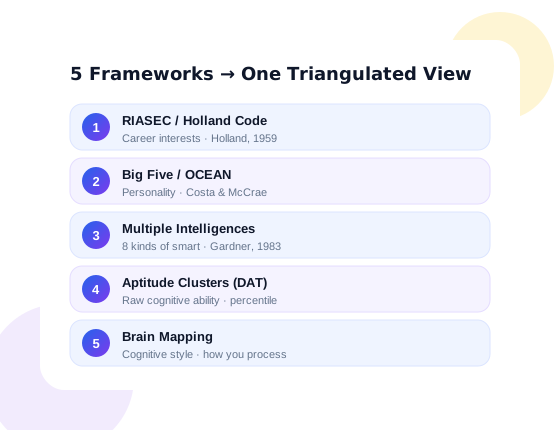
CCO combines five distinct psychometric frameworks — each measuring something a single test can't capture alone. Together, they produce a triangulated view of career fit rather than a single-dimension snapshot.
Framework 1: RIASEC / Holland Code
What it measures: Career interest orientation — the type of work environment where you'll naturally thrive.
Developer: Psychologist John Holland, 1959. Refined over decades of empirical research.
How it works: Places every person on six dimensions — Realistic (practical, hands-on), Investigative (analytical, scientific), Artistic (creative, expressive), Social (helping, teaching), Enterprising (leading, persuading), Conventional (organising, detail-oriented). Most people are a mix of 2–3 dominant orientations, expressed as a 3-letter code (e.g., "IAS" = Investigative-Artistic-Social).
Why CCO uses it: The most researched and predictive career-interest framework in psychology. Used by career centres at Harvard, Stanford, and the US Department of Labor's O*NET system.
Framework 2: Big Five / OCEAN Personality Model
What it measures: The five core dimensions of personality that predict long-term career fit.
Developers: Costa & McCrae in the 1990s, building on decades of factor-analytic research.
How it works: Rates five traits — Openness (curiosity, imagination), Conscientiousness (discipline, organisation), Extraversion (social energy, assertiveness), Agreeableness (cooperation, warmth), Neuroticism (emotional volatility). Each is a spectrum, not a binary.
Why CCO uses it: Considered the gold standard in personality science. Unlike MBTI (which forces binary categorisation and has known statistical limitations), Big Five uses continuous dimensions and is far more predictive of job performance and career satisfaction.
Framework 3: Multiple Intelligences (Gardner)
What it measures: The distinct kinds of "smart" a person is.
Developer: Harvard psychologist Howard Gardner, 1983.
How it works: Maps eight intelligences — linguistic, logical-mathematical, spatial, kinaesthetic, musical, interpersonal, intrapersonal, and naturalistic. School typically measures only linguistic and logical-mathematical — meaning students strong in other intelligences often underperform on school marks while excelling in areas like design, therapy, teaching, or environmental sciences.
Why CCO uses it: Rescues capable students from being misjudged by narrow academic assessment. Critical for identifying non-obvious career fits.
Framework 4: Aptitude Clusters (DAT-Based)
What it measures: Raw cognitive ability — the ceiling of what a person can do with training.
Developer: Bennett, Seashore, and Wesman, 1947 — the Differential Aptitude Test remains one of the most validated aptitude batteries in psychology.
How it works: Measures six independent reasoning types — numerical, verbal, abstract, spatial, mechanical, and clerical speed / accuracy. Each is scored against age-normed benchmarks (percentile-based).
Why CCO uses it: Aptitude is what training amplifies. Without underlying aptitude in the required areas, no amount of coaching produces career-level results. Measuring aptitude prevents costly mismatches (e.g., pushing a student with low mechanical reasoning into engineering).
Framework 5: Brain Mapping (Cognitive Style Analysis)
What it measures: How your brain prefers to process information.
How it works: Analyses left-brain / right-brain / whole-brain dominance and processing style — analytical vs holistic, sequential vs random, verbal vs visual. Influences everything from how a student studies to which work environments they'll be productive in.
Why CCO uses it: A dimension most Indian career assessments skip — but which often explains why students with matching aptitude and interest still struggle in specific work environments. Critical for the "why some people burn out in the 'right' career" question.
See your own 5-framework profile
Take the free demo assessment, or book a free call — and see how the five frameworks triangulate your career fit.
Take the Free Demo Assessment →Combined, these five frameworks produce a triangulated 40+ page career report — showing not just which careers fit, but why — with specific recommendations mapped to Indian streams, subjects, entrance exams, and colleges.
How Psychometric Career Tests Actually Work — The Underlying Science
Understanding why psychometric tests are reliable helps you evaluate whether any given test is credible. Here's the core science, in accessible language.
Reliability — does the test measure consistently?
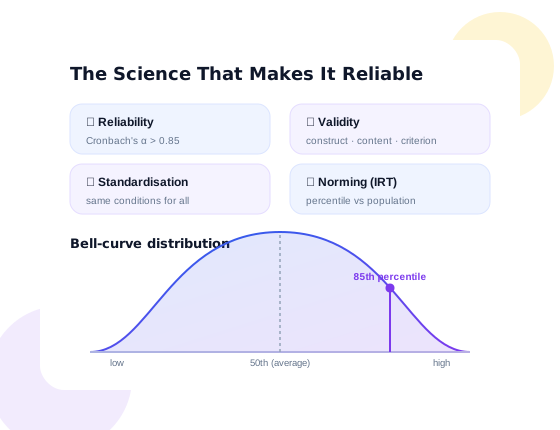
A reliable test gives similar results if the same person retakes it. Psychometric tests report their reliability using coefficients like Cronbach's alpha — a statistic ranging from 0 to 1. Well-designed psychometric instruments have Cronbach's alpha values above 0.7 (acceptable) or above 0.85 (excellent). Random online career quizzes typically have reliability values below 0.4 — barely better than random.
Validity — does the test measure what it claims?
A test can be reliable (consistent) without being valid (measuring the right thing). Psychometric validity has three types: construct validity (does it measure the underlying trait?), content validity (does the test cover the domain properly?), and criterion validity (does the score predict real-world outcomes?). Career psychometric tests are validated against career outcomes over years or decades.
Standardisation — is the test administered consistently?
Everyone should take the test under similar conditions with the same instructions. Standardised administration prevents test-taker confusion from distorting results.
Norming — what does a "high" or "low" score mean?
Psychometric tests are calibrated against norming samples — thousands of test-takers whose scores establish the population distribution. Your score gets compared to that norm, expressed as a percentile. "You scored in the 85th percentile of numerical reasoning" is meaningful because there's a reference population.
Item Response Theory (IRT) vs Classical Test Theory (CTT).
Modern psychometric assessments use IRT — where each individual test question is calibrated for difficulty and discriminating power. This makes tests shorter without sacrificing reliability. Older tests use CTT (Classical Test Theory), which requires more questions to achieve the same measurement precision.
Bell curve distribution.
Most psychometric traits follow a normal distribution (bell curve) in the population. Being in the 50th percentile means "average" — statistically, not judgmentally. Being in the 85th percentile means you're higher than 85% of the norming population. This maths matters because it means "average" isn't bad — it just isn't a differentiator.
CCO's psychometric career assessment adheres to all five principles above — reliability, validity, standardisation, norming, and modern scoring methodology.
Psychometric Career Assessment vs Other Career Tests — What's the Difference?
Not every "career test" is a psychometric career assessment. Here's how they compare.
| Test Type | Scientific Basis | Duration | Depth | Best For |
|---|---|---|---|---|
| Psychometric Career Assessment (CCO) | 5 validated frameworks, IRT-scored, norm-referenced | 60–90 min | High — combined 5-dimensional profile | Real career decisions |
| Personality Test (Big Five only) | Validated | 15–20 min | Medium — personality only | Understanding stable traits |
| Interest Inventory (RIASEC only) | Validated | 15–20 min | Medium — interests only | Early exploration |
| Aptitude Test (DAT / DBDA) | Validated | 45–60 min | Medium — cognitive ability only | Identifying trainable ceiling |
| MBTI / 16 Personalities | Popular but statistical limitations | 15 min | Low — forced binary categorisation | Self-reflection, limited career predictive value |
| DMIT (Dermatoglyphics) | Not scientifically validated for career prediction | 5 min | Very low | Not recommended for serious career decisions |
| Free online career quizzes | Usually no science | 5–10 min | Very low | Casual curiosity only |
A psychometric career assessment isn't the only useful test — it's the most comprehensive one for the specific question "what career should I pursue." Single-framework tests can be useful supplements. Non-validated tests (DMIT, casual quizzes) shouldn't drive career decisions.
On MBTI specifically: MBTI is popular globally but has known reliability issues (test-retest results often disagree) and validity issues (career predictions aren't backed by strong evidence). Serious career counselling worldwide has shifted from MBTI to Big Five for exactly these reasons. CCO uses Big Five, not MBTI.
How CCO's Psychometric Career Assessment Works — Step by Step
Standard 10–14 day process from booking to receiving your interpretation.
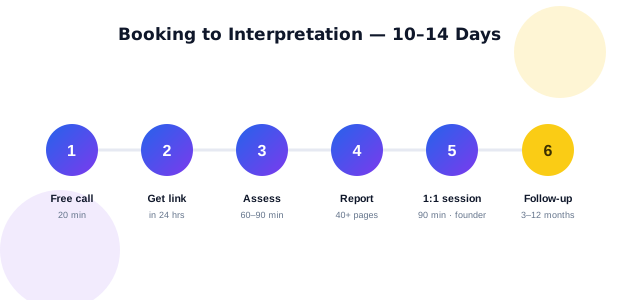
Step 1 — Free 20-Minute Discovery Call
We understand where you're stuck, which decisions are coming up, and confirm the psychometric career assessment is the right tool for your situation.
Step 2 — Receive Your Assessment Link
Within 24 hours of your discovery call, you receive a secure link to your personalised online assessment. Works on laptop, tablet, or mobile — but a computer with a full keyboard is recommended for the aptitude sections.
Step 3 — Complete the Assessment (60–90 minutes)
Complete the assessment at your own pace. There's no time limit (except individual timed aptitude sections). No preparation needed — no "right answers" to memorise. Most people finish in a single sitting.
Step 4 — Report Generation (Within 48 Hours)
Your personalised 40+ page psychometric career report is generated. The report includes scored profiles across all five frameworks, percentile rankings, career recommendations with reasoning, subject/stream/exam guidance, and an action plan.
Step 5 — 90-Minute 1:1 Interpretation Session With Founder Varun Vohra
This is what turns data into decisions. Founder-counsellor walks you (and parents, if you invite them) through the report, explains what each score means, explores 4–6 career possibilities that fit, and pressure-tests your top options against your own instincts.
Step 6 — 3–12 Months of Follow-Up Support
Career decisions rarely conclude at the interpretation session. WhatsApp + email support continues for 3–12 months (by plan) — for course corrections, second thoughts, or new questions as they arise.
What's Inside Your 40+ Page CCO Psychometric Career Report
Most Indian psychometric career reports are 8–15 pages of generic template. CCO's report is 40+ pages, personalised, and India-specific. Section-by-section breakdown:
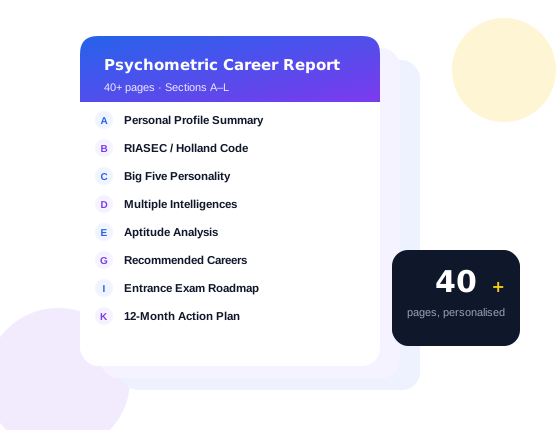
Section A — Your Personal Profile Summary
Cover, personal details, assessment date, plan level, one-page executive summary.
Section B — RIASEC / Holland Code Profile
Your six-code profile (primary, secondary, tertiary Holland codes) with detailed interpretation of what each score means for career fit.
Section C — Big Five Personality Profile
Percentile-scored profile across Openness, Conscientiousness, Extraversion, Agreeableness, Neuroticism — with plain-language interpretation.
Section D — Multiple Intelligences Map
Visual profile of your dominant intelligences with specific career implications.
Section E — Aptitude Analysis
Percentile-scored breakdown across numerical, verbal, abstract, spatial, mechanical, and clerical reasoning — interpreted for career fit.
Section F — Brain-Dominance Profile (Pro & Advanced plans)
Cognitive-style analysis — how your brain prefers to work, with implications for study environment and work culture fit.
Section G — Recommended Careers (Ranked)
6+ careers ranked by fit, each with: role description, salary in India, required education, entrance exams, top Indian colleges, growth outlook.
Section H — Subject / Stream Recommendation (for school students)
Specific stream choice (Science / Commerce / Arts) or subject combination, tied to your assessment data.
Section I — Entrance Exam Roadmap
Which entrance exams to target — JEE, NEET, CUET, CLAT, NIFT, NID, IPMAT, etc. — with timing and prep strategy.
Section J — College Shortlist Criteria
Types of colleges that fit your recommended path, with backup options.
Section K — 12-Month Action Plan
Month-by-month checklist for the next year.
Section L — Follow-Up Resources
Recommended books, courses, communities.
How Much Does a Psychometric Career Assessment Cost in India?
Psychometric career assessment pricing in India varies dramatically — from free (unreliable) to ₹25,000+ (premium bundled).
| Option | Price | What You Get |
|---|---|---|
| Free online psychometric quiz | ₹0 | Short quiz, generic report, no interpretation |
| Basic online psychometric test | ₹500 – ₹1,500 | Longer test, PDF report, no expert session |
| School-provided psychometric | Included in school fees | Group testing, brief report, minimal 1:1 time |
| Standalone psychometric assessment | ₹2,000 – ₹5,000 | Full report, sometimes short counsellor call |
| Premium platforms (Mindler, iDreamCareer) | ₹8,000 – ₹25,000 | Full assessment + junior-counsellor sessions |
| CCO | ₹5,000 – ₹7,500 | 5-framework assessment + brain mapping + founder-led 90-min 1:1 + 40+ page report + 3–12 months follow-up |
CCO's psychometric career assessment is bundled with founder-led counselling because a standalone psychometric report without expert interpretation delivers 20–30% of the value at 40–50% of the cost — poor economics for a decision this important.
Is Psychometric Career Assessment Actually Reliable?
Short answer: yes — when the specific test uses validated frameworks and is administered correctly. Long answer follows.
Reliability depends on the specific test, not the category.
Well-designed psychometric tests using validated frameworks (RIASEC, Big Five, DAT) have reliability coefficients above 0.85 — meaning results are highly consistent across repeated administrations. Poorly designed tests marketing themselves as "psychometric" often have reliability under 0.5. The word "psychometric" alone doesn't guarantee quality.
Interpretation matters as much as the test.
Two well-trained counsellors interpreting the same psychometric report will arrive at similar career recommendations. That inter-rater reliability is what makes psychometric-based counselling defensible. Untrained interpretation of a valid report produces unreliable recommendations.
Cultural adaptation matters.
A psychometric test developed and normed in the US may not translate directly to Indian career pathways, family dynamics, or education systems. CCO's assessment is India-adapted — the frameworks are universal, but career mapping and interpretation are calibrated to Indian realities (CBSE / ICSE / IB boards, Indian entrance exams, Indian salary bands).
Age matters.
Psychometric traits become measurable at different ages. Personality traits are meaningfully stable from around age 12–13. Interests stabilise through the teens. Aptitudes emerge earlier but mature through adolescence. CCO's assessment tools are age-calibrated — the version used for Class 8 is different from the version used for graduates.
Retesting reveals genuine change.
Someone who takes a psychometric career assessment at Class 10 and retakes it as a working professional at 30 will typically see minor score shifts (natural over a decade) but consistent overall profile. If the scores change dramatically over such a period, either the test wasn't reliable, or the person's circumstances have changed dramatically.
Bottom line
Bottom line: CCO's psychometric career assessment is built on the most reliably validated frameworks in career psychology. But no assessment substitutes for the 1:1 interpretation session — the assessment starts the conversation, it doesn't end it.
5 Common Myths About Psychometric Career Testing — Debunked
Myth 1: "One test decides your career."
No credible psychometric assessment does this. What a good assessment does is narrow down career possibilities to a specific set that match your profile — typically 6–12 careers. The final decision comes from combining assessment data with your own interests, family context, and financial realities.
Myth 2: "Psychometric tests are just personality quizzes with fancy names."
No — they use different underlying science. Personality quizzes typically use one framework (or none) and 10–20 questions. A proper psychometric career assessment uses multiple validated frameworks (RIASEC, Big Five, aptitude, MI) and 200+ questions, scored against norming populations.
Myth 3: "I can prepare for a psychometric test to get better results."
Preparing is counterproductive. Psychometric tests don't have "right" answers — they measure your actual patterns. Preparing to "look better" produces distorted results and career recommendations that don't match your real profile.
Myth 4: "My child is too young for a psychometric test."
Age-calibrated psychometric assessments work from Class 8 (age 13) onwards. The tools used at that age emphasise personality and interests (which are meaningfully stable) rather than aptitude (which is still developing). Age-inappropriate testing is the problem, not testing at a young age.
Myth 5: "MBTI / DMIT / free online quizzes give the same answer for less money."
No. MBTI has known reliability issues and forces binary categorisation. DMIT is not scientifically validated for career prediction. Free quizzes typically use no validated science. Paying less for less-reliable results is a false economy on a career-defining decision.
Want the real thing, not a quiz?
Take the free demo assessment or book a free call — a validated 5-framework test with founder-led 1:1 interpretation.
Take the Free Demo Assessment →What Families Say About CCO's Psychometric Career Assessment
"The psychometric assessment showed our son's spatial-mechanical aptitude was actually average, while his verbal reasoning was in the 92nd percentile. We'd been assuming engineering. Varun's session helped us see law was actually the better fit. He's now doing BALLB at a top NLU. The assessment saved us from a wrong four-year decision."
"I've taken three online career tests before. This was the first that felt like it actually understood me — probably because it used real psychometric science instead of quiz-format questions. The 5-framework combination showed nuances I'd never seen surfaced before."
"As a working professional considering a career pivot, I appreciated the technical rigor. Percentile-based scoring, honest interpretation, no over-claiming. Made the recommendation to move to Product Management genuinely defensible when I explained it to family."
Psychometric Career Assessment — Frequently Asked Questions
Q1. What is a psychometric career assessment?
A psychometric career assessment is a scientifically validated set of tests that measures personality traits, interests, aptitudes, and cognitive patterns using standardised, statistically calibrated instruments — designed to predict which careers a person is likely to enjoy and succeed at. CCO's psychometric career assessment combines five frameworks — RIASEC, Big Five, Multiple Intelligences, aptitude clusters, and brain mapping — into a single 40+ page report.
Q2. What does "psychometric" actually mean?
"Psychometric" combines the Greek words psyche (mind) and metron (measure) — literally "measurement of the mind." Psychometrics is the scientific discipline of measuring psychological traits — personality, intelligence, aptitude, interests — using validated instruments with defined reliability and validity properties.
Q3. How long does a psychometric career assessment take?
CCO's psychometric career assessment takes 60–90 minutes to complete online. The full process — booking, assessment, report generation, 90-minute 1:1 interpretation session, and roadmap delivery — takes 10–14 days end-to-end.
Q4. Does the person need to prepare for the assessment?
No preparation is required — and in fact, preparation is counterproductive. Psychometric tests don't have "right" answers. Preparation to "look better" produces distorted results and career recommendations that don't match your real profile.
Q5. Is the CCO psychometric career assessment done online?
Yes — 100% online. The assessment works on laptop, tablet, or mobile (though a computer with a full keyboard is recommended for aptitude sections). The 1:1 interpretation session happens over video call. Families anywhere in India (or abroad) can complete the full assessment from home.
Q6. Is the psychometric career assessment reliable?
Yes — when built on validated frameworks. CCO uses RIASEC, Big Five, Gardner's Multiple Intelligences, and DAT-based aptitude testing — all with strong published reliability values (Cronbach's alpha above 0.85 for most subscales). The assessment is age-calibrated (different versions for Class 8 vs graduates vs working professionals) and India-adapted for career mapping.
Q7. Can a psychometric test predict my exact career?
No credible psychometric test does this. What a good psychometric career assessment does is identify a set of careers (typically 6–12) that fit your underlying profile — narrowing your options from "hundreds" to "these specific ones worth exploring." The final choice is yours, based on assessment data + your own context.
Q8. What is the difference between a psychometric test and a personality test?
A personality test measures one aspect — personality. A psychometric career assessment is broader — it combines personality (Big Five), interests (RIASEC), aptitudes (numerical / verbal / spatial / etc.), and often intelligences (MI) into a triangulated profile. Every psychometric career assessment includes personality testing; not every personality test is a psychometric career assessment.
Q9. Are psychometric tests scientifically valid?
The specific tests CCO uses — RIASEC, Big Five, DAT-based aptitude, Gardner MI — have decades of peer-reviewed validation research. They meet the reliability and validity standards published by major psychology bodies (APA, BPS). Not every test marketed as "psychometric" meets these standards — the specific framework matters.
Q10. How is CCO's psychometric career assessment different from Mindler, iDreamCareer, or Edumilestones?
Three main differences: (1) CCO combines psychometric + brain mapping into a single 5-framework assessment — most competitors use only psychometric. (2) The 1:1 interpretation is always done by the founder-counsellor (with 1,000+ sessions of experience), not a rotating junior counsellor. (3) Transparent pricing (₹5,000–₹7,500) published upfront — competitors typically require an enquiry form before disclosing prices often at ₹12,000–₹25,000.
Q11. What is RIASEC?
RIASEC (also called the Holland Code) is a career-interest framework developed by psychologist John Holland in 1959. It classifies careers and people along six dimensions — Realistic, Investigative, Artistic, Social, Enterprising, Conventional. Most people are a mix of 2–3 dominant orientations. RIASEC is the most researched career-interest framework in psychology, used globally in career centres and the US Department of Labor's O*NET system.
Q12. What is Big Five / OCEAN?
Big Five (also called OCEAN) is a personality model measuring five dimensions — Openness, Conscientiousness, Extraversion, Agreeableness, Neuroticism. Developed through decades of factor-analytic personality research, it's considered the gold standard in personality science. Unlike MBTI (which forces binary categories), Big Five uses continuous dimensions and is more statistically reliable and predictive.
Q13. Do parents attend the interpretation session?
Yes — we strongly encourage it for students under 18. Career assessments involving parents in the interpretation session produce far better long-term outcomes than sessions where only the student attends. For working professionals and graduates, joining alone is standard.
Q14. What happens if the assessment result contradicts my child's stated interest?
That's actually one of the most valuable outcomes. In our interpretation session, we don't tell the student to abandon their preferred career — we explore why the assessment shows the mismatch. Sometimes the stated interest is still viable with some adjustments. Sometimes the assessment reveals the "interest" was actually peer pressure. Either outcome is useful.
Q15. How do I book CCO's psychometric career assessment?
Click Book Free Call above. Share the student's / your details and situation. First call is genuinely free — expect a real conversation, not a sales pitch. The psychometric career assessment is bundled with the counselling plan you choose (Basic ₹5,000, Pro ₹6,500, or Advanced ₹7,500).
Career Decisions Deserve Evidence, Not Guesswork
Every career decision is a bet. The question isn't whether to bet — it's whether to bet on evidence or on guess. A scientifically validated psychometric career assessment, interpreted 1:1 by a certified career counsellor, is the single fastest way to move from confusion to clarity — with data you can actually defend.
Free 20-minute discovery call. Free demo assessment. Founder-led interpretation. Transparent pricing.
Or book directly: Book Your Free Counselling Call →
Career decisions deserve evidence, not guesswork.
Free demo assessment · founder-led interpretation · transparent pricing.