Career Counselling for Graduates — Right Next Move, Whether Your Degree Fits or Not
Whether you're a final-year undergraduate deciding between a job and higher studies, a fresher realising your degree doesn't match your interests, or a graduate considering a career pivot — CCO's psychometric-backed 1:1 counselling helps you make the next move with evidence, not guesswork or regret. Independent. Founder-led. No coaching-institute agendas.
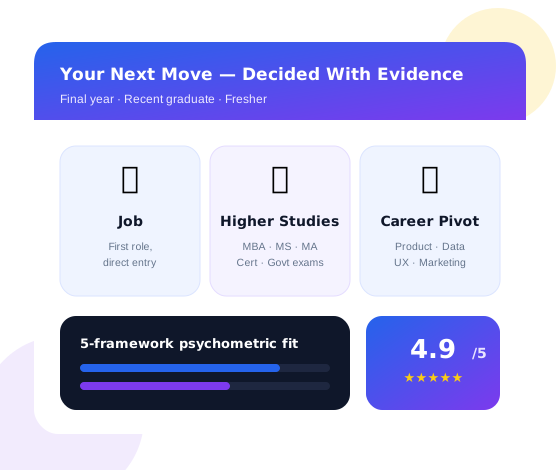
What Is Career Counselling for Graduates?
Career counselling for graduates is a structured, adult-focused guidance process that helps final-year undergraduates and recent graduates make their next career move — whether that's a first job, a higher studies decision (MBA, MS, MA, professional certifications, or government exams), or a full career pivot away from an unaligned degree. Unlike school-age career counselling (which centres on parents and stream/course choices), graduate career counselling talks directly to the graduate as an adult decision-maker — using scientific assessment to cut through the pressures, regrets, and second-guessing that surround the post-graduation moment.
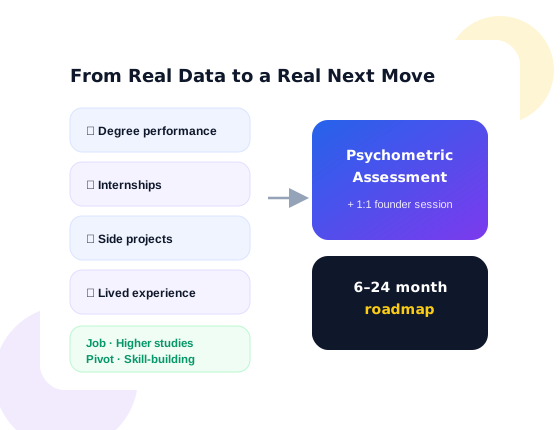
At CCO, career counselling for graduates combines a 5-framework psychometric assessment, a 90-minute founder-led 1:1 session, and a personalised roadmap covering the next 6–24 months — with specific recommendations across job paths, higher studies, entrance exams, career pivots, and skill-building. The assessment is honest about what fits — and honest about what doesn't.
Why Post-Graduation Is the Highest-Agency Decision Moment of Your Life
Class 10 and Class 12 decisions get made with parents in the driver's seat. Post-graduation is when that flips. You're now an adult making a career decision that will shape the next 40 years — and, for the first time, you actually get to make it.
You now have real data about yourself.
Class 10 you had no idea what you were suited for. Post-graduation you have 3–5 years of degree performance, internships, side projects, and lived experience. That's a much richer input than any teenager has to work with.
You're finally allowed to say "the last decision was wrong."
A significant portion of Indian graduates land at this moment realising their Class 12 course was a mismatch — pushed into engineering, medicine, or commerce for reasons that didn't reflect their actual profile. Career counselling for graduates exists specifically to help you fix that — cleanly, with evidence, without the shame patterns.
Higher studies is a ₹5–50 lakh decision.
An MBA at a mid-tier Indian college is ₹15–25 lakh. An MS abroad is ₹40 lakh–₹1 crore. A wrong choice at this stage isn't a school-mark problem — it's a real financial and time investment. Career counselling costs a small fraction and prevents most of the wrong bets.
The "everyone-else-is-doing-X" pressure is at its worst.
Batchmates enrolling for CAT. Cousins going for MS in the US. Family friends' kids clearing UPSC prelims. Post-graduation is when peer-comparison becomes especially loud — and it's often the worst possible guide for what you should actually do.
Job market timelines don't wait.
Campus placements have windows. CAT registration has deadlines. Study abroad has 18-month application cycles. Government exam preparation needs 12–18 months. Post-graduation is when your ability to time decisions well starts to compound.
Ready to make your move with evidence?
Book a free 20-minute discovery call and turn this decision window into your advantage — founder-led, no sales pressure.
Book Your Free Counselling Call →Structured career counselling turns this window into a real advantage — instead of a source of chronic anxiety.
Who CCO's Graduate Career Counselling Helps
If any of these describe you (or someone you know), this page is for you.
Final-year undergraduate.
You have 6–12 months before your degree ends. Decisions are looming: campus placements, higher studies applications, entrance exam prep, or first job. You need to figure out which door to walk through — not all of them.
Recent graduate, job-hunting.
You've finished your degree. You're applying, but the offers aren't matching your interests. Something is off — you're just not sure what.
Recent graduate, prepping for higher studies.
You've decided to do a masters — but you're not sure whether it should be MBA, MS abroad, MA/MSc in India, or something else. And the CAT prep classes are hard-selling.
Fresher (0–2 years work experience) already reconsidering.
You took a job. Six months in, you know it's not it. Do you switch companies, switch roles, switch industries, go for higher studies, or take a longer pause and reset?
Graduate with a "wrong" degree.
BCom but interested in design. BA but pulled toward tech. BTech but not enjoying engineering. Career pivots are absolutely possible — but they need a plan, not just a decision.
Government exam prepping graduate.
UPSC. State PSC. Banking. SSC. You're deep in prep but starting to wonder if this is really the fit — or if you're preparing because it feels safe.
Study-abroad-considering graduate.
MS in the US? Masters in the UK? Germany for the free tuition? Australia for the PR pathway? Post-graduate abroad decisions need real analysis, not just "everyone's going."
Recognise yourself in any of these?
Book a free 20-minute discovery call and we'll map your exact next move — no sales pressure, no coaching-institute agenda.
Book Your Free Counselling Call →The 6 Most Common Post-Graduation Situations CCO Handles
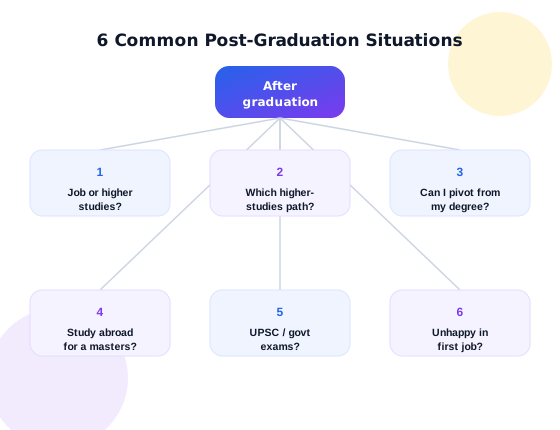
Situation 1: "Job or higher studies?"
The most common branching decision. Higher studies makes sense for some careers (academia, medicine, specific technical fields, MBA-track roles). Direct job entry works better for others (product management, design, marketing, general business). CCO helps you decide which fits your career direction — not what fits a generic template.
Situation 2: "Which higher studies path?"
MBA vs MS vs MA/MSc vs professional certifications (CA, CS, CFA, FRM) vs government exams. Each is a completely different bet — different entrance exam, different timeline, different cost, different long-term career trajectory. A structured comparison beats scattered advice.
Situation 3: "My degree doesn't match my interests — can I pivot?"
Yes — often more easily than you think. Product Management, Data Analytics, UX Design, Marketing, Consulting, Content, and Product roles are all reachable from most Indian degrees. The path is skill-building + certification + portfolio + strategic first job. CCO builds you the exact plan.
Situation 4: "Is it worth studying abroad for a masters?"
Depends. For some careers, absolutely yes (research, specific tech specialisations, US-based industry entry). For others, an Indian MBA or Indian masters is a far better ROI. This decision genuinely benefits from evidence-based analysis instead of peer influence.
Situation 5: "Should I be preparing for UPSC / government exams?"
Government exams can be excellent careers for the right personality profile — but they're a 3–6 year lifestyle commitment with real opportunity cost. Career counselling helps you honestly evaluate whether you fit the profile — before you invest three years of your life in a prep that might not match.
Situation 6: "I'm in my first job and already unhappy. What now?"
Very common. Options include internal role changes, external moves, industry shifts, higher studies at 12–18 months, or skill pivots. Each has different timing and cost implications. Better decided with a plan than by quitting on a Monday.
Career Options After Graduation — By Degree
Different undergraduate degrees open different paths. Here's an honest map of where each one leads — including the pivot options.
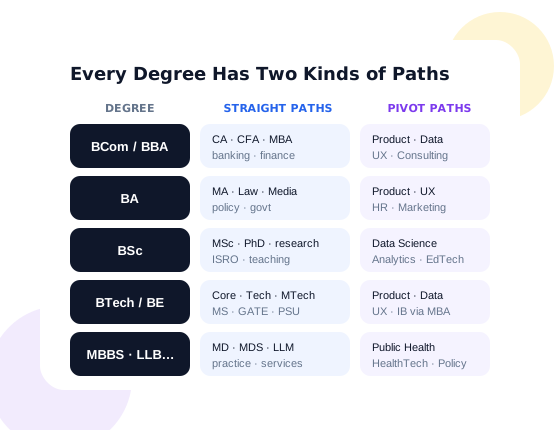
After BCom / BBA / BMS
Straight paths: CA (if not already done), CS, CFA, MBA (CAT / GMAT), banking, finance analyst roles, corporate roles, family business. Pivot paths: Product Management, Data Analytics, Digital Marketing, Consulting, UX Design (with certification), entrepreneurship.
After BA (Humanities)
Straight paths: MA in specialisation (Economics, Psychology, English, Political Science), Law (LLB, 3-year), Journalism / Media, MBA, Public Policy, Development Sector, government exams. Pivot paths: Product Management, UX Design, Content Strategy, HR, Marketing, Consulting, EdTech.
After BSc
Straight paths: MSc, PhD track, teaching, research, government scientific services (ISRO / DRDO / BARC), technical roles. Pivot paths: Data Science, Analytics, Product Management, Consulting, EdTech, science communication.
After BTech / BE
Straight paths: Core engineering job, tech industry, MTech, MS abroad, MBA, product/software roles, GATE + PSU jobs. Pivot paths: Product Management, Data Science, UX Design, Consulting, Investment Banking (via MBA), Development Sector, entrepreneurship.
After MBBS
Straight paths: MD/MS specialisation, general practice, government medical services, hospital roles. Pivot paths: Public Health, Medical Writing, Pharma industry, HealthTech, Medical Research, Hospital Administration (MBA).
After BDS
Straight paths: MDS, private practice, dental colleges. Pivot paths: Hospital Administration, Pharma, Healthcare consulting, HealthTech.
After LLB / BALLB
Straight paths: Litigation, corporate law firms, judicial services, government legal services, LLM. Pivot paths: Compliance, Consulting, Policy, Investment Banking, Legal Tech.
After BDes / BFA / Design Degrees
Straight paths: Design roles (Product, UX/UI, Visual, Communication), MDes, design consultancies. Pivot paths: Product Management, Design Management (via MBA), Design Education, Entrepreneurship, freelance.
After BArch
Straight paths: Architectural firms, MArch, urban planning, sustainable design. Pivot paths: Product Design, Interior Design, Real Estate, Consulting, Design Management.
For every degree, the "straight paths" are what school and family assume. The "pivot paths" are often where a genuine profile match lives. Career counselling helps identify which of these fits you.
Higher Studies Decision Framework — MBA vs MS vs MA/MSc vs Certifications vs Government Exams
Most graduates approach this decision emotionally ("MBA sounds prestigious") or by peer influence ("everyone's applying to MS abroad"). Here's the honest, structured comparison.
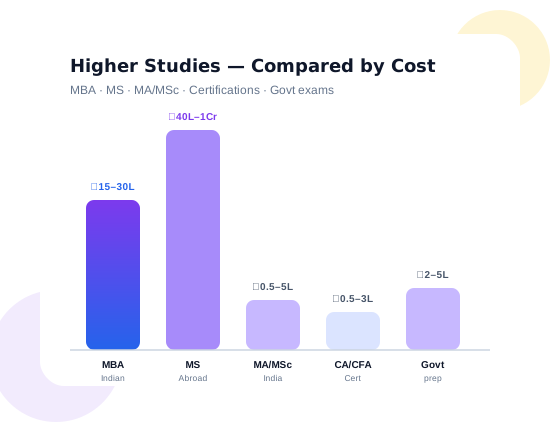
| Option | Best For | Typical Cost (INR) | Typical Duration | Career Payoff Timeline |
|---|---|---|---|---|
| MBA (Indian, Top Tier) | Business, consulting, finance, product, general management | ₹15–30 lakh | 2 years | Post-MBA + 2–3 years |
| MBA (Global) | International management roles, geographic pivot | ₹60 lakh – ₹1.2 Cr | 1–2 years | Post-MBA + 3–5 years |
| MS Abroad | Technical specialisation, research, US/EU/Canada career | ₹40 lakh – ₹1 Cr | 1.5–2 years | Post-MS + 2–5 years |
| MA / MSc India | Deep specialisation, academia, research, government | ₹0.5–5 lakh | 2 years | Post-degree + 1–3 years |
| CA / CS / CFA / FRM | Finance, accounting, corporate specialisation | ₹0.5–3 lakh | 2–4 years | Progressive |
| Government Exams (UPSC / PSC / RBI / SEBI) | Civil services, public policy, banking specialisation | Coaching ₹2–5 lakh | 2–4 years prep | Post-selection + long |
| PG Diploma / Certifications | Skill-based pivot (Product, Data, Design, Digital) | ₹1–8 lakh | 6–18 months | Immediate |
| Direct job + defer decision | Career exploration, salary earning, uncertain direction | ₹0 (positive salary) | 2–3 years | Post-work + reassess |
The right answer depends on your career direction, financial position, current profile strength, and — critically — your honest self-assessment. Career counselling helps you land on the specific option that fits your combination.
7 Signs You Need Career Counselling as a Graduate
1. You have a degree but no clear direction.
Getting the degree was the plan. Now you're realising there wasn't a plan for what came next.
2. You're applying to jobs half-heartedly.
Applications that don't get replies, or replies that don't excite you, usually signal a mismatch between what you're applying for and what you're actually good at.
3. You're prepping for CAT / GMAT / GRE without a specific reason.
"MBA is the default next step" is not a reason. If you can't name what you want to do after the MBA, the MBA won't fix anything.
4. You're considering a career pivot but scared to commit.
Fear is a signal, not a stop sign. Most pivots are more possible than they feel — but they need a plan.
5. Family is pushing UPSC / medicine / MBA and you're going along.
Silent compliance now = quiet resentment later. Better to have the honest conversation with data now.
6. Your batchmates seem to have plans and you don't.
Their plans might not be good either — they're just louder. Comparison to peer confidence is the wrong benchmark.
7. You took a job but you're already looking at higher studies.
Might be a genuine plan; might be an escape hatch. Structured career counselling helps you tell the difference.
See yourself in these signs?
A structured 1:1 session with a founder-counsellor turns the confusion into a clear, evidence-based next move.
Talk to an Expert →How the Graduate Career Counselling Process Works
Standard 10–14 day process. Faster if you're in a time-pressured window (final semester, imminent higher-studies application deadline).
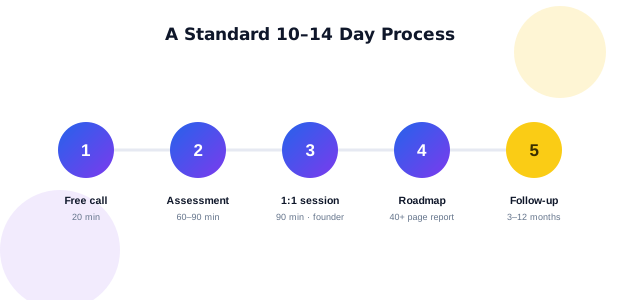
Step 1 — Free 20-Minute Discovery Call
We understand your specific situation: degree, current stage (final year vs recent grad vs fresher), current plans (if any), family constraints, top concerns. No sales pressure.
Step 2 — Psychometric + Brain-Mapping Assessment
60–90 minute online assessment. As an adult, you take this on your own — no parent alignment needed. The assessment covers RIASEC (interests), Big Five (personality), aptitude clusters, Multiple Intelligences, and (for Pro / Advanced plans) brain mapping.
Step 3 — 90-Minute 1:1 Session With Founder Varun Vohra
Video session. You can join alone or bring family — your choice. We walk through assessment results, map career possibilities, evaluate higher studies vs job decisions, and address specific worries directly.
Step 4 — Personalised Graduate Roadmap Report
40+ page report covering: recommended career direction, higher studies vs job recommendation with reasoning, specific entrance exams / certifications to consider, 12–24 month action plan, and — if applicable — study-abroad or pivot strategy.
Step 5 — 3–12 Months of Follow-Up
Applications, interview prep support, entrance exam decisions, first-job negotiations, and course corrections as they come up.
What's Included in Graduate Career Counselling at CCO
| Plan | Basic (₹5,000) | Pro (₹6,500) | Advanced (₹7,500) Most Popular |
|---|---|---|---|
| Psychometric Test | ✓ | — | ✓ |
| Brain Mapping Test | — | ✓ | ✓ |
| 1:1 Counselling Sessions | 2 | 3 | 4 |
| Career + Higher Studies Roadmap | ✓ | ✓ | ✓ |
| Higher Studies Path Comparison (MBA / MS / MA / Cert / Govt) | ✓ | ✓ | ✓ |
| Pivot / Career Switch Plan (if applicable) | — | ✓ | ✓ |
| Study Abroad Layer (if applicable) | — | Included where relevant | Included where relevant |
| Student Portal Access | — | 6 months | 1 year |
| Follow-Up Support | 3 months | 6 months | 1 year |
All sessions online over video · You can join alone or invite parents · Session recordings shared within 24 hours
8 Costly Post-Graduation Mistakes We See Every Year
Mistake 1 — Doing an MBA because "it's the default next step."
An MBA that isn't attached to a specific post-MBA career target is a ₹15–30 lakh expense with unclear return. Do the MBA when you know what you want it to do for you.
Mistake 2 — Studying abroad because peers are.
₹40 lakh to ₹1 crore is a real financial commitment. Choose it because the specific program + career target justifies the ROI — not because your batchmates chose it.
Mistake 3 — Preparing for UPSC because it feels "safe."
UPSC is not safe. It's a 3–5 year lifestyle commitment with a low success rate. It's excellent for the right personality profile and terrible for the wrong one. Assessment cuts through the ambiguity.
Mistake 4 — Taking the first job offer to end the uncertainty.
Accepting the wrong first job just to have a job locks you into a career trajectory that's hard to change later. Six more weeks of thoughtful job search almost always beats six years of a mismatched career.
Mistake 5 — Assuming pivots require another full degree.
Product Management, UX Design, Data Analytics, Digital Marketing, Content Strategy, Consulting — all reachable through 6–18 month certifications + strategic first jobs. You don't need another 4-year degree to change direction.
Mistake 6 — Believing your undergraduate degree "traps" you.
It doesn't. It just influences the specific pivot path. BA graduates work in tech. BCom graduates lead product. BTech graduates run marketing. The market cares more about capability than degree label.
Mistake 7 — Waiting for clarity before acting.
Clarity doesn't come from waiting. It comes from structured evaluation + first-step action. Six months of "figuring it out" without a framework produces the same confusion at Month 7.
Mistake 8 — Ignoring parents' concerns instead of addressing them with data.
Silent conflict with parents about career direction is one of the top stressors we see. Structured career counselling gives you an evidence-based answer to bring to family conversations — instead of "I want to do X because I feel like it."
What Graduates Say About CCO
"I had a BCom, was prepping for CAT because 'MBA next' seemed obvious, and hated every hour of it. Varun's assessment showed strong artistic-social interests and moderate mathematical aptitude — MBA would have been a slog. I pivoted to a UX design certification, built a portfolio in 8 months, and now work at a Bangalore product company. Best ₹6,000 I ever spent."
"Third year of BTech and I knew engineering wasn't for me. My family wanted MTech or MS. CCO's session showed my aptitude actually fit Product Management. I took the direct-job route via Product-track internships in final year, joined a startup as APM. Two years in, I'm now at a bigger company. No wasted years, no wasted lakhs."
"I was seven months into government-job prep after BA Political Science. Realised I was preparing because everyone in my hostel was — not because I wanted the job. Varun's session helped me see that policy research (via a specific Indian masters + policy think-tank track) fit better. I'm now doing exactly that."
Career Counselling for Graduates — Frequently Asked Questions
1. What is Career Counselling for Graduates?
Career Counselling for Graduates is a professional guidance process that helps graduates identify the most suitable career path based on their education, interests, personality, aptitude, skills, and long-term goals. Career Counselling for Graduates provides personalized recommendations for jobs, higher studies, certifications, career transitions, and future growth opportunities.
2. Why is Career Counselling for Graduates important?
Career Counselling for Graduates is important because graduation is one of the biggest career decision points. Career Counselling for Graduates helps individuals avoid costly mistakes, choose the right career direction, understand industry demand, and create a structured roadmap for professional success.
3. Who should opt for Career Counselling for Graduates?
Career Counselling for Graduates is suitable for final-year students, fresh graduates, working professionals with limited experience, career changers, and graduates planning higher studies. Career Counselling for Graduates helps anyone seeking clarity before making important career decisions.
4. Can Career Counselling for Graduates help me choose the right career?
Yes. Career Counselling for Graduates helps identify careers that align with your interests, strengths, personality, aptitude, and market opportunities. Career Counselling for Graduates provides practical guidance instead of relying on assumptions, trends, or peer influence.
5. Can Career Counselling for Graduates help me change my career after graduation?
Yes. Career Counselling for Graduates supports graduates who wish to change career paths by identifying transferable skills, recommending suitable certifications, suggesting career transition strategies, and creating a realistic roadmap for entering a new industry.
6. Does Career Counselling for Graduates help me decide between a job and higher studies?
Yes. Career Counselling for Graduates evaluates your career goals, financial considerations, academic background, and industry requirements to determine whether gaining work experience or pursuing higher education is the better option for your long-term success.
7. Can Career Counselling for Graduates help me decide between an MBA, an MS, or other postgraduate courses?
Yes. Career Counselling for Graduates compares postgraduate options such as MBA, MS, M.Tech, M.Des, M.Com, MA, LLM, and other professional programmes based on your career aspirations, budget, return on investment, and employment opportunities.
8. How does Career Counselling for Graduates help with higher studies?
Career Counselling for Graduates helps graduates shortlist suitable universities, compare courses, understand admission requirements, evaluate return on investment, and select programmes that align with their long-term career objectives.
9. What assessments are included in Career Counselling for Graduates?
Most Career Counselling for Graduates programmes include scientifically validated psychometric assessments that evaluate aptitude, personality, interests, work preferences, behavioural traits, emotional intelligence, and career motivation to provide evidence-based career recommendations.
10. Can Career Counselling for Graduates help me get a job?
Yes. Career Counselling for Graduates improves employability by identifying suitable career roles, highlighting skill gaps, recommending certifications, advising on resume strategy, interview preparation, networking, internships, and job search planning.
11. Is Career Counselling for Graduates available online?
Yes. Career Counselling for Graduates is available through secure online video consultations, allowing graduates to receive expert guidance from anywhere in India or abroad. Online Career Counselling for Graduates offers the same personalized support as offline counselling.
12. How many sessions are required for Career Counselling for Graduates?
The number of sessions depends on your career goals and level of clarity. A comprehensive Career Counselling for Graduates programme generally includes career assessments, one-to-one counselling, career planning, and follow-up guidance to help graduates make informed decisions.
13. What careers can I explore through Career Counselling for Graduates?
Career Counselling for Graduates helps graduates explore careers across technology, management, finance, consulting, marketing, human resources, design, psychology, healthcare, government services, entrepreneurship, artificial intelligence, data science, law, education, media, and many other emerging industries.
14. Is Career Counselling for Graduates worth it?
Yes. Career Counselling for Graduates can help save significant time, money, and effort by helping graduates choose the right career direction before investing in higher education, certifications, competitive exams, or career transitions.
15. How do I prepare for a Career Counselling for Graduates session?
Before attending Career Counselling for Graduates, gather your academic records, resume, internship details, work experience, entrance exam scores, career interests, and questions you want answered. Being prepared allows Career Counselling for Graduates to deliver more accurate and personalised recommendations.
16. How can I book Career Counselling for Graduates?
Booking Career Counselling for Graduates is simple. Schedule a consultation, complete the required career assessment, and attend a one-to-one counselling session with an experienced career counsellor. Career Counselling for Graduates helps you build a personalised roadmap for career growth, higher education, and long-term professional success.
Stop Drifting. Start Deciding — With Evidence.
Every year, thousands of Indian graduates spend six months in aimless job searches, take an MBA they didn't really want, prepare for UPSC without genuine interest, or drift into first jobs that don't match who they are. Then five years pass. Then ten. And a career gets built on autopilot instead of by choice.
The alternative is straightforward. A structured 10–14 day process. A scientific assessment. A 1:1 conversation with a founder-counsellor who's counselled 1,000+ people through this exact moment. A specific next-move recommendation with clear reasoning.
Free 20-min first call. No sales pressure. Founder-led throughout. Independent of coaching / admissions / institution incentives.
Prefer to explore first? Take the Free Career Assessment → · View Sample Career Report → · See Pricing →
Stop drifting. Start deciding — with evidence.
Free 20-min call · founder-led · independent of coaching incentives.