Career Aptitude Test in India — Scientific 6-Type Testing With Founder-Led Interpretation
Aptitude isn't the same as interest, personality, or school marks. It's the underlying cognitive strength — the ceiling of what training can develop. CCO's career aptitude test measures six reasoning types (numerical, verbal, abstract, spatial, mechanical, clerical) using DAT-based methodology, scored against Indian norming samples, and interpreted 1:1 to identify careers your cognitive profile is genuinely built for.
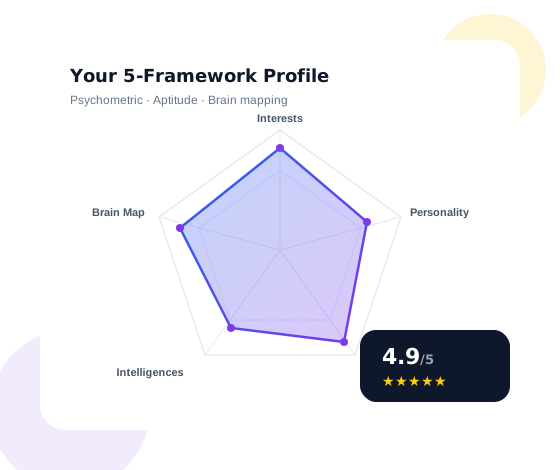
What Is a Career Aptitude Test?
A career aptitude test is a scientifically validated assessment that measures a person's underlying cognitive abilities across specific reasoning types — numerical, verbal, abstract, spatial, mechanical, and clerical — to identify which careers their brain is naturally built to succeed at. Unlike a personality test (which measures who you are) or an interest inventory (which measures what you enjoy), an aptitude test measures what you can potentially do well with training. It's the diagnostic that answers "would my brain thrive at this specific type of work?"
At CCO, the career aptitude test is built on DAT (Differential Aptitude Test) methodology — the same framework used globally for career and educational assessment for over 75 years. Scores are expressed as percentiles against Indian norming samples, interpreted 1:1 by a certified career counsellor, and combined with career mapping so aptitude data translates into specific career recommendations rather than sitting as raw numbers on a report.
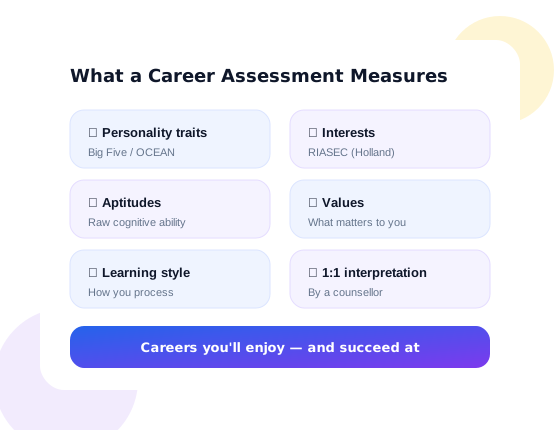
Why Aptitude Matters — The Piece Interests and Personality Can't Give You
Every serious career decision needs three inputs: interests (what you'd enjoy), personality (how you naturally are), and aptitude (what your brain is capable of). Miss any one of them and the career recommendation is incomplete.
Interest without aptitude fails.
A student passionate about engineering but with low spatial and mechanical aptitude will struggle through Class 11 PCM, underperform in JEE, and either drop to a mid-tier college or drop the year. Interest is necessary but not sufficient. Aptitude is what determines whether interest becomes achievement.
Aptitude without interest fails.
A student with strong numerical and abstract reasoning who has no interest in mathematics-heavy work will drift through a Commerce or Engineering degree without engagement. High aptitude in the wrong direction produces boredom, not success.
Personality without aptitude fails.
A high-Conscientiousness student who wants a design career but has weak spatial and abstract reasoning will discipline themselves into a career they can never quite excel at. Effort compensates for aptitude only partially, and it exhausts.
All three together produce clarity.
A student with strong verbal + abstract aptitude + high Investigative interest + high Openness personality → clear signal for Law, Journalism, Research, or Policy careers. A student with strong numerical + spatial aptitude + high Realistic interest + high Conscientiousness → clear signal for Engineering. These triangulations are what make evidence-based career counselling defensible.
Aptitude is what training can develop, not create.
Coaching institutes love to promise "we'll turn any student into an IIT student." That's not what training does. Training amplifies existing aptitude — but it doesn't create aptitude that isn't there. A student with weak numerical reasoning won't reach JEE Advanced through effort alone, no matter how good the coaching is. Aptitude testing tells you the honest ceiling.
The families who take aptitude testing seriously make dramatically better career decisions than those who rely on marks alone.
Aptitude vs IQ vs Intelligence vs School Marks — What's the Difference?
Most Indian parents use "aptitude," "IQ," "intelligence," and "good marks" interchangeably. They shouldn't. Understanding the distinction changes how you interpret every subsequent career decision.
IQ (Intelligence Quotient) — General cognitive capacity
A single number attempting to summarise overall cognitive ability. Historically important in psychology, but limited in career prediction because it treats intelligence as one dimension. Modern career psychology has largely moved away from IQ in favour of multi-dimensional aptitude testing.
Aptitude — Specific reasoning capabilities
Different types of thinking, measured separately. A student can have very high numerical aptitude but only average verbal aptitude — a pattern that points to engineering or data careers, not law or journalism. Aptitude testing reveals patterns that IQ testing hides. This is the single most important thing to understand about aptitude.
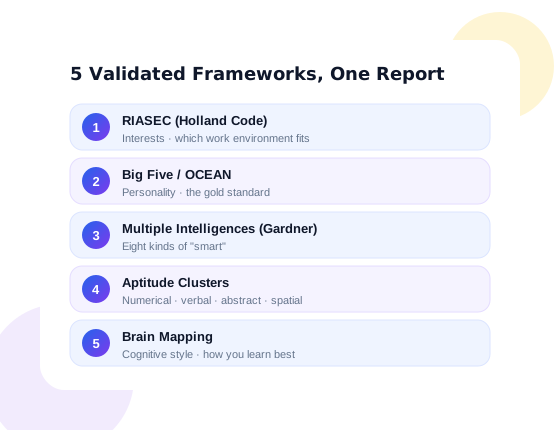
Multiple Intelligences (Gardner framework) — Different kinds of "smart"
Overlaps with aptitude but broader — includes intelligences that aptitude tests don't measure well (musical, kinaesthetic, interpersonal). Complementary to aptitude testing, not a substitute for it.
School Marks — Performance on syllabus
Reflect effort × current syllabus quality × test-taking ability × home support × coaching quality. Marks are a measurement of learned performance — not underlying capability. A student can score 95% in Class 10 Maths through disciplined effort even with moderate mathematical aptitude — which then hits a wall in Class 11 PCM when the difficulty increases beyond what effort can bridge.
Why this matters for career decisions:
A student with excellent Class 10 marks but only moderate aptitude in the required areas will underperform in Class 11–12. Parents who don't understand the distinction assume the child is "not trying hard enough" — when the truth is that the required aptitude ceiling has been reached. Aptitude testing surfaces this before it becomes a problem.
Conversely, a student with average marks but exceptionally strong aptitude in a specific area (say, spatial reasoning) is often being underserved by traditional academic evaluation. Aptitude testing surfaces potential that marks hide.
The 6 Aptitude Types CCO's Career Aptitude Test Measures
Based on DAT (Differential Aptitude Test) methodology, calibrated for Indian norming.
Aptitude Type 1: Numerical Reasoning
Aptitude Type 2: Verbal Reasoning
Aptitude Type 3: Abstract Reasoning
Aptitude Type 4: Spatial Reasoning
Aptitude Type 5: Mechanical Reasoning
Aptitude Type 6: Clerical Speed & Accuracy
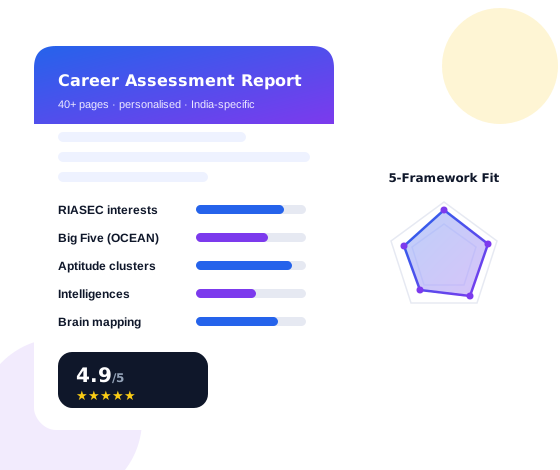
Combined, these six aptitudes create a cognitive strength profile — showing not just overall intelligence but the specific pattern of what your brain does well. Different careers require different patterns. Matching the profile to careers is what career aptitude testing exists to do.
What Different Aptitude Patterns Point To — Career Mapping
Every student's aptitude profile has a shape. Here are common patterns and what they typically indicate.
| Aptitude Pattern | Typical Career Directions |
|---|---|
| High Numerical + Abstract + Spatial | Engineering (any branch), Data Science, Physics, Actuarial |
| High Numerical + Verbal + Abstract | Economics, Consulting, Finance, Research, Law |
| High Verbal + Abstract + moderate others | Law, Journalism, Consulting, Policy, Academia |
| High Spatial + Mechanical + Numerical | Mechanical / Aerospace / Civil Engineering, Architecture |
| High Spatial + moderate Verbal + Abstract | Product Design, UX / UI Design, Architecture, Animation |
| High Verbal + moderate Numerical + high Abstract | Content Strategy, Product Management, Marketing, Consulting |
| High Numerical + Clerical + moderate Abstract | Accounting (CA), Banking, Financial Analysis |
| High Verbal + Social interest + moderate aptitude across | Teaching, Counselling, Human Resources, Communications |
| Balanced across all six | Broad options — the assessment triangulates with personality + interests to narrow |
| High Mechanical + Spatial + low Verbal | Skilled trades, technical / vocational careers, specialised engineering |
These patterns are illustrative — real career recommendations combine aptitude with interests (RIASEC) and personality (Big Five) for full triangulation. But the aptitude profile is the strongest single predictor of career capability.
How CCO's Career Aptitude Test Works — Step by Step
Standard 10–14 day process from booking to interpretation.
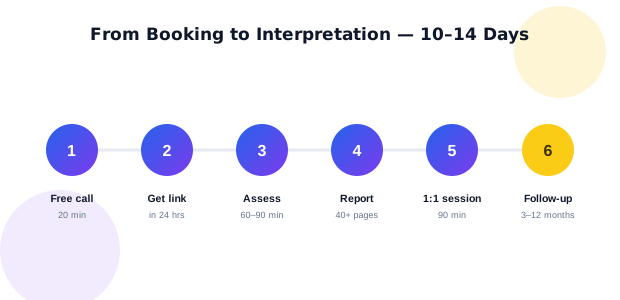
Step 1 — Free 20-Minute Discovery Call
We understand the specific situation: current class, board, top-of-mind career questions, and whether aptitude testing is the right entry point (vs a broader assessment).
Step 2 — Receive Your Test Link
Within 24 hours of your discovery call, you receive a secure link to your personalised career aptitude test. Works on laptop or tablet — a computer with full keyboard is strongly recommended for the timed reasoning sections.
Step 3 — Complete the Test (45–60 minutes)
The six aptitude subsections are administered in sequence, each with timed sections calibrated to measure real cognitive speed and accuracy (not memorised knowledge). Complete in one sitting for best results. No preparation is needed — in fact, preparation distorts results.
Step 4 — Report Generation (Within 48 Hours)
Your personalised aptitude report is generated with percentile-scored results across all six aptitude types, along with the specific cognitive strength profile and career mappings.
Step 5 — 90-Minute 1:1 Interpretation Session With Founder Varun Vohra
This is what turns numbers into decisions. Founder-counsellor walks you through each percentile score, explains what the specific pattern means, and translates aptitude data into 4–6 concrete career recommendations aligned with your profile.
Step 6 — 3–12 Months of Follow-Up Support
Career decisions rarely conclude at the interpretation. Ongoing WhatsApp + email support for course corrections, second thoughts, or new questions as they arise.
What's Inside Your CCO Career Aptitude Report
Section-by-section breakdown.
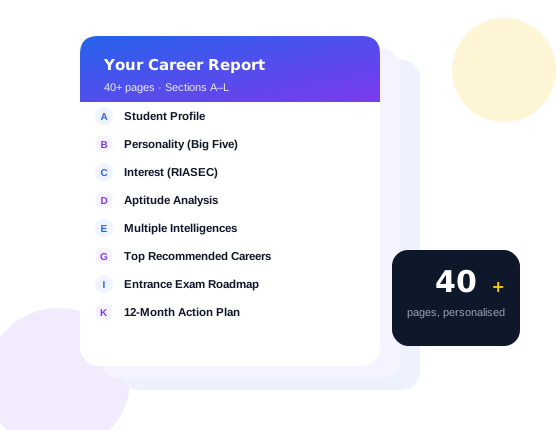
Section A — Executive Summary
One-page summary of your six aptitude scores and top career recommendations.
Section B — Numerical Reasoning Profile
Percentile score + interpretation + specific career implications.
Section C — Verbal Reasoning Profile
Percentile score + interpretation + specific career implications.
Section D — Abstract Reasoning Profile
Percentile score + interpretation + specific career implications.
Section E — Spatial Reasoning Profile
Percentile score + interpretation + specific career implications.
Section F — Mechanical Reasoning Profile
Percentile score + interpretation + specific career implications.
Section G — Clerical Speed & Accuracy Profile
Percentile score + interpretation + specific career implications.
Section H — Your Cognitive Strength Profile
Visual profile showing your specific pattern across all six aptitudes.
Section I — Recommended Careers (Ranked)
6+ careers ranked by aptitude fit, each with reasoning and typical educational pathway.
Section J — Subject / Stream Recommendations
If you're at Class 10 or 12, specific stream and subject combinations that match your profile.
Section K — Entrance Exam Fit Analysis
Which entrance exams (JEE, NEET, CLAT, NIFT, IPMAT, etc.) your aptitude profile is well-suited for.
Section L — Development Recommendations
Which aptitudes have room to strengthen through targeted training, and which are natural strengths to lean into.
Career Aptitude Test vs Personality Test vs Interest Inventory — What's the Difference?
Different tests measure different things. Each has a specific role in career decisions.
| Test Type | What It Measures | Answers the Question | Best For |
|---|---|---|---|
| Career Aptitude Test | Cognitive reasoning abilities | "What am I naturally good at?" | Career-capability match |
| Personality Test (Big Five) | Stable personality traits | "How do I naturally show up?" | Long-term work-fit prediction |
| Interest Inventory (RIASEC) | Career-environment preferences | "What kind of work would I enjoy?" | Career-interest match |
| Multiple Intelligences (Gardner) | Broader kinds of "smart" | "What kinds of intelligence do I have?" | Non-academic strength discovery |
| Full Psychometric Career Assessment | All of the above combined | "What careers should I pursue?" | Full career decisions |
Aptitude test alone answers "capability" — but not "fit."
A student with high numerical aptitude might not want to work with numbers all day. Aptitude tells you what your brain can do; interest tells you what you'd enjoy doing. Both matter.
Personality test alone answers "how you'll work" — but not "what work."
A high-Extraversion student will thrive in customer-facing roles — but which customer-facing role (sales, teaching, therapy, PR) depends on interests and aptitude.
Interest inventory alone answers "what you'd enjoy" — but not "whether you can succeed."
Loving design without spatial aptitude produces frustrated designers.
The combined psychometric career assessment triangulates all three — which is why CCO's Advanced plan includes the full 5-framework combination. Standalone aptitude testing is valuable when the specific question is "what's my child's cognitive capability profile?" — but for full career decisions, combining aptitude with personality and interests produces stronger recommendations.
Are Free Online Career Aptitude Tests Reliable?
Short answer: for casual exploration, sometimes. For real decisions, no.
What most free online aptitude tests actually are:
- 10-20 question quizzes taking 5-10 minutes total
- Non-standardised administration (no timing controls)
- Generic scoring against unclear norming samples
- No India-specific career mapping
- No expert interpretation
Where free tests are useful:
- Casual pre-assessment before committing to a proper test
- Giving your child exposure to what aptitude testing "feels like"
- Sanity-checking whether a proper aptitude test is worth booking
Where free tests fail:
- Producing defensible career recommendations
- Distinguishing between similar career paths that require different aptitude patterns
- Providing percentile scores that mean anything against a real norming population
If you want a taste of the CCO approach without cost, try our free demo assessment →. It's a short version of the CCO methodology — honest about what it can and can't do at that scale. For the actual career decision, take the full paid aptitude test with 1:1 interpretation.
How Much Does a Career Aptitude Test Cost in India?
Aptitude test pricing in India varies from free (unreliable) to ₹20,000+ (premium bundled).
| Option | Price | What You Get |
|---|---|---|
| Free online aptitude quiz | ₹0 | 10-question quiz, generic result |
| Basic online aptitude test | ₹500 – ₹1,500 | Longer test, PDF report, no interpretation |
| School-provided aptitude test | Included in school fees | Group test, minimal interpretation |
| Standalone aptitude test | ₹2,000 – ₹5,000 | Full report, sometimes short counsellor call |
| Premium platforms (Mindler, iDreamCareer) | ₹8,000 – ₹20,000 | Aptitude + other tests + junior-counsellor session |
| CCO | ₹5,000 – ₹7,500 | 6-type DAT-based aptitude test + 40+ page report + founder-led 90-min 1:1 + 3–12 months follow-up |
Aptitude testing bundled with expert interpretation dramatically outperforms cheaper standalone tests. Percentile scores without a counsellor to explain what they mean produce anxiety, not decisions.
5 Common Myths About Career Aptitude Testing — Debunked
Myth 1: "My child scores well in school, so their aptitude is obviously high."
No — this is the most damaging misconception. School marks measure learned performance on syllabus with support from coaching, teachers, and effort. Aptitude measures underlying cognitive capability. The two often diverge — sometimes dramatically. A 95% Class 10 student can have only moderate aptitude in the specific reasoning types their target career requires, which becomes visible only in Class 11 or later when the difficulty increases.
Myth 2: "Aptitude can be improved through practice."
Partially. Aptitude scores can improve modestly with familiarity and reduced test anxiety, especially for younger students. Underlying aptitude patterns are relatively stable from Class 8 onwards. Practice helps at the margins — but doesn't fundamentally reshape the profile.
Myth 3: "IQ tests and aptitude tests are the same."
No. IQ tests produce one general number. Aptitude tests produce a profile across specific reasoning types. IQ testing has largely been superseded by multi-dimensional aptitude testing in modern career psychology because career fit depends on which specific abilities are strong, not on general cognitive capacity alone.
Myth 4: "One aptitude test decides my child's career forever."
No. Aptitude testing is one input in a full career decision — combined with interests, personality, family context, and financial realities. Aptitude testing narrows career options; it doesn't dictate a single answer.
Myth 5: "Low aptitude in a specific area means we should give up on that career."
Not necessarily. Low aptitude in a required area suggests career success will require extraordinary effort — which is sometimes possible for genuinely passionate students. But it also suggests alternative careers where existing strengths align might produce better outcomes. Career counselling helps weigh this honestly rather than reactively.
Get the honest read on aptitude
A scientific 6-type test with a founder-led interpretation that tells you what the data really means.
Talk to an Expert →What Families Say About CCO's Career Aptitude Test
"My daughter was scoring 88% in Class 10 Maths — everyone assumed engineering. The aptitude test showed her numerical reasoning was in the 62nd percentile (average), while her verbal-abstract was in the 91st. Varun's interpretation was clear: she'd struggle with JEE-level maths but could excel in law, journalism, or economics. She's now in Class 11 humanities with economics honours, doing brilliantly. The aptitude test caught what marks were hiding."
"As a working professional considering a career switch to Product Management, I wanted evidence I'd actually be capable — not just interested. The aptitude test showed strong abstract reasoning and moderate numerical, which fit product roles well. Made the pivot with confidence I couldn't have manufactured otherwise."
"The most valuable insight wasn't the high scores — it was seeing that my son's mechanical reasoning was in the 90th percentile despite never having shown interest in machines. That opened up career paths (aerospace, robotics, industrial design) we'd never considered. He's now doing a design foundation year at NID."
Career Aptitude Test — Plans & Pricing
Every other career counselling platform hides pricing behind a form. We don't. Here's exactly what things cost.
Basic
- Psychometric Test
- 2 counselling sessions
- 3 months support
- Personalised career roadmap
- College & university guidance
Pro
- Brain Mapping Test
- 3 counselling sessions
- 6 months support
- Career roadmap
- College/university guidance
- Certifications & internships guidance
- 6 months portal access
Advanced
- Brain Mapping + Psychometric Test
- 4 counselling sessions
- 1 year support
- Career roadmap
- College/university guidance
- Certifications & internships guidance
- 1 year portal access
Every plan includes: complete report · brain-mapping profile · WhatsApp + email support · session recording · zero hidden charges.
Career Aptitude Test — Frequently Asked Questions
Q1. What is a career aptitude test?
A career aptitude test is a scientifically validated assessment that measures cognitive reasoning abilities — numerical, verbal, abstract, spatial, mechanical, and clerical — to identify careers a person is cognitively suited for. CCO's career aptitude test uses DAT (Differential Aptitude Test) methodology with Indian norming.
Q2. How is a career aptitude test different from an IQ test?
An IQ test produces a single general intelligence number. A career aptitude test produces a profile across specific reasoning types — showing which types of thinking a person does well. Career decisions require the profile, not the single number.
Q3. How is a career aptitude test different from a personality test?
A personality test measures how you naturally show up (extraversion, conscientiousness, etc.). An aptitude test measures what your brain is naturally good at (numerical, verbal, spatial, etc.). Both are needed for career decisions — personality tells you how you'll work; aptitude tells you what you can do well.
Q4. Can aptitude improve with practice?
Marginally. Repeated aptitude testing produces small score improvements from familiarity and reduced test anxiety, particularly for younger students. Underlying aptitude patterns — the shape of your cognitive strengths — are relatively stable from Class 8 onwards. Practice doesn't fundamentally reshape the profile.
Q5. How long does the career aptitude test take?
CCO's aptitude test takes 45–60 minutes to complete online. The full process from booking through 1:1 interpretation and roadmap delivery takes 10–14 days.
Q6. Do I need to prepare for the aptitude test?
No. In fact, preparing distorts results. Aptitude tests measure natural reasoning speed and pattern recognition — attempting to "prepare" produces performance data that doesn't reflect underlying capability. Complete the test in a well-rested state with no distractions.
Q7. Is the CCO career aptitude test online?
Yes — 100% online. Best taken on a laptop or tablet with a full keyboard for the reasoning sections. The 1:1 interpretation session happens over video call.
Q8. Can school students take a career aptitude test?
Yes. Age-appropriate versions are available from Class 8 onwards. Below that, aptitude patterns aren't stable enough to produce reliable career recommendations.
Q9. What if my child's aptitude test result contradicts what they want to do?
That's one of the most valuable outcomes. In the interpretation session, we explore why the mismatch exists — sometimes the preferred career is still viable with some adjustments, sometimes the mismatch reveals the preference was actually peer or family pressure. Either outcome produces better decisions than ignoring the data.
Q10. Is CCO's aptitude test scientifically valid?
Yes. Built on DAT (Differential Aptitude Test) methodology — developed by Bennett, Seashore, and Wesman in 1947 and refined over 75 years of research. DAT remains one of the most reliably validated aptitude batteries in career psychology. CCO's version is calibrated with Indian norming samples for accurate percentile scoring.
Q11. How is CCO's career aptitude test different from Mindler, iDreamCareer, or Edumilestones?
Three differences: (1) CCO's test uses DAT-based 6-type methodology — most competitors use fewer types or non-standardised custom tests. (2) Interpretation is always done by the founder-counsellor, not a rotating junior. (3) Transparent pricing published upfront (₹5,000–₹7,500) — competitors typically require an enquiry form.
Q12. How do I book CCO's career aptitude test?
Click Book Free Call above. Share the student's / your current class or profession and top-of-mind career questions. First call is genuinely free — expect a real conversation, not a sales pitch. The aptitude test is bundled with the counselling plan you choose (₹5,000–₹7,500).
Test What Your Brain Is Actually Built For — Not Just What Your Marks Suggest
School marks measure effort and learned performance. Aptitude testing measures underlying cognitive strength. The two often produce different — sometimes opposite — career signals. Ignoring the aptitude data because "marks are good" is one of the most costly career mistakes Indian families make.
The alternative is straightforward. A structured, scientifically validated 45–60 minute test. Percentile scores against Indian norming samples. A founder-led 1:1 interpretation that translates numbers into career recommendations. And a defensible answer to "what is my brain actually built for?"
Free 20-min first call. Transparent pricing. Founder-led interpretation. 3–12 months of follow-up.
Prefer to explore first? Try the Free Demo Assessment → · View Sample Career Report · See Pricing
Related pages: Psychometric Career Assessment · Stream Selection Test · Personality & Interest Test · Career Assessment (Pillar)
Test what your brain is actually built for.
A structured, scientifically validated 45–60 minute test. Percentile scores against Indian norming samples. A founder-led 1:1 interpretation that translates numbers into career recommendations.
Free 20-min first call. Transparent pricing. Founder-led interpretation. 3–12 months of follow-up.