DU Admission Guidance in India — CSAS Portal Strategy, College Shortlisting & Choice-Filling for Delhi University
Delhi University is among the most competitive undergraduate ecosystems in India — 90+ colleges, dozens of courses, complex CSAS portal choice-filling, multi-round counselling, and specialised admissions for St. Stephen's, JMC, and top-tier colleges. CCO's DU admission guidance helps CUET aspirants and their families navigate every step: college shortlisting for your profile, CSAS choice-filling strategy, ECA/sports quotas, and multi-round counselling decisions.
What Is DU Admission Guidance?
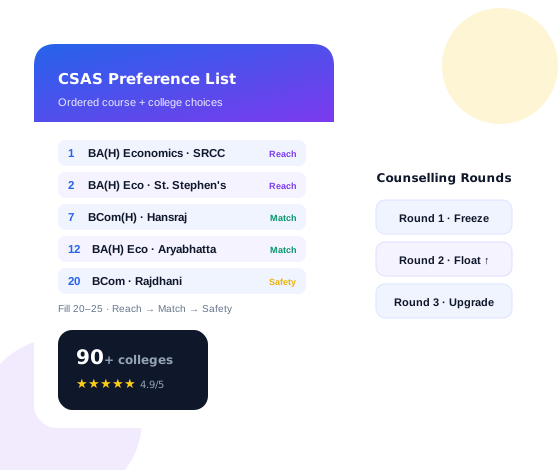
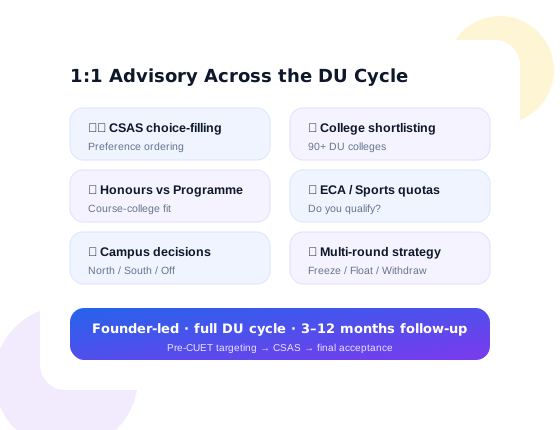
DU admission guidance is structured 1:1 advisory support specifically for students and parents navigating the Delhi University admissions process — the CSAS (Common Seat Allocation System) portal, college-course preference filling, campus decisions, ECA and sports quotas, and multi-round counselling. Unlike general CUET counselling (which covers the entrance exam broadly), DU admission guidance is calibrated to the specific decisions Delhi University creates: which of the 90+ affiliated colleges to prioritise, honours vs programme course decisions, North Campus vs South Campus vs off-campus considerations, and the specialised processes for colleges like St. Stephen's that don't rely solely on CUET.
At CCO, DU admission guidance is delivered end-to-end across the entire DU admissions cycle — from pre-CUET college targeting through CSAS choice-filling and final admission acceptance. Every family gets founder-led sessions, transparent pricing, and 3–12 months of follow-up support.
Why DU Admissions Have Become Genuinely Difficult
Delhi University admissions were straightforward for decades — check the cut-off list, apply to the college for your marks, get admitted. That world is gone. Six factors have transformed DU admissions into one of the most complex decision environments in Indian education.
1. CUET replaced board-based cut-offs in 2022.
Historic DU cut-offs (98.5% for Economics honours at SRCC, for example) no longer directly determine admission. CUET percentiles now do. That's a completely different math with completely different strategic implications.
2. CSAS is a unified portal, not per-college applications.
Every DU aspirant applies through one CSAS (Common Seat Allocation System) portal — filling a single preference list across colleges and courses. That means one strategic decision covers all your DU applications. Get the strategy wrong and no individual college app fixes it.
3. Multiple counselling rounds with upgrade windows.
CSAS runs 3–5 rounds. Every round brings potential upgrades, freeze decisions, and withdrawal choices. Each round has strategic implications for the next. Families making round-by-round decisions on gut feel typically end up at their 3rd- or 4th-preferred college instead of their 1st.
4. 90+ colleges with meaningful quality differences.
Every DU college is nominally the same university — but placements, faculty depth, campus culture, and location vary enormously. SRCC, LSR, Miranda House, Hindu, and St. Stephen's aren't just "top colleges" — they open significantly different downstream doors than mid-tier DU colleges for the same degree.
5. Course-college interaction is complex.
BA (Honours) Economics at SRCC and BA (Honours) Economics at St. Stephen's have different cultures, placement outcomes, and student profiles — despite the same degree. Deciding which combination matters more (course + college) requires actual analysis.
6. ECA, sports, and other quotas add strategic complexity.
Extra Curricular Activities (ECA) quota, sports quota, PwBD (Persons with Benchmark Disability), Kashmiri Migrant, Wards of Employees — each has different application processes and different strategic implications. Many families don't know they qualify for quotas that could dramatically change their admit.
Structured DU admission guidance exists because "check the cut-off list and apply" is a strategy from 2020. It doesn't work anymore.
The 6 Major DU Admission Decisions CCO's Guidance Helps With
Every DU aspirant faces this set of decisions. CCO's counselling addresses whichever ones are most pressing for your situation.
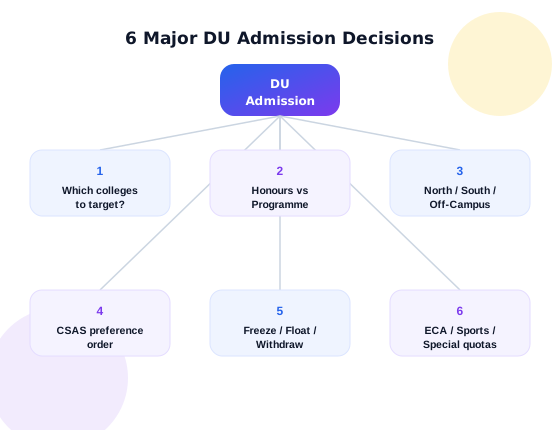
Decision 1: Which DU colleges to target given your CUET percentile?
CUET results narrow the realistic list. From the 90+ affiliated colleges, which 15–25 should you actually target as Reach / Match / Safety choices?
Decision 2: Honours vs Programme course selection.
BA (Honours) Economics at Hindu vs BA Programme at Hindu — very different downstream implications. Some students choose Programme thinking it's "easier"; some choose Honours reflexively. The right answer depends on career direction and academic profile.
Decision 3: North Campus vs South Campus vs Off-Campus.
North Campus (SRCC, Hindu, St. Stephen's, Miranda House, KMC, Hansraj, Ramjas): traditional, competitive, culturally intense. South Campus (LSR, JMC, Venkateswara, Jesus and Mary, Gargi, Kamala Nehru): equally strong colleges, different vibe, geographically distinct. Off-Campus: excellent colleges (DCAC, Aryabhatta, Rajdhani, Aurobindo, Bhaskaracharya) but different accessibility. The right campus depends on location preference, campus culture fit, and specific course strength.
Decision 4: CSAS portal preference order.
The single highest-leverage decision. CSAS gives you the highest preference you qualify for — so preference order determines final admit. Get this wrong and you may end up at your 8th preference instead of your 3rd.
Decision 5: Freeze vs Float vs Withdraw across counselling rounds.
After Round 1, you decide whether to accept and exit (Freeze), accept and stay open to upgrades (Float), or reject and try Round 2 (Withdraw). Each has strategic implications.
Decision 6: Should you apply through ECA / Sports / Special quotas?
Extra Curricular Activities (ECA), Sports, PwBD, Kashmiri Migrant, and other quotas can dramatically change admit outcomes. Many families don't know they qualify.
DU College Shortlisting — The 4-Layer Framework
Building the right list of target DU colleges requires layering four factors. Doing this right is what separates a good admit from a great one.
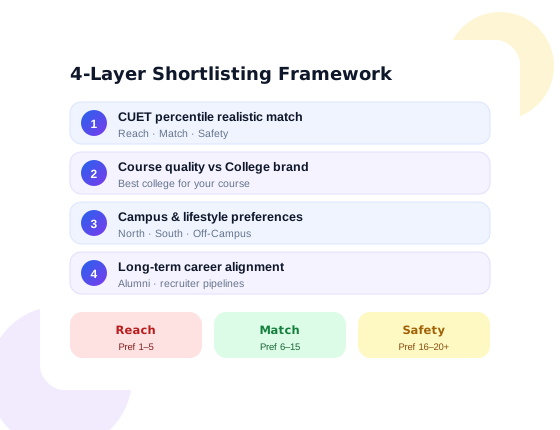
Layer 1: CUET percentile realistic match.
For each college-course combination, look at recent cut-off percentiles. Sort colleges into Reach (above your percentile, aspirational), Match (aligned with your percentile), and Safety (below your percentile).
Layer 2: Course quality vs College brand.
Some DU colleges are legendary overall (SRCC, LSR, Hindu). Others are legendary for specific courses (Miranda House for humanities, BCAS for applied sciences, JMC for economics, IP College for women's professional courses). Sometimes the "less famous" college is stronger for your specific course.
Layer 3: Campus and lifestyle preferences.
- North Campus — Traditional, competitive, close-knit college culture, walking distance between colleges, high political and cultural activity.
- South Campus — More spread out, greener, quieter campus culture at colleges like JMC, LSR, Venkateswara.
- Off-Campus — More diverse in vibe (some highly urban like DCAC, others suburban), often more accessible commute.
Layer 4: Long-term career alignment.
Some DU colleges have stronger alumni networks and recruiter pipelines for specific careers. SRCC dominates finance/consulting recruitment. LSR dominates media/social sector. Miranda House dominates journalism and government service. Hindu spans multiple domains. Course + college + career pipeline should align.
Top 20 DU Colleges Typically in Target Lists:
| College | Campus | Known For |
|---|---|---|
| Shri Ram College of Commerce (SRCC) | North | Commerce, Economics, top placements |
| St. Stephen's | North | Honours across, elite reputation, separate interview |
| Hindu College | North | Balanced excellence across streams |
| Miranda House | North | Women's college, journalism, government service |
| Kirori Mal (KMC) | North | Strong sciences, hindi honours, mixed courses |
| Ramjas College | North | Balanced, strong journalism |
| Hansraj College | North | Strong sciences, commerce, mixed courses |
| Lady Shri Ram College (LSR) | South | Women's college, humanities, journalism, arts |
| Jesus and Mary College (JMC) | South | Women's college, honours courses, arts |
| Sri Venkateswara College (Venky) | South | Strong sciences, humanities, mixed |
| Gargi College | South | Women's college, honours across |
| Kamala Nehru College | South | Women's college, humanities |
| Deshbandhu College | South | Multi-course, commerce |
| Delhi College of Arts and Commerce (DCAC) | Off-Campus | Commerce, media |
| Aryabhatta College | Off-Campus | Strong commerce, sciences |
| Bhaskaracharya College of Applied Sciences (BCAS) | Off-Campus | Applied sciences specialist |
| Aurobindo College | Off-Campus | Commerce, humanities |
| Rajdhani College | Off-Campus | Sciences, commerce |
| Cluster Innovation Centre (CIC) | Off-Campus | Interdisciplinary programs |
| Indraprastha College for Women (IP) | North | Women's college, professional courses |
Your specific list should have 15–25 combinations across Reach / Match / Safety layers. Section 5 explains how to sequence them in CSAS choice-filling.
DU CSAS Portal Choice-Filling — The Strategic Framework
CSAS choice-filling is where most DU aspirants lose good outcomes. Here's the strategy that actually works.
Principle 1: Preferences should reflect your genuine priority ranking, not "what's most likely."
CSAS gives you the highest preference you qualify for. If you accept your #6 preference, you can be upgraded to #4 or #5 in later rounds — but never to #8 or #9. That means preference #1 through #5 should be what you'd genuinely most want to attend.
Principle 2: Course-college combinations, not just colleges.
Preferences are course-college combinations. "BA (H) Economics at SRCC" is one preference. "BCom (H) at SRCC" is a different preference. Both matter separately. Order them based on actual course + college fit for your career direction.
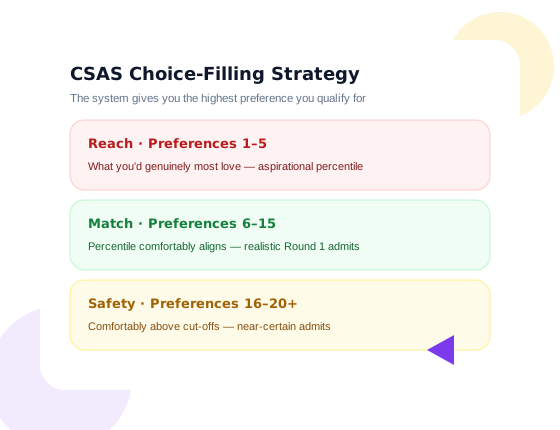
Principle 3: Layer the list Reach → Match → Safety.
- Reach layer (preferences 1–5): Course-college combinations you'd love but where your percentile is at the aspirational end.
- Match layer (preferences 6–15): Course-college combinations where your percentile comfortably aligns with typical cut-offs. Realistic Round 1 admits.
- Safety layer (preferences 16–20+): Course-college combinations where your percentile is comfortably above cut-offs. Near-certain admits.
Principle 4: Fill enough preferences to avoid dropping out of counselling.
A common mistake is filling only 5–8 preferences because "we only want these colleges." If you don't qualify for any of your 5 preferences, you're out — with no admit at all. Fill 20–25 combinations to ensure at least one Safety admit.
Principle 5: The freeze / float / withdraw decision after Round 1 matters as much as the initial preferences.
- Freeze: Accept your current admit and exit. Choose freeze when the current admit is genuinely your target.
- Float: Accept your current admit but stay open to upgrades in subsequent rounds. Choose float when the current admit is acceptable but a higher preference is realistically achievable.
- Withdraw: Reject the current admit and try Round 2. High-risk — only choose withdraw when the current admit is not viable and your percentile makes better admits likely.
Get your CSAS list sequenced right
Book a free call and we'll help you order 20–25 preferences across Reach, Match and Safety — before the portal deadline.
Book Your Free DU Counselling Call →Common mistake: freezing on Round 1 admits without evaluating upgrade potential. Every year, students freeze on their 4th-preference admit when their percentile could realistically upgrade them to their 2nd preference in Round 2. Structured counselling makes this evaluation honest.
ECA, Sports, and Special Quotas — Should You Apply Through Them?
Many DU aspirants qualify for admission through non-CUET quotas but never explore them. This is significant lost opportunity.
Extra Curricular Activities (ECA) Quota
Available for students with achievements in music (Indian classical, vocal, instrumental), dance (classical, folk), theatre, debate, quiz, creative writing, photography, and other creative pursuits. If you have district / state / national level achievements, ECA quota can give you access to colleges you wouldn't reach via CUET alone.
Sports Quota
Available for students with achievements in specific sports at district / state / national levels. Different colleges have different sports specialisations. Sports quota often admits students at colleges 15–20 percentile above their CUET score.
Persons with Benchmark Disability (PwBD) Quota
5% of seats reserved. Requires disability certificate from authorised authority. Applicable across all colleges and courses.
Kashmiri Migrant Quota
Available for students displaced from Kashmir. Requires appropriate certification.
Wards of Employees
Available for children of DU employees. Limited seats.
Foreign National Category
Applicable for non-Indian citizens. Distinct application process.
How to Decide Whether to Apply Through a Quota:
- Do you qualify with legitimate documentation?
- Are your target colleges accepting applications through this specific quota this year?
- Is the quota-based admit better or worse than your realistic CUET-based admit? (Sometimes yes, sometimes no — depends on your percentile).
- Would applying through the quota preclude or complicate your general merit application?
CCO's counselling covers these questions specifically — because many families miss quota opportunities they'd have qualified for.
How CCO's DU Admission Guidance Works — Step by Step
Standard 10–14 day process. During peak DU admission season (May–August), compressible to under a week.
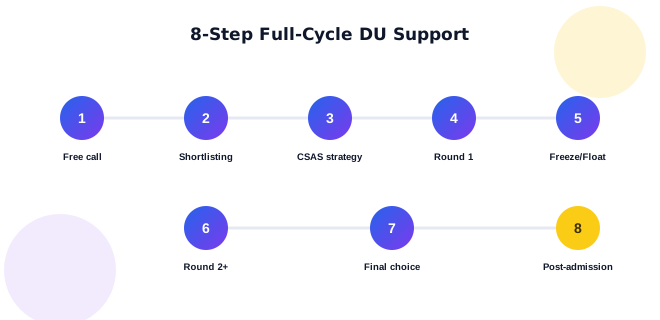
Step 1 — Free 20-Minute Discovery Call
We understand your specific situation: Class 12 board, marks (if available), CUET status, target career direction, and DU preferences.
Step 2 — DU College Shortlisting Session
1:1 session building your Reach / Match / Safety college list based on CUET percentile projections (pre-results) or actuals (post-results).
Step 3 — CSAS Choice-Filling Strategy
Detailed session on preference ordering, safety-net inclusion, and ECA / Sports / Special quota evaluation.
Step 4 — Round 1 Support
Live support through CSAS portal choice filling. Real-time guidance if you're stuck on ordering.
Step 5 — Post Round 1 Session (Freeze / Float / Withdraw)
Once Round 1 results arrive, dedicated session evaluating whether to freeze, float, or withdraw based on your specific admit and realistic upgrade potential.
Step 6 — Round 2 and Subsequent Rounds Support
Ongoing WhatsApp + email support through all subsequent counselling rounds.
Step 7 — Final Choice Session (If Multiple Offers)
When you have multiple admits (DU + other CUET universities + private universities + abroad), a dedicated comparison session.
Step 8 — Post-Admission Support
Even after final admission, follow-up support for orientation, hostel, or switching decisions.
What's Included in CCO's DU Admission Guidance
| Component | Detail |
|---|---|
| Discovery call | Free · 20 min · With founder |
| DU college shortlisting | Reach / Match / Safety framework |
| Course-college fit analysis | Honours vs Programme, specific college strengths |
| ECA / Sports / Quota evaluation | Which quotas fit your profile |
| CSAS choice-filling strategy | Preference ordering and safety layers |
| Live Round 1 support | Real-time WhatsApp guidance |
| Freeze / Float / Withdraw sessions | Round-by-round decisions |
| St. Stephen's / JMC interview prep | Where applicable |
| Multi-offer final decision | When multiple admits arrive |
| Follow-up support | 3–12 months (by plan) |
| Pricing | ₹5,000 – ₹7,500 · Published upfront |
7 Costly DU Admission Mistakes CCO's Guidance Prevents
Mistake 1 — Underfilling CSAS preferences.
Filling only 5–8 preferences because "we only want these colleges" — then not qualifying for any of them and dropping out of counselling entirely. Fill 20–25 combinations.
Mistake 2 — Choosing Honours reflexively over Programme.
Not every student needs Honours. For some careers, a strong Programme degree at a top college outperforms a mid-tier Honours degree. Assess your career direction, not conventional wisdom.
Mistake 3 — Ignoring off-campus colleges.
DCAC, Aryabhatta, BCAS, Rajdhani, Aurobindo — strong colleges often dismissed because they're "off-campus." For many students, an off-campus college is a much better match than a mid-tier North Campus college.
Mistake 4 — Freezing on the first admit.
The comfort of "at least we have something" often costs a better upgrade. Assess whether the Round 1 admit is genuinely your target or just relief.
Mistake 5 — Not applying through eligible quotas.
Many students qualify for ECA, sports, or special quotas but never apply because they don't know the process. This is significant lost opportunity.
Mistake 6 — Applying to St. Stephen's without preparing for the interview.
St. Stephen's admits partly based on interview performance for many courses. Applying and then getting caught unprepared costs the shot.
Mistake 7 — Deciding by college brand alone, not course quality.
The best college for BA (H) Economics is not necessarily the best college for BSc (H) Physics. Evaluate course + college combinations, not colleges alone.
Avoid these — with a strategy
Talk to a founder-counsellor who's guided 1,000+ students through DU admissions. Free 20-minute call, same-day during peak season.
Talk to an Expert →St. Stephen's — The Special Admission Process
St. Stephen's College operates partly outside the standard DU admission process. Here's what's specific.
Application Timeline
St. Stephen's typically opens its own application separately from CSAS, running earlier in the admissions cycle.
Selection Criteria
For most courses at St. Stephen's, admission combines CUET score with interview performance (typically weighted around 85% CUET + 15% interview). This makes the interview significant — different from most other DU colleges.
Interview Preparation Matters
The interview is not a formality. Panels look for critical thinking, articulation, subject depth, and broader intellectual engagement. Coming in unprepared or arrogant costs the admit.
Applicable Courses
Not every course at St. Stephen's uses the interview weighting — check current-year specifics. Historically, Economics, English, Philosophy, and some sciences use the interview process.
Reserved Categories
St. Stephen's follows separate reservation practices for various categories including SC/ST/OBC, Christian minority, and others.
Applying to St. Stephen's?
CCO's guidance covers St. Stephen's specifically, including interview preparation for students applying there.
Book Your Free DU Counselling Call →What DU Families Say About CCO's Admission Guidance
"We shortlisted 22 preferences with Varun's help — including several off-campus colleges I'd been dismissing. My daughter ended up at Aryabhatta for BA (H) Economics after Round 3 upgrades. Three months in, she loves it. Without the guidance, we'd have frozen on a mid-tier North Campus admit in Round 1 and missed this."
"The CSAS choice-filling session was what saved us. We had three top-choice combinations but no idea how to sequence them. Varun explained the upgrade logic clearly. My son got into Hindu College BSc (H) Chemistry — his top preference — in Round 2."
"As someone who cleared the ECA quota through debate achievements, CCO's guidance was crucial. Varun helped me understand which colleges accept ECA applications, how to prepare for the ECA trial, and how to strategise between ECA and CUET admits. I ended up at Miranda House through ECA."
DU Admission Guidance — Frequently Asked Questions
Q1. What is DU admission guidance?
DU admission guidance is 1:1 advisory support specifically for the Delhi University admissions process — including CSAS portal choice-filling, college shortlisting across 90+ affiliated colleges, honours vs programme decisions, ECA and sports quota evaluation, and multi-round counselling strategy.
Q2. When should we start DU admission guidance?
Ideally before CUET (October–February of Class 12) — to plan target colleges and subject alignment. Second-best window: immediately after CUET results (May–June) to plan CSAS choice-filling. During counselling rounds (July–August), CCO can compress support to under a week.
Q3. How is DU admission guidance different from CUET counselling?
CUET counselling covers the exam broadly — subject selection, general choice-filling logic, and comparison across universities. DU admission guidance goes DU-specific — CSAS portal specifics, DU college dynamics, ECA / Sports quotas, St. Stephen's interview process, campus decisions. Most DU aspirants need both, but the depth of DU-specific guidance is what this page provides.
Q4. Which DU colleges are best for BA (H) Economics?
Historically top-tier: SRCC, LSR, St. Stephen's, Hindu, Miranda House, Ramjas, Hansraj. But "best" depends on your CUET percentile realism, campus preference, and specific career direction. CCO's session builds a personalised shortlist rather than relying on generic rankings.
Q5. Should I take Honours or Programme?
Depends on your career direction and academic profile. Honours is more rigorous, opens more academic-track doors, and is expected for competitive higher-studies (MBA at top IIMs, MS abroad). Programme is broader, allows more flexibility, and can be excellent at a top college. Don't choose either reflexively.
Q6. What is CSAS?
CSAS (Common Seat Allocation System) is Delhi University's unified admission portal. Every DU aspirant applies through CSAS by filling an ordered preference list of course-college combinations. The system allocates the highest preference the student qualifies for. Understanding CSAS strategy is central to DU admission success.
Q7. Should I apply through ECA or Sports quota if I qualify?
Usually yes — if it's likely to give you a better admit than your CUET-based option, and if the application process doesn't preclude general merit consideration. Section 6 covers when it makes sense.
Q8. How does the St. Stephen's admission process work?
St. Stephen's has a separate application (earlier than CSAS) and combines CUET with interview weighting (typically ~85% CUET + 15% interview for most courses). Interview preparation is genuinely important — not a formality.
Q9. How many CSAS preferences should I fill?
Ideally 20–25 course-college combinations across Reach / Match / Safety layers. Fewer than 15 risks dropping out of counselling if none of your top preferences match your percentile.
Q10. What's the difference between DU North Campus, South Campus, and Off-Campus?
Location and vibe primarily. North Campus (SRCC, Hindu, St. Stephen's, KMC, Miranda House, Ramjas, Hansraj) — traditional, close-knit college culture. South Campus (LSR, JMC, Venkateswara, Gargi, Kamala Nehru, JMC, Deshbandhu) — greener, quieter, well-known colleges. Off-Campus (DCAC, Aryabhatta, BCAS, Aurobindo, Rajdhani, CIC) — geographically distributed, some excellent for specific courses.
Q11. How is CCO's DU counselling different from Mindler / iDreamCareer / Edumilestones?
Three main differences: (1) CCO is founder-led — every session is with Varun Vohra, who has counselled 1,000+ students through DU admissions specifically. (2) Full DU cycle support (from pre-CUET planning through final acceptance) is included, not sold as separate services. (3) Transparent pricing published upfront (₹5,000–₹7,500) — competitors typically require an enquiry form.
Q12. What if my CUET score is lower than expected?
This is one of our most common counselling situations. Options include Reach / Match / Safety-based DU shortlisting with realistic expectations, other CUET universities beyond DU (JNU, BHU, Jamia, HCU, TISS), private universities with entrance-based admits, or drop-year considerations. Structured counselling evaluates all options.
Q13. How do I book DU admission counselling with CCO?
Click Book Free Call above. Share your Class 12 board, tentative CUET plan or results (if available), and target DU colleges (if you have any). During peak counselling window (July-August), we prioritise same-day or next-day booking.
Navigate DU Admissions With Strategy — Not Just Hope
Every year, DU aspirants and their families make CSAS choice-filling decisions that either open doors to their target college or close them. Underfilled preferences that dropped them from counselling entirely. Freezing on Round 1 admits when Round 2 upgrades were realistic. Missing eligible quota opportunities. Applying to St. Stephen's without preparing for the interview.
The alternative is straightforward. Structured DU admission guidance with a certified counsellor who's guided 1,000+ students through Delhi University admissions specifically. Founder-led. Transparent pricing. Full-cycle support from pre-CUET college targeting through final acceptance and beyond.
Free 20-min first call. Same-day booking during counselling window. Founder-led throughout.
Prefer to explore first? Take the Free Career Assessment → · View Sample Career Report → · See Pricing →
Navigate DU admissions with strategy — not just hope.
Free 20-min call · founder-led · same-day booking in peak season.