Career Counselling for Working Professionals — Right Career Move, With Real Analysis Instead of Hope
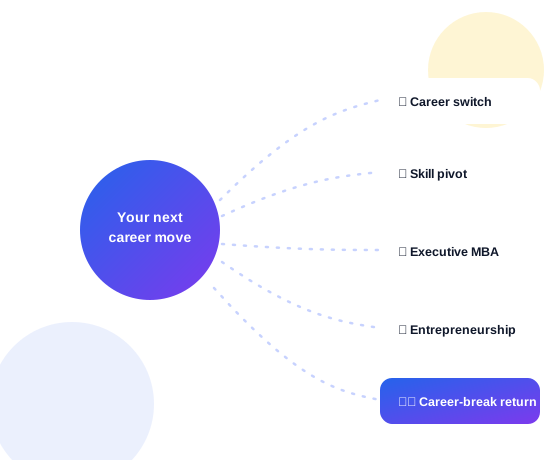
Career switch. Skill pivot. Executive MBA decision. Entrepreneurship exploration. Return after a career break. Whatever's driving your reevaluation, CCO's psychometric-backed 1:1 counselling gives working professionals structured, honest analysis of the next move — with a founder-counsellor who's advised 1,000+ people through this exact decision. Independent. Confidential. Founder-led. Priced at a fraction of typical executive coaching.
What Is Career Counselling for Working Professionals?
Career counselling for working professionals is a structured, adult-focused advisory process that helps professionals with 3+ years of work experience make deliberate career decisions — whether that's a role change, industry switch, complete career pivot, higher-studies decision, entrepreneurship evaluation, or career break return. Unlike career counselling for students (where parents are often involved and the decision is future-oriented), working-professional counselling is fully self-directed and grounded in real career capital, real financial responsibilities, and real time constraints.
At CCO, career counselling for working professionals combines a 5-framework psychometric assessment (calibrated to interpret adult career patterns rather than student-age exploration), a 90-minute founder-led 1:1 session, and a personalised transition roadmap. Every conversation is fully confidential. The output is a clear-eyed answer to "what should my next move be, and what's the honest path to get there?" — with financial realism built in.
Why More Indian Working Professionals Are Seeking Career Counselling Than Ever Before
The Indian job market of 2026 is structurally different from the one most professionals started their careers in. Six shifts are behind the surge in demand.
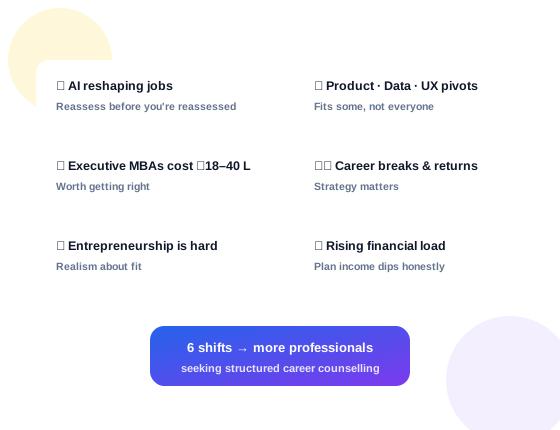
1. AI is changing job architecture faster than resumes.
Roles that seemed secure five years ago are being reshaped — coding, content, marketing operations, customer service, junior analytics. Professionals who don't reassess are being reassessed for them. Counselling helps you get ahead of it deliberately.
2. Product Management, Data Science, and UX have become the "safe pivot" destinations — but not for everyone.
Every second working professional we counsel is exploring one of these three tracks. Some genuinely fit. Many don't. Making the pivot without honest assessment produces the same disillusionment 18 months later — just in a different role.
3. Executive MBAs and mid-career master's programs are expensive.
ISB YLP, IIM Kozhikode Executive MBA, XLRI GMP, IIM Ahmedabad PGPX, Great Lakes PGPM — these run ₹18–40 lakh. Getting the decision right is worth structured analysis. Getting it wrong is a real financial setback.
4. Career breaks are more common — and returning is harder than staying.
Whether from parental leave, health, or a deliberate reset, the return-to-work moment is where structured counselling adds enormous value. Employers evaluate returners differently; strategy matters.
5. Entrepreneurship is legitimately harder than most professionals expect.
"I'll start something on the side" without an honest self-assessment of entrepreneurial fit produces a lot of exhausted professionals with side projects that never scale. Counselling isn't discouragement — it's realism about whether the specific person is likely to succeed at the specific idea.
6. Financial responsibilities have grown alongside career expectations.
The Indian professional in 2026 typically carries a mortgage, a car EMI, parental medical costs, children's education planning, and lifestyle expectations built during 8–15 years of income growth. Career decisions have to factor in transition income drops honestly — not aspirationally.
Structured career counselling for working professionals exists because "I'll figure it out" is a strategy that consistently underperforms the alternative.
Who CCO's Working Professional Counselling Helps
If any of these describe your current situation, this page is for you.
Professionals stuck at a plateau.
You've been at the same level for 2–3 years, promotions are elusive, and the internal moves feel lateral. Not clear whether the problem is you, the company, or the wrong career track.
Professionals experiencing burnout.
Work has become extractive rather than energising. You know something has to change — you're just not sure what.
Professionals in industries facing disruption.
IT services, traditional media, banking operations, print journalism, physical retail — you can see the direction of change and want to move before the change moves you.
Professionals considering a full career switch.
Doctor thinking about hospital administration or MedTech. Engineer moving to Product Management. Marketing executive exploring entrepreneurship. Lawyer considering General Counsel roles. HR professional pivoting to L&D or consulting.
Professionals evaluating higher studies.
Executive MBA. MS abroad. Specialised certifications (PMP, CFA, FRM, Data Science). Government-exam attempt (UPSC, banking) at mid-career. Each is a different bet with different returns.
Professionals returning after a career break.
Parental leave, health-related, deliberate sabbatical, or family relocation. Return strategy matters as much as the return itself.
Professionals eyeing entrepreneurship.
Started thinking about your own venture, freelance consulting, or a side business that could become primary. Wondering whether you'd actually succeed at it.
Professionals just post-layoff or redundancy.
Sudden job loss creates both crisis and opportunity. Structured counselling helps you use the moment rather than get used by it.
The 8 Major Career Decision Scenarios CCO Handles for Working Professionals
Scenario 1: "I'm at a plateau — do I switch companies, roles, or careers entirely?"
Three different problems, three different solutions. Company switch is the simplest — same role at a better employer. Role switch is mid-difficulty — new function at same or new employer. Career switch is hardest but often the highest-return move. CCO helps identify which one you actually need.
Scenario 2: "Should I do an MBA / Executive MBA at this stage?"
Depends entirely on target post-MBA career. ISB / IIM Executive MBA can accelerate consulting, product, and general management careers. It's a poor bet for careers where hands-on skill or founder-track experience matters more. Honest analysis beats "MBA seems like the next step."
Scenario 3: "Should I move to Product Management / Data Science / UX?"
These three destinations account for ~60% of the career switches we counsel. Product Management fits some IT / consulting / marketing professionals brilliantly and others terribly. Data Science favours specific cognitive profiles. UX requires design sensibility that not every analytical professional has. Assessment reveals fit honestly.
Scenario 4: "Am I actually cut out for entrepreneurship?"
The hardest honest question. Entrepreneurship isn't just about "having an idea" — it's about tolerance for ambiguity, decision-making under uncertainty, comfort with financial volatility, and social capital to build teams. CCO's assessment includes entrepreneurial-fit indicators. Some professionals discover they're natural entrepreneurs. Others realise they're better as an early employee at someone else's startup. Both are valuable answers.
Scenario 5: "I'm returning after a career break — how do I plan the comeback?"
Whether the break was 6 months or 6 years, return requires strategy. Which roles are realistic? Which certifications or coursework help? Do you return to the previous field or reset? What negotiation leverage do you have? Structured counselling maps all of this before the first application goes out.
Scenario 6: "My current industry is being disrupted — where should I move?"
IT services professionals moving to product companies. Print journalists moving to digital content strategy. Traditional banking moving to fintech. Retail buyers moving to e-commerce. Every disruption creates specific migration paths — some easier than others.
Scenario 7: "I got laid off — what's my next move?"
The moment matters. First reaction is usually panic (accept any offer). Second reaction is sometimes overcorrection (take too much time). Structured counselling in Week 1 or 2 post-layoff produces materially better next-role outcomes than reactive job hunting.
Scenario 8: "I want to move from corporate to social sector / non-profit / academia."
Values-driven pivots are common and legitimate — but they need income planning, skill translation, and honest expectation-setting. Financial responsibilities don't pause because the values did.
The Most Common Career Pivot Destinations for Indian Professionals in 2026
If you're considering a career switch, here's an honest map of where working professionals are actually going — and which pivots are working.
| Target Career | Best Suited Origin Roles | Typical Transition Timeline | Realistic Salary Trajectory |
|---|---|---|---|
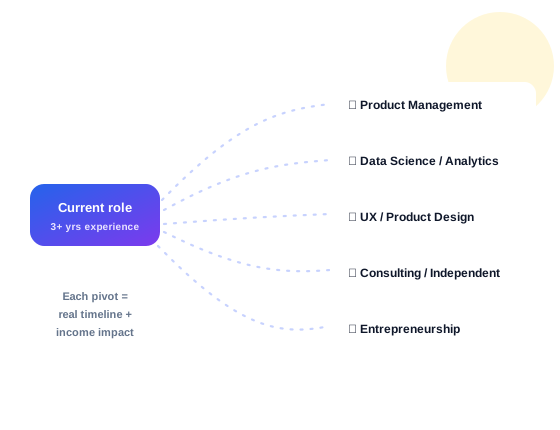
| Product Management | Software engineering, consulting, tech marketing, business analyst | 6–18 months | Similar to origin initially; strong upside 2–4 years |
| Data Science / Analytics | Software engineering, finance analyst, research, actuarial | 9–18 months | Similar or 10–20% dip; strong upside |
| UX / Product Design | Marketing, visual design, communication, tech PM | 12–24 months | 10–30% initial dip; recovers 18 months |
| Consulting (Boutique / Independent) | Corporate strategy, senior functional roles | 6–12 months | Highly variable; depends on network |
| Entrepreneurship | Any role with domain depth + risk tolerance | Immediate to 2 years | Volatile; income planning critical |
| Executive MBA → Consulting / Product | Any mid-senior role | 2-year MBA + placement | Typically 30–60% salary jump post-MBA |
| Digital Marketing / Growth | Traditional marketing, sales, content | 6–12 months | Comparable to origin; strong senior-level upside |
| EdTech / HealthTech / Fintech Product | Corresponding domain expertise + tech interest | 6–12 months | Comparable or slight upside |
| General Counsel / In-House Legal | Law firm associate 5+ years | 12–24 months | Salary comparable; better lifestyle |
| Executive Coaching / L&D | HR business partner, consulting, senior management | 12–36 months | Variable early, strong senior-level |
| Fractional Executive Roles | Senior functional experience (CFO, CMO, CHRO) | 12–24 months | Portfolio-based; can exceed corporate |
| Corporate → Social Sector / Policy | Any corporate role with values alignment | 6–18 months | 30–60% dip; long-term meaningful |
| Government Exam Attempt (UPSC / RBI / SEBI) | Any background | 2–4 years prep | Long-term stable, high status |
Every pivot has a real timeline and a real income implication. The specific pivot that fits you depends on assessment + situation — not on which pivot is "hot."
7 Signs It's Time for Career Counselling as a Working Professional
1. You've been at a plateau for 2+ years.
Not a career signal on its own. But if it's persistent and paired with reduced engagement, it's structural — not situational.
2. You spend more time thinking about "what's next" than doing "what's now."
Universal signal that internal reset is needed. Ignoring it usually escalates into either burnout or accidental resignation.
3. Sunday evening dread is chronic, not occasional.
Occasional Sunday dread is normal. Chronic Sunday dread is data.
4. You're comparing career notes with friends and losing the comparison.
Not necessarily accurate — but the emotional signal is real. Structured counselling replaces emotional comparison with objective self-assessment.
5. Your compensation has plateaued while your peers' hasn't.
Sometimes explained by industry or company. Often explained by career track choice.
6. You keep hearing about a specific career (usually Product, Data, or UX) and wondering if it's for you.
The wondering itself is a signal. Career counselling turns "wondering" into "knowing whether you'd actually fit."
7. A major life change (marriage, parenthood, health, relocation) has shifted your priorities.
Life-stage-driven career reassessment is one of the most legitimate reasons to engage counselling — and one of the easiest to postpone dangerously.
How the Working Professional Career Counselling Process Works
Standard 10–14 day process. Faster if you're in a time-pressured window (post-layoff, imminent decision, pre-deadline for Executive MBA applications).
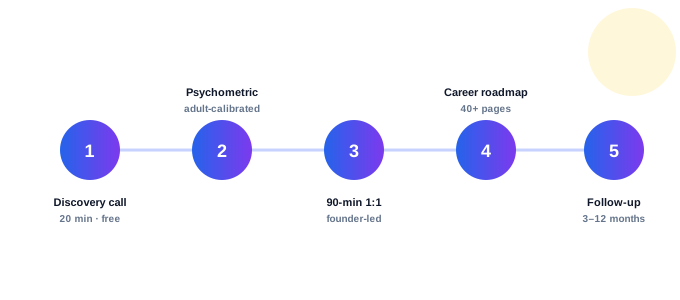
Step 1 — Free 20-Minute Discovery Call
Confidential video call. We understand your specific situation: current role, years of experience, current-role satisfaction, family / financial context, top-of-mind concerns. If there's a specific reason you're researching now (burnout, layoff, plateau, opportunity), we start there.
Step 2 — Adult-Calibrated Psychometric Assessment
60–90 minute online assessment. The five frameworks (RIASEC, Big Five, Multiple Intelligences, aptitude, brain mapping) are interpreted through an adult-career lens — not a student-exploration lens. Focus is on stable strengths, work-value patterns, and career-fit predictors relevant to mid-career decisions.
Step 3 — 90-Minute 1:1 Session With Founder Varun Vohra
Confidential video session. Founder-counsellor with 1,000+ real client sessions of experience — including specific expertise in career transitions from IIFT MBA and corporate strategy background at Wipro / Lanco / MMTC. We evaluate current situation, walk through assessment findings, explore realistic pivot options, and pressure-test the top 2–3 paths.
Step 4 — Personalised Working Professional Career Roadmap
40+ page report covering: current-role recommendation (stay, upgrade internally, exit), pivot analysis (top 2–3 realistic pivots), skill-building path (courses, certifications, side projects), timing (aggressive vs measured), financial planning implications, and 12–24 month transition timeline.
Step 5 — 3–12 Months of Follow-Up Support
Career-transition decisions play out over months, not weeks. Follow-up covers application strategy, interview prep, negotiation guidance, and course-correction if the initial plan needs revision.
What's Included in Working Professional Career Counselling at CCO
| Plan | Basic (₹5,000) | Pro (₹6,500) | Advanced (₹7,500) Most Popular |
|---|---|---|---|
| Adult-Calibrated Psychometric Test | ✓ | — | ✓ |
| Brain Mapping (Cognitive Style + Work Environment Fit) | — | ✓ | ✓ |
| 1:1 Counselling Sessions | 2 | 3 | 4 |
| Current Role Analysis (Stay / Move / Pivot) | ✓ | ✓ | ✓ |
| Career Pivot / Switch Roadmap | ✓ | ✓ | ✓ |
| Higher Studies Path Analysis (MBA / MS / Certifications) | — | ✓ | ✓ |
| Entrepreneurship Fit Analysis | — | ✓ | ✓ |
| Financial Transition Planning Layer | — | ✓ | ✓ |
| Fully Confidential Delivery | ✓ | ✓ | ✓ |
| Follow-Up Support | 3 months | 6 months | 1 year |
All sessions online over video · Fully confidential (we never contact employers or references without explicit request) · Session recordings shared within 24 hours · Weekend and evening slots available
The Four Response Options — And How to Choose Between Them
Every working professional considering a change is actually choosing between four fundamentally different responses. Naming them clearly is often 60% of the analysis.
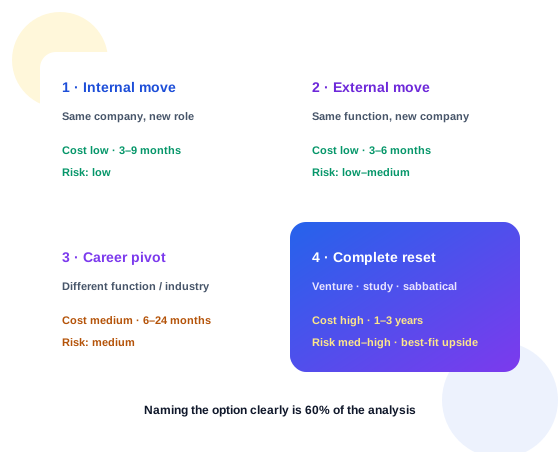
Option 1: Internal Move (Same Company, Different Role)
Best when: The company is strong, the specific role is the problem, and internal politics allow lateral mobility. Cost: Low. Timeline: 3–9 months. Risk: Low.
Option 2: External Move (Same Function, Different Company)
Best when: You like the work but the company / manager / culture is the problem. Cost: Low (interviewing + notice period). Timeline: 3–6 months. Risk: Low–medium.
Option 3: Career Pivot (Different Function or Industry)
Best when: You've realised the fundamental function isn't the right fit — not the company. Cost: Medium (skill-building, possible income dip for 12–18 months). Timeline: 6–24 months. Risk: Medium.
Option 4: Complete Reset (Entrepreneurship, Higher Studies, Sabbatical + Restart)
Best when: Assessment reveals deep misalignment and you have financial runway to bet on a longer transition. Cost: High (income dip or financial outlay). Timeline: 1–3 years. Risk: Medium–high (but the highest-return option when it fits).
Career counselling doesn't push you toward the highest-risk option or the "safest" option. It maps your specific situation to the response that actually fits — with realistic timelines and financial implications.
Financial Planning for a Career Switch — The Realism Layer Most Counselling Skips
Career counselling that ignores financial reality is aspirational, not useful. Here's what an honest transition-planning conversation covers.
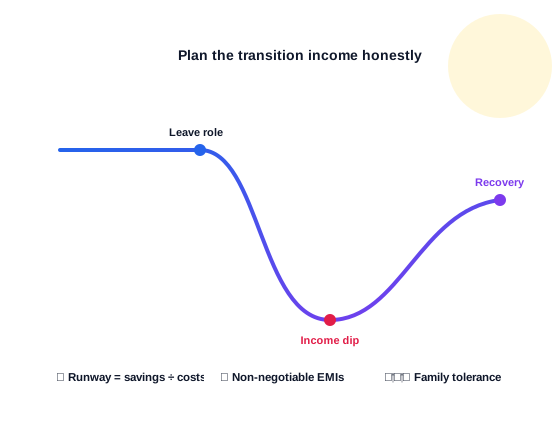
How much runway do you actually have?
Total liquid savings ÷ monthly essential expenses = months of runway. This determines aggressive vs measured pivot timing. Most professionals underestimate their expenses; a real calculation is uncomfortable but essential.
What's the realistic income dip during pivot?
Product Management pivots from tech: often flat or 10–20% dip. Design pivots: 20–40% initial dip. Corporate to social sector: 40–70% dip. Entrepreneurship: variable, often 100% for 6–18 months. Executive MBA: full income loss for 1–2 years + program cost.
What non-negotiable expenses exist?
Home loan EMI. Children's school fees. Parents' medical support. Insurance premiums. These don't pause. Any transition plan has to service them without disruption.
What's your family's tolerance for income variability?
Some spouses / partners are supportive of a 12-month income dip. Others aren't. Some children are old enough to be told; others need the change to be invisible. Family alignment matters more than most professionals admit.
Are there part-time or bridging options?
Fractional consulting during transition. Side project during nights and weekends. Sabbatical-with-return-guarantee from a supportive employer. Parallel skill-building without quitting. Some pivots don't require immediate leap.
CCO's session covers the financial layer honestly — not as advice (we're not financial planners), but as reality-check for the career decision itself.
8 Common Career-Switch Mistakes We See Every Year
Mistake 1 — Announcing intent before having a plan.
Telling your manager, spouse, or LinkedIn network you're "exploring options" before you have a plan invites pressure that pushes bad decisions.
Mistake 2 — Doing an MBA to figure out what you want.
₹18–40 lakh is a lot to spend on self-discovery. Career counselling is much cheaper for the "what do I actually want?" question. MBA makes sense once you know.
Mistake 3 — Waiting for a burnout crisis to trigger the switch.
Reactive career decisions consistently underperform planned ones. Book counselling when things are "meh," not when things are "burning."
Mistake 4 — Pivoting to Product Management because everyone else is.
Product Management is a great fit for specific cognitive and personality profiles. It's a bad fit for others. "It's hot" isn't a plan.
Mistake 5 — Underestimating the transition timeline.
Most career pivots take 12–24 months, not 3. Aggressive timelines produce compressed decisions and often failed pivots.
Mistake 6 — Overestimating your existing capital in the new field.
"I did marketing so I understand consumers" — not the same as being a marketer. "I coded so I understand tech" — not the same as being a Product Manager. Bridging the gap requires structured skill-building.
Mistake 7 — Ignoring the family conversation until it's urgent.
Career transitions affect the entire family. Deferring the family conversation to "after I decide" produces family conflict that decisions could have avoided.
Mistake 8 — Confusing career counselling with career coaching.
Career counselling is decision-support — structured, finite, focused on direction. Career coaching is ongoing accountability, more expensive over time. Different needs. CCO does counselling.
What Working Professionals Say About CCO
"Eight years into an IT services career, plateau clear, thinking about Product Management because everyone else was. Varun's assessment showed my profile actually fit consulting far better — different cognitive strengths, different work-environment preferences. Six months later I'd moved to a boutique consulting firm. Best career decision I've made — and I'd been about to make the wrong one."
"Post-maternity break of 3 years, considering full reset. CCO's session helped me see that returning to my finance career at a fintech was actually the right move — not the career reset I was planning. Fintech gave me the modern work culture I wanted without abandoning my career capital. I'm now in a senior finance role at a Series B fintech, no regrets."
"Doctor by training, 12 years into practice, seriously considering hospital administration + MBA. Varun's honest analysis showed the MBA + admin path was a great fit for my profile. I'm now doing an Executive MBA at IIM Kozhikode alongside clinical practice, planning the transition over the next 3 years. The clarity was worth 10× the cost."
Career Counselling for Working Professionals — Frequently Asked Questions
Q1. Is career counselling different from career coaching?
Yes, meaningfully. Career counselling is a structured, finite, direction-setting process — assessment + expert 1:1 sessions + roadmap. Career coaching is ongoing accountability partnership, typically multi-session over months. CCO does counselling. If you need an ongoing coach after the counselling, we can refer you appropriately.
Q2. How is CCO's working professional counselling different from an executive coach?
Executive coaching typically costs ₹25,000–₹1,00,000+ for multi-session engagements and focuses on leadership skills at senior levels. CCO's career counselling is ₹5,000–₹7,500 for a complete assessment-and-decision-support engagement — much narrower scope, dramatically more accessible pricing. Both have their place; they're not the same product.
Q3. Is everything confidential?
Yes. Fully confidential. We never contact your employer, colleagues, or references without your explicit request. Assessment results are shared only with you. Sessions are private video calls. This matters for the ~40% of working professionals researching career transitions confidentially.
Q4. Should I do an Executive MBA (ISB / IIM / XLRI)?
Depends on target post-MBA career. Executive MBA makes sense for accelerating consulting, product, general management, or geographic pivot careers. It's a poor fit for careers where founder-track experience, hands-on skill, or specific technical depth matters more. CCO's session evaluates fit honestly using your assessment + career direction.
Q5. Can I actually switch careers after 30 / 35 / 40?
Yes — with realistic expectations. Career switches happen successfully across every age. The specific pivot options change (some new-graduate paths close; others open based on experience). The timeline lengthens (12–24 months typical vs 6–12 for younger professionals). Financial planning becomes more critical. All manageable with structure.
Q6. Should I pivot to Product Management / Data Science / UX?
Only if assessment shows genuine fit. All three destinations are popular for good reasons — but not every analytical professional fits Product Management, not every engineer thrives in Data Science, not every visually-inclined person is meant for UX. Structured assessment separates "sounds interesting" from "would actually thrive."
Q7. I just got laid off. Is this the right time for counselling?
Yes — one of the highest-return moments to book. Booked in Week 1–2 post-layoff, career counselling helps you use the moment strategically instead of taking the first available offer out of panic. Same-day booking available for post-layoff situations.
Q8. Should I consider entrepreneurship?
Depends on your specific profile. Some working professionals are natural entrepreneurs waiting to launch; others are natural early-startup-employees who'd struggle as founders. CCO's assessment includes entrepreneurial-fit indicators — cognitive style, risk tolerance, decision-making patterns — that surface whether you'd likely succeed at founding vs joining.
Q9. I'm returning after a career break — do you help with that specifically?
Yes. Return-to-work strategy is one of our most common working-professional situations. Assessment plus session covers: realistic role targets, upskilling needs, employer positioning, interview preparation for the "why the break" conversation, and financial expectations.
Q10. Are sessions available in the evenings or on weekends?
Yes. Weekend and evening slots are specifically kept available for working professionals who can't do daytime calls. Same-day evening booking often possible during the discovery-call phase.
Q11. How is CCO's counselling different from Mindler / iDreamCareer / general career coaches?
Three differences that matter at this stage: (1) Founder-led sessions with a counsellor who's advised 1,000+ working professionals through actual career transitions. (2) Pricing (₹5,000–₹7,500) is dramatically lower than typical adult career coaching (₹25,000–₹75,000+) while including full psychometric assessment. (3) Independent — no revenue-share with executive MBA programs, coaching bootcamps, or certification providers, so recommendations aren't commercially distorted.
Q12. How do I book career counselling as a working professional?
Click Book Free Call above. Share your current role, years of experience, top-of-mind concerns, and preferred timing (evening slots explicitly available). First call is fully confidential and genuinely free.
Stop Drifting. Start Deciding — With Structure.
Most working professionals reach the "something needs to change" moment 3–7 years before they act on it. Those years are almost always spent in reactive career decisions, incremental job hops, and vague upskilling that doesn't compound.
The alternative is straightforward. A structured 10–14 day process. A confidential 1:1 conversation with a founder-counsellor who's guided 1,000+ working professionals through this exact decision. A specific next-move recommendation with realistic timelines and financial planning built in.
Free 20-min first call. Fully confidential. Evening / weekend slots available. Founder-led throughout. ₹5,000–₹7,500 — a fraction of what executive coaching costs.
Prefer to explore first? Take the Free Career Assessment → · View Sample Career Report · See Pricing
Related pages: Career Counselling for Graduates · Career Assessment · Meet Your Counsellor
Stop drifting. Start deciding — with structure.
Free 20-min confidential call · evening & weekend slots · founder-led throughout.