Career Counselling in India — Personalised 1:1 Guidance for Students, Graduates & Professionals
Get the right career, course, and college with structured career counselling from a certified career counsellor. Backed by science, delivered 1:1 over video call, and built around your unique strengths — not generic advice. Boutique. Founder-led. Free first call.
What Is Career Counselling?
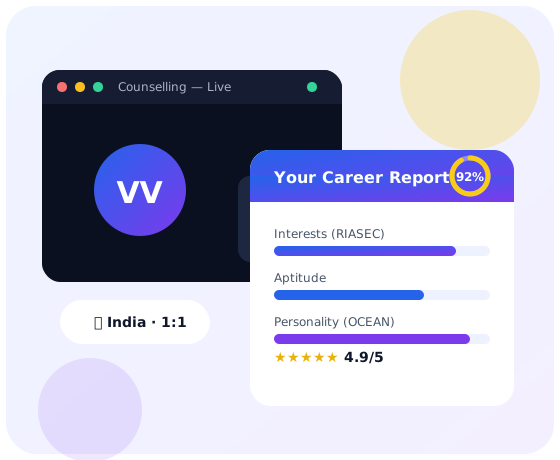
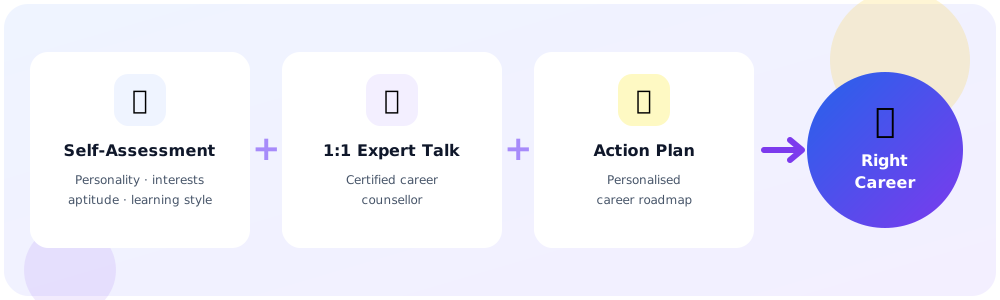
Career counselling is a structured, professional guidance process that helps a student or working individual identify the right career path by combining scientific self-assessment (personality, interests, aptitudes, and learning style) with 1:1 expert conversations and a personalised action plan. Unlike casual advice from family, friends, or seniors, career counselling is evidence-based — it uses globally validated frameworks like RIASEC (Holland Code), the Big Five personality model, and multiple intelligences theory to match a person's natural strengths to careers where they'll actually thrive.
In India, career counselling matters more than ever. The National Education Policy (NEP) 2020, the Common University Entrance Test (CUET), and the explosion of new career paths (data science, product management, UX design, biotechnology, AI research) mean that career decisions parents and students face today look nothing like the ones from 20 years ago. Career counselling bridges that gap.
At CCO, we deliver end-to-end career counselling to families across India — for Class 8 students exploring interests, Class 10 students choosing a stream, Class 12 students picking a course, graduates seeking direction, and working professionals planning a switch.
Why Career Counselling Matters More Than Ever in India
Career counselling used to be a "nice-to-have." In today's India, it's essential. Here's why.
93% of Indian students choose their career without any formal guidance.
Industry surveys consistently show that fewer than 10% of Indian students have access to structured career counselling before making the biggest decision of their academic life. The rest choose based on parental pressure, peer influence, coaching-class marketing, or a subject they happened to score well in.
Career paths have exploded — and outdated.
Twenty years ago, the "safe" list was engineering, medicine, CA, or civil services. Today, there are 500+ viable career paths in India across technology, design, healthcare, media, business, sustainability, sports, psychology, and the creative economy. Most parents and school teachers simply weren't trained in this new landscape.
Wrong career decisions cost lakhs — and years.
A wrong course choice at 18 can mean 4 years of a degree the student doesn't want, ₹5–15 lakh in tuition, and 2–3 more years re-training into a different field. Career counselling done properly at Class 10 or Class 12 costs a small fraction of that — and prevents most of it.
CUET and NEP 2020 have changed the rules.
Stream selection, subject combinations, entrance-exam strategy, and college shortlisting are all interconnected now. A single wrong subject in Class 11 can shut down 6 careers. Career counselling maps those interdependencies before decisions get locked in.
40% of working professionals want to switch careers.
This isn't a student-only problem. Multiple industry reports show that nearly half of Indian professionals under 40 are dissatisfied with their career. Career counselling for working professionals turns "I hate my job" into a structured plan.
7 Signs Your Child (or You) Needs Career Counselling
Not sure whether career counselling is the right step yet? These are the seven most common signals we see in first-call conversations with parents.
1. They can't articulate what they want to do.
"I don't know" or "whatever you say" is not a career plan — it's a signal.
2. Their answer changes every three months.
"Doctor... no, engineer... actually psychology... maybe business" — a shifting compass usually means self-awareness hasn't caught up with the decision.
3. They're choosing based on friends.
"Everyone in my class is taking science" is one of the single worst reasons to pick a stream.
4. They're copying an older sibling.
Different children, different strengths. What worked for one rarely maps to the other.
5. Parents are pushing engineering, medicine, or civil services.
Not because these are wrong careers — they're excellent for the right person — but because pushing without matching strengths is what creates the "40% of professionals want to switch" problem later.
6. Marks are dropping despite effort.
Persistent underperformance in a subject often signals a mismatch between the student's cognitive style and the subject demands. Career counselling identifies it early.
7. You're stuck between two "safe" options and can't decide.
Commerce vs Science. Engineering vs BBA. CA vs Investment Banking. When two options both look reasonable, career counselling is what separates a good decision from a great one.
If any two of these are true, book a free 20-minute counselling call — we'll tell you in that call whether structured career counselling is worth it for your situation.
Career Counselling for Every Stage
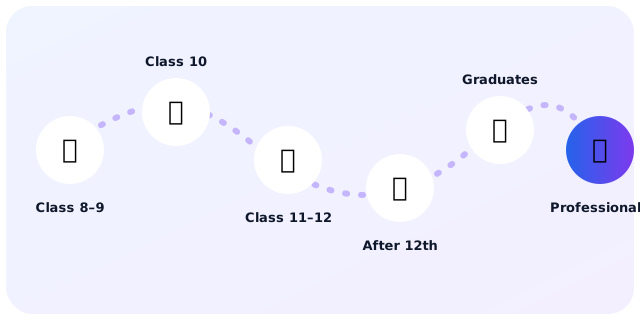
Career counselling isn't one-size-fits-all. The decisions a Class 9 student faces are completely different from the ones a graduate faces. CCO offers stage-specific programs so the guidance matches exactly where you are.
Career Counselling for Class 8–9
The earliest and most powerful window. Students explore strengths and interests before high-stakes decisions arrive. Focus: self-awareness, subject preferences, early exposure to career possibilities.
Learn more: Career Counselling for Class 8–9 →Career Counselling for Class 10
The stream-selection window. Science, Commerce, or Arts (Humanities) — this is the single most consequential academic decision most Indian students make. Focus: aligning stream with natural strengths and long-term career direction.
Learn more: Career Counselling for Class 10 →Career Counselling for Class 11–12
Career-course-college planning. Which entrance exams to prepare for (JEE, NEET, CUET, CLAT, NIFT, NID, IPMAT). Which subjects to prioritise. Which colleges to shortlist. Focus: connecting current subjects to real career destinations.
Learn more: Career Counselling for Class 11–12 →Career Counselling After 12th
Post-boards decision window — often the most anxious. Course choice, college shortlisting, entrance-exam strategy, direct-admission options, and study-abroad decisions all collide at once. Focus: making a specific, actionable plan by admission season.
Learn more: Career Counselling After 12th →Career Counselling for Graduates
"I have a degree — now what?" Whether you're in the final year of college or a year post-graduation and drifting, this program bridges the gap between your degree and a career you actually want.
Learn more: Career Counselling for Graduates →Career Counselling for Working Professionals
Career transition planning. Change roles, change industries, change tracks (corporate to entrepreneurship, tech to product, engineering to policy). Focus: building a realistic 12–24 month transition roadmap.
Learn more: Career Counselling for Working Professionals →The Science Behind Effective Career Counselling
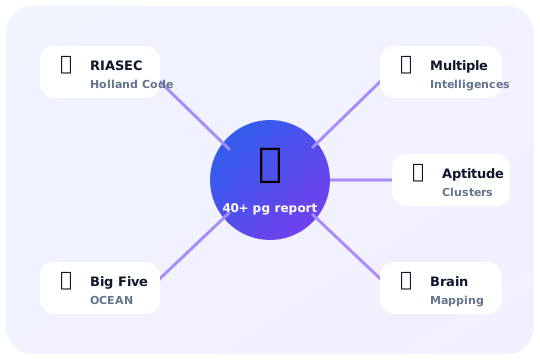
Good career counselling isn't opinion — it's evidence. CCO's career counselling is built on the five most validated frameworks in career psychology, each addressing a different dimension of who you are.
RIASEC / Holland Code — What career environments fit you
Developed by psychologist John Holland and used by career centres worldwide, RIASEC identifies which of six career orientations — Realistic, Investigative, Artistic, Social, Enterprising, or Conventional — matches a person's natural interests. It's the backbone of most modern career counselling.
Big Five (OCEAN) — Your personality architecture
Openness, Conscientiousness, Extraversion, Agreeableness, and Neuroticism. The Big Five is the most scientifically validated personality model in psychology, replacing older tools like MBTI in serious career counselling because it predicts job performance and satisfaction with far more accuracy.
Multiple Intelligences (Gardner) — How you're smart
Howard Gardner's framework maps eight distinct intelligences: linguistic, logical-mathematical, spatial, kinaesthetic, musical, interpersonal, intrapersonal, and naturalistic. A student may score average on school marks but be exceptional in spatial intelligence — which points directly toward careers in design, architecture, or engineering.
Aptitude Clusters — What you're naturally good at
Numerical reasoning, verbal reasoning, abstract reasoning, spatial reasoning, mechanical reasoning, and clerical speed. Aptitude tests measure raw cognitive ability — the ceiling of what a person can do with training — separate from what they enjoy.
Brain Mapping — How your brain prefers to work
Left-brain, right-brain, or whole-brain dominance influences everything from how a student studies to which work environments they'll be productive in. It's a critical layer most Indian career counselling programs skip.
A 40+ page CCO career counselling report
Combined, these five frameworks produce a 40+ page CCO career counselling report that pinpoints not just which careers fit, but why — with specific recommendations for streams, courses, entrance exams, and colleges aligned to Indian pathways.
Our Career Counselling Process — Step by Step
Every family that engages CCO follows the same structured, transparent process. No mystery. No surprise upsells.
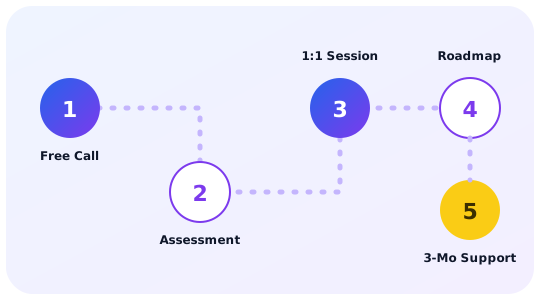
Step 1 — Free 20-Minute Discovery Call
We understand your specific situation. What's the student stuck on? What are the parents worried about? What decisions are looming? By the end of the call, you'll know whether CCO career counselling is right for you — and if we're not the right fit, we'll say so honestly.
Step 2 — Psychometric + Brain-Mapping Assessment
The student takes a 60–90 minute online assessment combining the five frameworks above. It's not an exam — there are no right or wrong answers — so no preparation is needed. The assessment is completed from home, at the student's own pace.
Step 3 — 90-Minute 1:1 Career Counselling Session
A structured video session with founder-counsellor Varun Vohra. We walk through the assessment results, explore 4–6 career possibilities that match, address parent questions, and pressure-test the top options against the student's own instincts.
Step 4 — Personalised Career Roadmap Report
You receive a 40+ page CCO career counselling report covering: recommended careers ranked by fit, subject/stream recommendations, entrance exams to target, college shortlist, timeline, and specific next steps for the next 3, 6, and 12 months.
Step 5 — 3 Months of Follow-Up Career Support
Career decisions rarely end at the session. You get 3 months of WhatsApp + email follow-up for questions as they come up — exam updates, second thoughts, college shortlists, new information. That safety net is what turns a good session into a good decision.
CCO Career Counselling Plans — What You Get
Every plan starts with a free 20-minute discovery call. Once you decide to proceed, you choose the plan that fits — pricing is published upfront, no enquiry form required.
| Feature | Basic (₹5,000) | Pro (₹6,500) | Advanced (₹7,500) Most Popular |
|---|---|---|---|
| Psychometric Test | ✓ | — | ✓ |
| Brain Mapping Test | — | ✓ | ✓ |
| 1:1 Counselling Sessions | 2 | 3 | 4 |
| Personalised Career Roadmap | ✓ | ✓ | ✓ |
| College & University Guidance | ✓ | ✓ | ✓ |
| Certifications & Internships Guidance | — | ✓ | ✓ |
| Student Portal Access | — | 6 months | 1 year |
| Support Period | 3 months | 6 months | 1 year |
All sessions are online over video · Parents welcome to join · Session recordings shared within 24 hours · Free reschedule up to 24 hrs before
The Measurable Benefits of Career Counselling
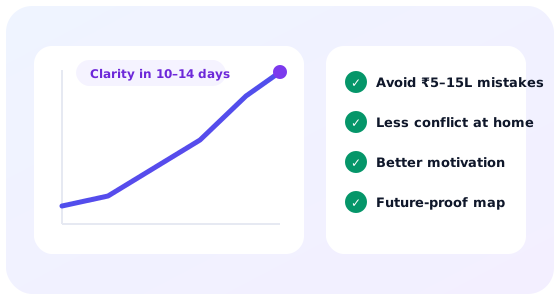
Clarity within two weeks.
Most CCO families report going from "we have no idea" to "we have a specific plan" within 10–14 days of starting.
Prevention of costly wrong decisions.
The cost of a wrong 4-year degree is ₹5–15 lakh in tuition plus 2–3 years of career delay. Structured career counselling costs a small fraction of that.
Reduced parent-child conflict.
When decisions are made based on assessment data rather than opinion, arguments drop dramatically. Parents see the reasoning. Students feel heard.
Better academic motivation.
Students who understand why they're studying a subject — and where it leads — score meaningfully higher than students studying without a target.
A future-proof career map.
Decisions grounded in stable personality traits and aptitudes hold up over time. Trends change. Personality doesn't.
Confidence at admission time.
By the time entrance exam and college application season arrives, CCO families already know their course, their target colleges, their backup options, and their timeline. No last-minute panic.
5 Myths About Career Counselling — Debunked
Myth 1: "Career counselling is only for confused students."
False. The most productive career counselling sessions we do are with students who think they know exactly what they want. Confirming a decision with evidence is just as valuable as making a new one — and it prevents second-guessing later.
Myth 2: "One test will decide my child's future."
No single test decides anything. Good career counselling uses 5+ frameworks, cross-references results, and layers in 90+ minutes of 1:1 conversation. The assessment starts the conversation — it doesn't end it.
Myth 3: "It's just personality quizzes with fancy names."
The frameworks we use (RIASEC, Big Five, Gardner's MI, aptitude testing) are the same ones used by career psychologists globally, backed by decades of peer-reviewed research. They are not personality quizzes.
Myth 4: "Career counselling only helps for engineering or medicine."
Actually, it's most valuable for students considering non-traditional paths — design, psychology, media, entrepreneurship, sports management, biotechnology, sustainability. The traditional paths are relatively well-mapped. The new ones need real guidance.
Myth 5: "One session is enough."
For simple confirmations, sometimes yes. For actual decisions (stream, course, college), no. That's why CCO builds 3 months of follow-up into every plan — the decisions live in the follow-up, not just the session.
How Much Does Career Counselling Cost in India?
Career counselling in India ranges widely — from ₹2,000 for a basic single session to ₹30,000+ for premium multi-session packages. Here's what typical pricing looks like across the market.
| Provider Type | Typical Price Range | What You Usually Get |
|---|---|---|
| Local single-counsellor practice | ₹2,000 – ₹5,000 | Basic assessment + 1 session |
| Online career counselling platforms | ₹8,000 – ₹15,000 | Assessment + junior counsellor session |
| Premium platforms (Mindler, iDreamCareer) | ₹15,000 – ₹30,000 | Multi-session package, often upsold |
| CCO | ₹5,000 – ₹7,500 | Founder-led sessions, 2–4 counselling sessions, psychometric &/or brain-mapping tests, career roadmap, 3–12 months of support |
The reason CCO can offer founder-led career counselling at platform prices is deliberate boutique scale — we take fewer families each month, so we don't need the overhead of a large sales and delivery team.
How to Choose the Right Career Counsellor — A Buyer's Checklist
If you're evaluating CCO against other career counselling options, use this checklist. It's the same one we'd use.
✅ Is the counsellor certified?
Look for career counselling certification (ICCC, NCDA, or equivalent) plus a psychology or business/education background. "Founder" alone isn't a credential.
✅ Is the assessment framework transparent?
Ask which frameworks the assessment uses. Legitimate providers will tell you (RIASEC, Big Five, aptitude, etc.). Vague answers ("proprietary AI-driven algorithm") often mean thin science.
✅ Are the reports personalised or templated?
Ask to see a sample report. If two students would receive nearly identical reports with just the name changed, the counselling isn't personalised.
✅ Is pricing published?
If you have to submit a form and take a sales call just to hear the price, factor that friction into your evaluation.
✅ Is the session with the person you're evaluating?
On many platforms, the founder does the marketing but a rotating team of junior counsellors does the sessions. Ask specifically: "Which counsellor will conduct my child's session?"
✅ Is follow-up included?
A single session, however good, rarely settles a career decision. Ask what follow-up is included, in writing.
✅ Are reviews verifiable?
Look for verifiable reviews on Google Business Profile, not just testimonials on the provider's own site.
Real Career Counselling Outcomes From CCO Families
"We came in convinced our son should take science. His assessment showed strong verbal reasoning, low mechanical aptitude, and an artistic-social RIASEC profile. Varun walked us through why humanities with psychology would actually be a better fit — with career paths we hadn't even considered. Two years later, he's thriving in a BA Psychology honours program."
"As a working professional, I wasn't sure if career counselling was even meant for someone my age. It absolutely is. I moved from a stuck marketing role to a product management track using the exact roadmap Varun laid out."
"The best part wasn't the report — it was that our daughter finally understood herself. She stopped comparing with her cousins and started making her own decisions."

Varun Vohra
Founder-Counsellor, Career Counselling Online (CCO)
Every CCO family works directly with Varun — not an assigned junior counsellor. He personally conducts each 1:1 career counselling session, walking students and parents through their assessment results and building the personalised roadmap.
Career Counselling — Frequently Asked Questions
Q1. What exactly is career counselling?
Career counselling is a professional, structured process where a certified career counsellor helps a student or working individual identify the right career path using validated psychometric assessments, aptitude testing, and 1:1 conversation. It combines science (assessment) with expertise (interpretation) with action (a personalised roadmap).
Q2. What is the right age for career counselling?
The earliest impactful window is Class 8–9 (age 13–15) for early exploration. The most consequential window is Class 10 (stream selection). The next critical window is Class 12 / after 12th (course + college). But career counselling is valuable at any age — including for graduates, working professionals, and mid-career switchers.
Q3. How is career counselling different from just talking to my school counsellor or a family friend?
School counsellors and family friends give opinions based on their experience. Professional career counselling uses standardised, scientifically validated assessments (RIASEC, Big Five, aptitude tests) that measure a student's traits objectively — then interprets those results against the current career landscape. It's the difference between an opinion and an evidence-based recommendation.
Q4. Is career counselling really worth it?
For most students, yes. The cost of a wrong course/career decision is ₹5–15 lakh in tuition plus 2–5 lakh in lost earning years. CCO's career counselling plans start at just ₹5,000 (Basic) with Pro at ₹6,500 and Advanced at ₹7,500 — a small fraction of the cost of a wrong decision, and typically 2–3× cheaper than platforms like Mindler or iDreamCareer.
Q5. What happens in a career counselling session?
A CCO career counselling session is a 90-minute video call where the counsellor walks the family through the psychometric assessment results, explains what the data means, explores 4–6 careers that fit the student's profile, addresses parent questions, and ends with a specific recommended direction. The session is recorded and sent to you within 24 hours.
Q6. Does the student have to take a test?
Yes, but it's not an exam — there are no right or wrong answers and no preparation is needed. The assessment takes 60–90 minutes online, and the student answers honestly based on how they feel and think. That's it.
Q7. Can parents be part of the career counselling session?
Yes — and we strongly encourage it. In our experience, career decisions that involve the parents in the same conversation as the student produce far better long-term outcomes. Parents ask the questions students don't. Students say things they wouldn't otherwise.
Q8. How is CCO different from Mindler, iDreamCareer, Edumilestones, or CareerGuide?
Three differences: (1) CCO career counselling is founder-led — every family works directly with Varun Vohra, not an assigned junior counsellor. (2) Our Advanced plan combines psychometric + brain mapping — most platforms only do psychometric. (3) Our pricing is published upfront (Basic ₹5,000 · Pro ₹6,500 · Advanced ₹7,500) — competitors typically require an enquiry form before disclosing pricing that often runs ₹15,000+.
Q9. What if my child's career interest is very unusual (e.g., esports, standup comedy, sustainability)?
That's actually where career counselling is most valuable. Traditional careers have well-mapped paths. Non-traditional ones need thoughtful planning — market realities, income timelines, backup options, skill-building sequences. We routinely counsel students into paths like UX design, product management, biotechnology, sports psychology, sustainability consulting, and creative careers.
Q10. How long does the whole career counselling process take?
Typically 10–14 days from your first free call to receiving the final roadmap report. During admission season, we can compress this to under a week if needed.
Q11. What happens after the session? Do I get ongoing support?
Yes. Every CCO career counselling plan includes 3 months of follow-up via WhatsApp and email. Use it for exam updates, college shortlisting help, second thoughts, or new questions as they arise. Most families use this follow-up more than the session itself.
Q12. How do I book a career counselling session with CCO?
Click any Book Free Call button on this page. You'll pick a slot, share a few basics about the student, and we'll confirm within 24 hours. The first call is always free — no card, no commitment.
Ready for a Career Decision Made With Evidence, Not Guesswork?
Career decisions get made once and shape decades. Whether you're a parent trying to help your Class 10 child choose a stream, a Class 12 student picking a course, a graduate looking for direction, or a working professional planning a switch — CCO's career counselling gives you the clarity to move forward with confidence.
Free 20-min first call. No sales script. No hidden fees. Just a genuine conversation.
Prefer to explore first? Take the Free Demo Assessment → or See a Sample Career Report →
Career decisions get made once. Make this one with evidence.
Free 20-min call · no sales script · no hidden fees.