Personality & Interest Career Test in India — Big Five + RIASEC With Expert Interpretation
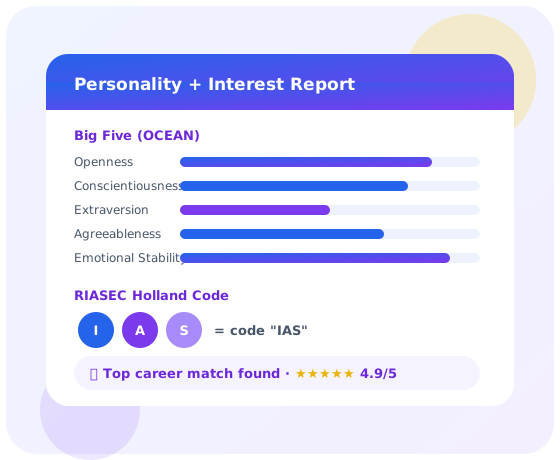
Aptitude tells you what your brain can do. Personality tells you who you naturally are. Interests tell you what you'll enjoy doing every day for years. CCO's personality & interest career test combines the two most validated frameworks in career psychology — Big Five (OCEAN) and RIASEC (Holland Code) — interpreted 1:1 by a certified counsellor to identify careers where your natural traits and genuine preferences will actually make you happy long-term.
What Is a Personality & Interest Career Test?
A personality & interest career test is a scientifically validated assessment that measures the two dimensions most predictive of long-term career satisfaction — the stable personality traits that shape how you naturally show up at work, and the career interests that determine what kind of work you'll find meaningful over decades. Unlike an aptitude test (which measures cognitive capability) or a full psychometric assessment (which combines many frameworks), a focused personality & interest test answers a specific question: "Given who I naturally am and what I naturally enjoy, which careers will genuinely fit me?"
At CCO, the personality & interest career test combines Big Five personality assessment (OCEAN) and the RIASEC (Holland Code) career interest inventory — the two most rigorously validated instruments in modern career psychology. Results are interpreted 1:1 by a certified career counsellor, mapped to specific Indian career pathways, and delivered as a personalised report. The full process takes 45–60 minutes for the test itself, plus a 90-minute interpretation session.
Why Combining Personality + Interests Is More Powerful Than Either Alone
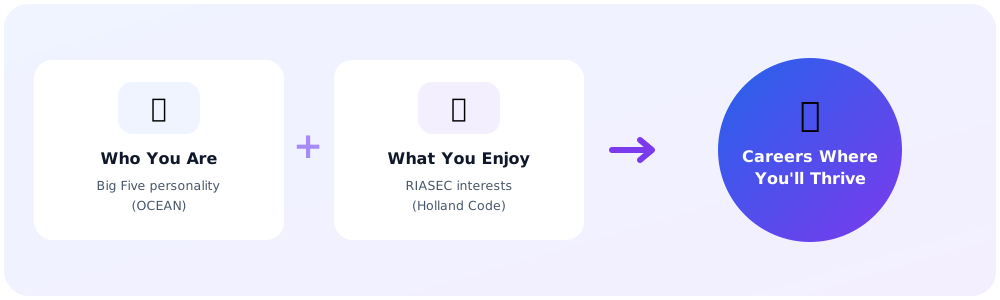
Every serious career decision depends on two questions being answered together. Not either. Both.
"Who am I naturally?"
Personality traits stay stable across decades. A naturally introverted person doesn't turn into an extrovert through willpower. A high-Conscientiousness student doesn't become disorganised just because school is over. These traits shape how you'll experience any career you enter — and predict which environments will drain you vs energise you over the long term.
"What will I enjoy doing every day for the next 40 years?"
Interests aren't just about "what sounds cool right now." Structured interest inventories like RIASEC measure the type of work environment you'll thrive in — practical vs analytical vs creative vs helping vs leadership vs organisation. These preferences are surprisingly stable from around age 14 and predict career satisfaction with remarkable consistency.
Personality without interest = career you can do but won't enjoy.
A high-Conscientiousness, high-Agreeableness student pushed into competitive corporate law will succeed on the technical work but often burn out from the environment mismatch. Personality fit doesn't guarantee interest fit.
Interest without personality = career you'd enjoy but can't sustain.
A student with strong Artistic RIASEC interest but low Openness personality will love the idea of a creative career but struggle with the actual daily uncertainty and ambiguity design work requires. Interest fit doesn't guarantee personality fit.
Combined = careers where you'll thrive.
A student showing high Conscientiousness + high Openness + strong Investigative-Artistic RIASEC → clear fit for research, architecture, or medical specialisation with a research focus. That triangulation is what makes personality + interest testing genuinely useful for career decisions rather than academically interesting.
The Big Five (OCEAN) Personality Framework — What It Actually Reveals About Career Fit
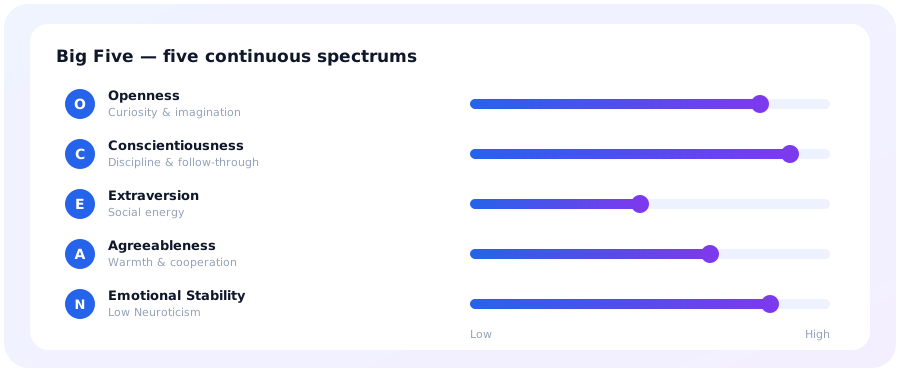
The Big Five is the personality model used by serious career psychology worldwide. Five dimensions, each a continuous spectrum, together painting a nuanced picture of how a person naturally operates.
Openness to Experience
What it measures: Curiosity, imagination, willingness to explore new ideas, tolerance for ambiguity.
High Openness careers: Research, academia, design, entrepreneurship, product management, creative careers, innovation-focused roles, strategy consulting.
Low Openness careers: Accounting, operations, compliance, structured technical roles, government service, disciplined execution roles.
Conscientiousness
What it measures: Discipline, organisation, follow-through, attention to detail, reliability.
High Conscientiousness careers: Medicine, chartered accountancy, engineering, law, project management, quality assurance, financial services, defence.
Low Conscientiousness careers: Creative freelance work, sales, entrepreneurship, artistic pursuits (where structure comes from external deadlines, not internal discipline).
Extraversion
What it measures: Social energy, assertiveness, comfort with public engagement, preference for external stimulation.
High Extraversion careers: Sales, marketing, teaching, public relations, hospitality, HR, corporate leadership, journalism, live media, event management.
Low Extraversion (Introversion) careers: Software engineering, research, writing, data analysis, laboratory science, surgery (heavy solo focus), academic careers, forensic analysis.
Agreeableness
What it measures: Cooperation, warmth, willingness to prioritise others' needs, conflict avoidance vs directness.
High Agreeableness careers: Teaching, counselling, healthcare, human resources, social work, therapy, community-facing roles.
Low Agreeableness careers: Litigation, corporate strategy, competitive sales, journalism (investigative), management consulting, entrepreneurship.
Neuroticism (Emotional Stability)
What it measures: Emotional volatility, stress response, tolerance for high-pressure environments. Lower Neuroticism = more emotionally stable.
Low Neuroticism careers: Emergency medicine, aviation, defence, high-stakes negotiation, entrepreneurship, senior corporate leadership.
Higher Neuroticism careers: Structured environments with predictable rhythms, roles with strong support systems, careers requiring emotional depth (therapy, arts, writing).
The value of Big Five is nuance.
A student who is high Openness + high Conscientiousness + high Extraversion + moderate Agreeableness + low Neuroticism is a completely different career fit from a student with the same Openness but different other traits. Career recommendations flow from the specific combination, not from single-trait scoring.
The RIASEC (Holland Code) Career Interest Framework — What Each Orientation Points To
Developed by psychologist John Holland in 1959 and refined over 65+ years of career research. Six orientations, most people are a mix of 2–3.
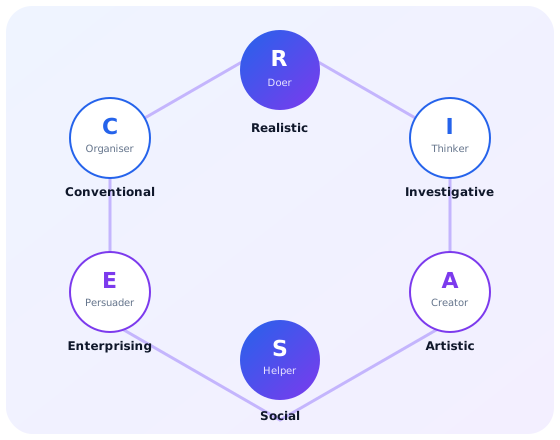
Realistic (R) — The "Doer"
Interested in: Hands-on work, physical activity, mechanical tasks, direct results, working with objects and tools.
Careers: Engineering (mechanical, civil, aerospace), architecture, agriculture, defence, aviation, sports careers, skilled trades, veterinary sciences, technical roles.
Investigative (I) — The "Thinker"
Interested in: Analysis, research, problem-solving, understanding how things work, working with ideas.
Careers: Research (any field), medicine, data science, software engineering, academia, pure sciences, forensic science, actuarial, technical writing.
Artistic (A) — The "Creator"
Interested in: Self-expression, aesthetics, originality, unstructured work, working with imagination.
Careers: Design (product, UX, fashion, graphic), architecture (creative side), fine arts, music, writing, journalism, film, advertising creative, culinary arts.
Social (S) — The "Helper"
Interested in: Working with people, teaching, helping, understanding human dynamics, community focus.
Careers: Teaching, counselling, therapy, healthcare (patient-facing), human resources, non-profit work, social work, coaching, hospitality management.
Enterprising (E) — The "Persuader"
Interested in: Leading, influencing, competing, business outcomes, taking initiative.
Careers: Sales, marketing, entrepreneurship, corporate leadership, law (litigation), politics, business development, real estate, finance (client-facing), management consulting.
Conventional (C) — The "Organiser"
Interested in: Structure, order, working with data, following systems, precision.
Careers: Accounting (CA), banking operations, financial analysis, compliance, administration, actuarial (structured side), auditing, taxation, project coordination.
Most people are a "3-code Holland profile" — three dominant orientations expressed as letters like "IAS" (Investigative-Artistic-Social) or "ESC" (Enterprising-Social-Conventional). Each 3-code combination maps to specific career clusters.
RIASEC is used by the US Department of Labor's O*NET system, career centres at leading universities globally, and every serious career psychology practice — because it's the most predictively validated career interest framework in the field.
MBTI vs Big Five — Why CCO Uses Big Five, Not MBTI
MBTI (Myers-Briggs Type Indicator) is easily the most well-known personality test in the world. It's fun, memorable, and gives you a 4-letter type that feels satisfying. It's also not what serious career psychology uses anymore. Here's why.
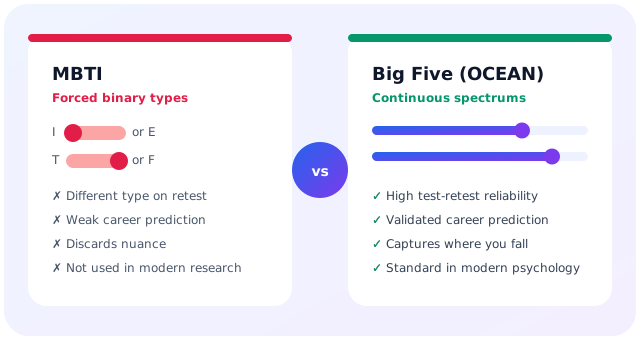
MBTI Problem 1: Binary categorisation of continuous traits.
MBTI forces you into either Introvert or Extravert, Thinking or Feeling. But real personality is a spectrum — most people fall somewhere in the middle. Forcing someone into a binary category discards nuance and produces recommendations that don't match reality.
MBTI Problem 2: Test-retest unreliability.
Multiple peer-reviewed studies show that a significant proportion of people receive different MBTI types on retest just weeks apart. If a personality assessment gives you different answers on Tuesday and Thursday, its career recommendations can't be trusted for decade-long decisions.
MBTI Problem 3: Weak career prediction.
Meta-analyses show MBTI is poorly correlated with actual career performance and satisfaction outcomes. Big Five, by contrast, has decades of research showing meaningful predictive validity for job performance and career satisfaction.
MBTI Problem 4: Roots in less rigorous psychology.
MBTI was developed by Katharine Cook Briggs and Isabel Briggs Myers in the 1940s — neither of whom had formal training in psychology. Big Five emerged from decades of factor-analytic research by trained psychologists (Costa, McCrae, and many others) applying rigorous statistical methods to personality measurement.
Big Five's advantages:
- Continuous dimensions capturing where you actually fall (not forced binary)
- High test-retest reliability (Cronbach's alpha values above 0.85 for well-designed instruments)
- Meaningful career prediction validated across hundreds of studies
- Standard in modern psychology — used by APA, BPS, and serious career research globally
Does this mean MBTI is useless? For casual self-reflection, no. Many people find MBTI-style categorisation genuinely useful for thinking about themselves. But for career decisions with 40-year consequences, using an instrument with known reliability and validity issues is a mistake.
CCO uses Big Five for exactly these reasons — the same reasons serious career counselling worldwide has shifted away from MBTI.
How CCO's Personality & Interest Career Test Works — Step by Step
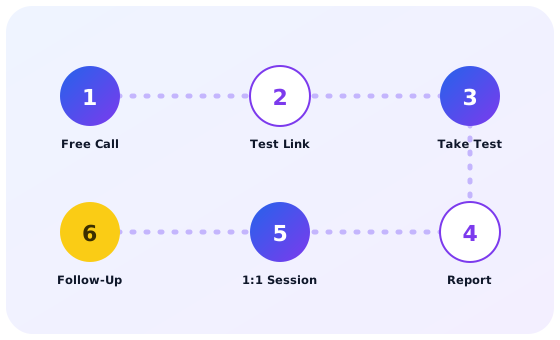
Step 1 — Free 20-Minute Discovery Call
We understand your specific situation, career questions, and confirm whether the personality + interest test is the right entry point (or whether a full psychometric assessment fits better).
Step 2 — Receive Your Test Link
Within 24 hours of your discovery call, you receive a secure link to your personalised personality + interest test.
Step 3 — Complete the Test (45–60 minutes)
The Big Five personality inventory and RIASEC career interest inventory are administered in sequence. Complete at your own pace. No preparation needed — no "right answers." Answer honestly based on what feels natural, not what "sounds better."
Step 4 — Report Generation (Within 48 Hours)
Your personalised report is generated: full Big Five personality profile with percentile scoring, complete RIASEC career interest orientation (with 3-letter Holland code), and combined career recommendations.
Step 5 — 90-Minute 1:1 Interpretation Session With Founder Varun Vohra
Video session that translates test data into decisions. We walk through personality dimensions, RIASEC code interpretation, and specific career recommendations aligned to Indian career pathways.
Step 6 — 3–12 Months of Follow-Up Support
WhatsApp + email support for course corrections, second thoughts, and new questions as they arise.
What's Inside Your CCO Personality & Interest Career Report
Section A — Executive Summary
One-page summary of your personality profile, RIASEC code, and top career recommendations.
Section B — Big Five Personality Profile
Detailed percentile scores across Openness, Conscientiousness, Extraversion, Agreeableness, Neuroticism — with plain-language interpretation.
Section C — Personality-Based Career Environments
Which work environments and cultures your specific personality profile will thrive in vs struggle with.
Section D — RIASEC Career Interest Orientation
Full 3-letter Holland code (e.g., "IAS" or "ESC") with detailed interpretation of what each dominant orientation reveals.
Section E — RIASEC-Based Career Directions
Specific careers, roles, and industries that match your top-3 RIASEC orientations.
Section F — Combined Career Recommendations
6+ careers ranked by combined personality + interest fit, each with reasoning.
Section G — Career Environments to Avoid
Specific work environments and cultures that will likely produce dissatisfaction or burnout given your profile.
Section H — Long-Term Career Trajectory Guidance
How your personality + interest profile suggests you should structure career choices over time.
Section I — Development Suggestions
Which personality dimensions (if any) benefit from conscious development, and how.
Section J — Follow-Up Resources
Recommended readings and self-exploration tools.
Personality & Interest Test vs Career Aptitude Test vs Full Psychometric Assessment
Different tests answer different questions. Here's how to know which one fits your situation.
| Test Type | Answers | Best For |
|---|---|---|
| Personality & Interest Career Test | "Who am I, and what will I enjoy?" | Self-understanding, early exploration, working professionals reassessing fit |
| Career Aptitude Test | "What is my brain naturally good at?" | Testing cognitive capability for specific careers (engineering, medicine, design, etc.) |
| Stream Selection Test | "Which Class 11 stream fits me?" | Class 10 students facing the stream decision |
| Full Psychometric Career Assessment | "Which specific careers should I pursue?" | Real career decisions requiring the full picture |
When personality + interest is the right entry point:
- Working professionals evaluating whether their current career fits who they naturally are
- Class 8-9 students beginning career exploration (personality is measurably stable at this age; aptitude is still developing)
- Graduates deciding between multiple career paths where the differentiator is fit, not capability
- Anyone whose primary career question is "will I enjoy this long-term?"
When aptitude testing is a better entry point:
- Students choosing between capability-intensive careers (engineering, medicine, law)
- Career switchers questioning whether they have the cognitive strength for a target role
- Parents concerned about a mismatch between marks and target career
When the full psychometric assessment makes sense:
- Real career decisions with multi-year consequences
- Situations where combining all frameworks produces stronger recommendations than any single one alone
- Advanced-plan buyers who want the fullest possible picture
CCO's plans include the personality & interest test as part of the psychometric package (Advanced tier). For focused personality-first exploration, the Basic or Pro plans work well.
Are Free Online Personality Tests Reliable?
Short answer: some free tests are reasonably valid; most aren't. Almost none include the expert interpretation that turns personality data into career decisions.
Reasonably valid free options:
- 16Personalities.com — Based on Big Five with MBTI-style presentation. Widely used and reasonably reliable for self-reflection.
- Truity's Holland Code Career Test — Based on RIASEC. Reputable career psychology publisher.
- Big Five Inventory (BFI) hosted on various academic sites — the actual scientific Big Five, minus expert interpretation.
Where free tests fail:
- No India-specific career mapping (US-frameworks aren't translated to Indian career realities)
- No 1:1 interpretation to translate data into decisions
- No combined Big Five + RIASEC triangulation
- No India-adapted percentile scoring
- No follow-up support
When to use free tests:
- Getting a rough personality direction before committing to paid testing
- Sanity-checking whether a full assessment is worth booking
- Casual self-exploration and reflection
When to use CCO's paid personality + interest test:
- Making a real career decision
- Needing evidence-based recommendations that hold up to family or spousal scrutiny
- Wanting the results contextualised to Indian career pathways specifically
If you want a taste of the CCO methodology, try our free demo assessment → — honest about what a free tool can and can't do.
How Much Does a Personality & Interest Career Test Cost in India?
| Option | Price | What You Get |
|---|---|---|
| Free online personality test | ₹0 | Test only, no interpretation |
| Basic online personality test | ₹500 – ₹1,500 | PDF report, no expert session |
| School-provided personality test | Included in fees | Group testing, brief interpretation |
| Standalone personality + interest assessment | ₹2,000 – ₹5,000 | Full report, sometimes short counsellor call |
| Premium platforms (Mindler, iDreamCareer) | ₹8,000 – ₹18,000 | Full test bundle + junior-counsellor session |
| CCO | ₹5,000 – ₹7,500 | Big Five + RIASEC assessment + 40+ page report + founder-led 90-min 1:1 + 3–12 months follow-up |
Personality data without expert interpretation produces anxiety, not decisions. CCO's pricing bundles the test with 1:1 interpretation because interpretation is where 60% of the value lives.
5 Common Myths About Personality Career Testing — Debunked
Myth 1: "MBTI and other free personality tests give the same answer."
No. MBTI has known reliability issues (retest disagreement) and validity issues (weak career prediction). Free lifestyle-website "personality" tests have no validation at all. Big Five (which CCO uses) has decades of peer-reviewed validation. The results and career recommendations differ meaningfully.
Myth 2: "My personality will change as I grow up, so testing at 15 is pointless."
Actually, Big Five personality traits become meaningfully stable from around age 12–13 and are essentially fixed by early 20s. The exact scores may shift modestly over time, but the overall profile is remarkably stable. That stability is what makes personality-based career recommendations reliable for decade-long decisions.
Myth 3: "Introverts can't succeed in customer-facing careers."
Wrong framing. High Introversion (low Extraversion) doesn't disqualify anyone from customer roles — it just changes which specific customer roles fit. Introverts often excel in advisory client relationships, professional services, and consultative sales that reward depth over volume. Personality testing doesn't rule out careers; it identifies which specific versions of those careers work best.
Myth 4: "The test will tell my child what career they must pursue."
No credible personality test does this. A good personality + interest test narrows the field — usually to 6–12 careers that align with the profile. The final choice is still yours, informed by family context, financial realities, and personal preference.
Myth 5: "One test result decides everything."
Personality + interest testing is one input in career decisions. The interpretation session, combined with your own reflection and family conversation, is what produces good decisions. The test itself starts the conversation; it doesn't end it.
What Families & Professionals Say About CCO's Personality & Interest Career Test
"The Big Five profile revealed my daughter had unusually high Openness combined with moderate Extraversion — a pattern that pointed toward research careers with a public-facing dimension. Traditional advice would have pushed her into pure lab science; the assessment showed science journalism, science communication, or academic teaching would fit far better. She's now in a specialised science journalism track and thriving."
"I've done MBTI three times over 10 years and got three different types. When I took CCO's Big Five test, the results actually made sense — high Conscientiousness, high Openness, moderate Introversion, and low Neuroticism. That specific profile is why product management fits me and why I burned out in sales, even though sales offered better money."
"The RIASEC code was the surprise. I expected 'A' (Artistic) to dominate since I'd always thought of myself as creative. It was actually 'S' (Social) that scored highest, then 'A' second. The interpretation session helped me see why teaching or therapy fit my profile better than pure design work — even though I'd been forcing myself into design roles for years."
Personality & Interest Career Test — Frequently Asked Questions
Q1. What is a personality & interest career test?
A personality & interest career test combines two scientifically validated frameworks — Big Five personality assessment (OCEAN) and RIASEC career interest inventory (Holland Code) — to identify careers matching who a person naturally is and what they naturally enjoy. CCO's version is interpreted 1:1 by a certified career counsellor with India-specific career mapping.
Q2. Is MBTI a good career test?
For casual self-reflection, it's fine. For real career decisions, no. MBTI has well-documented reliability issues (people often get different types on retest) and weak career-prediction validity. Big Five, which CCO uses, is the modern career psychology standard for exactly these reasons. Section 5 above covers this in detail.
Q3. How is a personality test different from an aptitude test?
A personality test measures who you naturally are — how you show up, what environments you'll thrive in. An aptitude test measures what your brain can do — specific cognitive reasoning abilities. Both are needed for career decisions. Personality tells you how you'll work; aptitude tells you what work you can excel at.
Q4. Are Big Five results stable over time?
Yes — this is a key strength of the Big Five framework. Traits become meaningfully stable from around age 12–13 and remain highly stable across adulthood. Modest score shifts happen over a decade but overall profile stability is high. That stability is what makes Big Five reliable for decade-long career decisions.
Q5. What is RIASEC / Holland Code?
RIASEC is a career interest framework developed by John Holland in 1959 — the most researched career interest model in psychology. It places you on six dimensions (Realistic, Investigative, Artistic, Social, Enterprising, Conventional) and produces a 3-letter code representing your dominant orientations. Used globally by career centres and the US Department of Labor's O*NET system.
Q6. Can working professionals take the personality career test?
Yes — often especially valuable at mid-career. Working professionals reassessing career fit or considering a switch benefit from understanding whether their current career actually matches their stable personality and interests. Assessment at 30 or 35 typically reveals patterns that were less clear at 20.
Q7. Do personality traits determine career success?
Personality shapes career fit more than success. Someone with the "wrong" personality profile can still succeed at a career through effort and skill-building — but they typically report lower satisfaction and higher burnout than someone whose profile naturally aligns. The test is about long-term fit, not raw capability.
Q8. How long does the personality & interest test take?
The test itself takes 45–60 minutes online. Full process from booking through 1:1 interpretation and roadmap delivery takes 10–14 days.
Q9. What if my personality test results contradict what my family expects?
This is where the interpretation session earns its value. In our sessions, we don't force conclusions — we walk parents and students (or working professionals and family) through the reasoning together. When decisions are backed by scientific personality data, family disagreements typically resolve productively. Data outperforms opinion.
Q10. Is the personality + interest test enough for a career decision, or do I need the full psychometric assessment?
Depends on the situation. For self-understanding, early exploration, or working-professional reassessment, personality + interest is often sufficient. For consequential decisions (Class 10 stream, Class 12 course, career switch, higher-studies commitment), the full psychometric assessment adds aptitude and other frameworks that make recommendations meaningfully stronger. CCO's plans include the personality + interest test; the Advanced plan adds the full 5-framework combination.
Q11. How is CCO's personality career test different from Mindler, iDreamCareer, or general online tests?
Three differences: (1) CCO uses Big Five (not MBTI) — the modern scientific standard, not the popular but less-reliable alternative. (2) Interpretation is always done by the founder-counsellor, not a rotating junior. (3) Transparent pricing published upfront (₹5,000–₹7,500) — competitors typically require an enquiry form.
Q12. How do I book CCO's personality & interest career test?
Click Book Free Call above. Share your current stage (student class or profession) and top-of-mind career questions. First call is genuinely free — expect a real conversation, not a sales pitch.
Understand Who You Naturally Are — Then Match That to a Career
Careers built against personality drain people. Careers aligned with personality energise them. The difference isn't in the work — it's in whether the work fits who the person naturally is. That match, honestly measured, is what long-term career satisfaction actually depends on.
CCO's personality & interest career test uses the two most validated frameworks in career psychology — Big Five and RIASEC — interpreted 1:1 by a certified counsellor with 1,000+ real sessions of experience. In 10–14 days, you have a clear-eyed answer to "which careers actually fit who I am?"
Free 20-min first call. Founder-led interpretation. Transparent pricing. 3–12 months of follow-up.
Prefer to explore first? Try the Free Demo Assessment → · View Sample Career Report · See Pricing
Related pages: Psychometric Career Assessment · Career Aptitude Test · Stream Selection Test · Career Assessment (Pillar)
Match your career to who you naturally are.
Free 20-min call · Big Five + RIASEC · founder-led interpretation.