College Admission Guidance in India — Right Course, Right College, Right Application Strategy
Structured 1:1 guidance for CUET strategy, DU / IPU / JNU shortlisting, private universities, liberal arts, and study-abroad admissions. Move from "which college?" to a specific application plan — with a certified counsellor by your side through the entire admissions season.
What Is College Admission Guidance?
College admission guidance is a structured advisory process that helps Class 12 students and parents move from an unclear list of college options to a specific, prioritised application plan — including course selection, college shortlisting, entrance exam strategy, application timing, and interview/SOP preparation. Unlike a coaching institute (which prepares you for an exam) or a career counsellor (who helps you decide what to pursue), a college admission counsellor helps you decide where to apply, when to apply, and how to build a strong application.
At CCO, college admission guidance is delivered 1:1 by a certified counsellor over the entire admissions season — starting with career and course fit, then moving through college shortlisting (CUET, DU, IPU, private universities, or abroad), application preparation, and final-choice decisions. It's built for Indian families navigating an admissions ecosystem that has changed dramatically since CUET was introduced and NEP 2020 restructured undergraduate degrees.
Why College Admissions in India Are Harder Than They Used to Be
Parents who applied to college 20–30 years ago had it easier — in a specific way. There were fewer options, one board exam decided most outcomes, and cutoffs were predictable. That world is gone.
CUET has restructured everything.
The Common University Entrance Test (CUET), introduced by the National Testing Agency (NTA), is now the primary admission route for 250+ central, state, and private universities. Class 12 marks alone no longer decide undergraduate admissions to most top public universities — CUET score, subject combination, and cutoffs vary by course and college, and the strategy differs for every student.
There are 500+ course options at the UG level in India.
Twenty years ago, "after 12th" meant Engineering, Medicine, Commerce, or a general BA/B.Sc. Today it means Data Science, UX Design, Culinary Arts, Sports Management, Sustainability, Liberal Arts, Behavioural Economics, Biotechnology, Product Design, Robotics, Public Policy — plus every traditional path. Most parents have never heard of half of them.
Private universities are legitimately competitive now.
Ashoka, Krea, FLAME, Plaksha, Shiv Nadar, Jindal, Symbiosis, Manipal, VIT, BITS — the private university landscape has matured. Some private universities now have tougher entrance criteria than DU or IPU. Choosing wisely requires understanding which private university makes sense for which career, not a generic "private vs public" debate.
Study-abroad interest has exploded — and gotten expensive.
Indian applications to universities in the US, UK, Canada, Australia, and Europe have doubled since 2020. But the process (SAT/ACT, TOEFL/IELTS, SOP, LORs, essays, financial documentation, visa) is completely different from Indian admissions, and one wrong step can cost the application year.
The application timeline is unforgiving.
CUET registration, JEE Main sessions, NEET, CLAT, NIFT, private-university entrance exams, DU / IPU counselling rounds, abroad applications — all have hard deadlines, mostly clustered in a chaotic January-to-July window. Missing one shifts the entire plan by a year.
Structured college admission guidance exists because this ecosystem has become too complex to navigate on WhatsApp forwards and coaching-institute newsletters.
The 6 Main College Admission Pathways in India
Every Indian Class 12 student is choosing between six broad admission routes — sometimes just one, often two or three in parallel. CCO offers focused guidance for each pathway.
CUET Counselling & Guidance
Common University Entrance Test — the primary admission route for DU, JNU, Jamia, BHU, Allahabad, and 250+ other central, state, and private universities. Covers subject selection, exam prep strategy, college-course combinations, and counselling-round decisions.
CUET Counselling Guidance →Delhi University (DU) Admission Guidance
North Campus, South Campus, off-campus colleges, honours vs general courses, CUET-based cutoffs, ECA / Sports quotas. Historically India's most competitive undergraduate ecosystem.
DU Admission Guidance →Guru Gobind Singh Indraprastha University (IPU) Admission Guidance
IPU / IP University CET, quota structures, affiliated colleges (VIPS, BVP, MSI, etc.), professional courses (BBA, BCA, B.Ed, BALLB, BJMC), and counselling-round strategy.
IPU Admission Guidance →Private University Admission Guidance
Ashoka, Krea, FLAME, Plaksha, Shiv Nadar, Jindal, Symbiosis, Manipal, VIT, SRM, BITS, LPU, Amity — private university admissions require completely different application strategy, including scholarship applications and management-quota decisions.
Private University Admission Guidance →Study Abroad Counselling
US, UK, Canada, Australia, Singapore, Germany, Ireland — university selection, standardised test strategy (SAT / ACT / IELTS / TOEFL), Statement of Purpose (SOP), Letters of Recommendation (LOR), essays, financial planning, visa preparation.
Study Abroad Counselling →Liberal Arts Admission Guidance
Ashoka, Krea, FLAME, Azim Premji, Symbiosis Liberal Arts, Jindal Liberal Arts — the liberal arts application process (interviews, essays, personal statement) is very different from a marks-based CUET admission and requires focused preparation.
Liberal Arts Admission Guidance →How Our College Admission Guidance Process Works
Every family enrolled in CCO's college admission guidance follows the same structured process — sequenced to line up with India's admissions calendar.
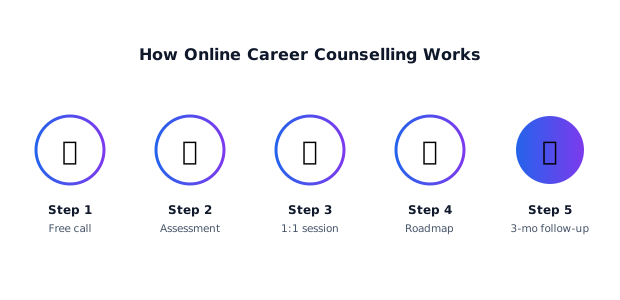
Step 1 — Free 20-Minute Discovery Call
We map your current situation: student's Class 12 subjects, boards, target career direction (if known), and any preferred colleges or geographies. If you haven't done career counselling yet, we recommend starting there — because course selection drives everything downstream.
Step 2 — Career & Course Alignment
Before shortlisting colleges, we confirm the course and specialisation — because "should I do BA Economics honours or BBA Finance?" changes which colleges make sense. This step draws on our full psychometric assessment when needed.
Step 3 — College Shortlisting (3-Tier Framework)
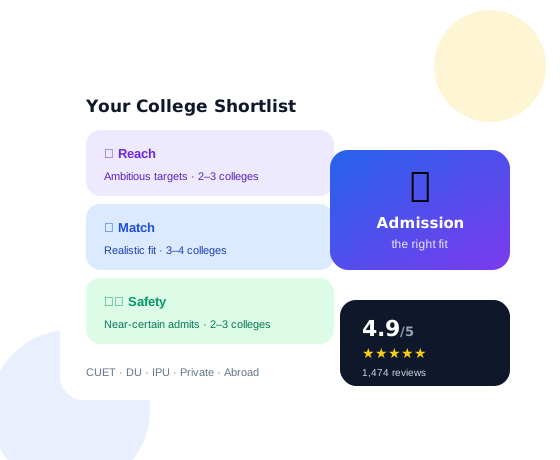
We build a shortlist across three tiers — Reach colleges (ambitious targets), Match colleges (realistic based on profile), and Safety colleges (near-certain admits). For each, we match your profile to the specific admission criteria (CUET score, board %, ECA record, interview performance).
Step 4 — Entrance Exam Strategy
Which entrance exams should you write? In what order? What's the realistic score target? Which coaching route makes sense (self-study, group coaching, 1:1)? We map exam prep to the college shortlist.
Step 5 — Application Preparation
Application forms, SOPs, personal statements, LORs, interview prep, portfolio (for design / architecture / liberal arts). We review every application before submission.
Step 6 — Counselling Rounds & Final Choice
Once results come in, admission counselling rounds begin. We help decide between multiple offers — factoring in college brand, course fit, location, cost, ROI, and long-term career impact.
Step 7 — Post-Admission Support
Even after admission is confirmed, questions arise — accommodation, orientation, whether to consider switching. We stay available for 3–12 months (depending on plan).
What's Included in CCO's College Admission Guidance
| Component | Detail |
|---|---|
| Discovery call | Free · 20 min · With founder |
| Career + course fit review | Uses assessment data where relevant |
| 3-tier college shortlist (Reach / Match / Safety) | Personalised · India + abroad options |
| Entrance exam roadmap | CUET / JEE / NEET / CLAT / NIFT / private uni exams |
| Application review | Forms · SOPs · essays · LORs |
| Interview prep | For colleges requiring interviews (liberal arts, private unis, abroad) |
| Counselling-round strategy | DU / IPU / CUET / private uni counselling |
| Final-choice decision session | When multiple offers arrive |
| Follow-up support | 3–12 months (by plan) |
| Pricing | ₹5,000 – ₹7,500 · Published upfront |
Indian College Admissions Timeline — Month-by-Month
This is the typical rhythm of an Indian Class 12 admissions cycle. Actual dates shift each year, but the sequence is stable. Last updated: 2026.
| Month | What's Happening | What Families Should Be Doing |
|---|---|---|
| August – October (Class 12) | Class 12 starts | Finalise career direction · Register for entrance-exam coaching · Decide CUET vs JEE vs abroad path |
| November – December | Study Abroad early deadlines | Study-abroad applicants submit early apps · Domestic students focus on board prep |
| January – February | CUET, JEE Main, private uni entrance exams begin registration | Register for all target exams · Confirm CUET subject choices |
| March – April | Board exams · JEE Main sessions · CUET application closes | Board exam focus · Complete every entrance-exam application before deadlines |
| May | CUET UG conducted · JEE Advanced · Private uni entrance exams · Study abroad final decisions arrive | Complete exam attempts · Choose from abroad admits |
| June | Results announced (Board · CUET · JEE · NEET · private unis) | Cross-reference results with shortlisted colleges |
| July | DU / IPU / CUET counselling rounds begin | Fill choice preferences carefully · Track cutoffs · Attend counselling rounds |
| August | Final admissions confirmed · Colleges start | Confirm final choice · Post-admission decisions |
Missing a step in this timeline typically costs a year. CCO's admission guidance is calendar-driven for exactly this reason.
7 Costly College Admission Mistakes We See Every Year
Mistake 1 — Applying to a college before finalising the course.
Families obsess over "which college is best" before deciding what they want to study. A great college for the wrong course delivers a worse outcome than a mid-tier college for the right one.
Mistake 2 — Ignoring the CUET subject-college interaction.
CUET scores are course-specific and college-specific. A high score in the wrong subject combination unlocks the wrong colleges. This trips up more Class 12 families than any other single issue.
Mistake 3 — All Reach, no Safety.
Applying only to top-tier options (DU top colleges, top IITs, Ashoka) with no realistic safety colleges is a strategy that ends in a gap year for many students each cycle.
Mistake 4 — Believing college brand > course fit.
The best-known college for a course isn't always the best college for that student's strengths. Someone who thrives in a discussion-heavy Ashoka classroom may struggle in a large DU lecture hall — regardless of "prestige."
Mistake 5 — Underestimating private university options.
Many parents write off private universities as "expensive" — while missing that top private universities offer serious merit scholarships and course flexibility. A ₹4-lakh/year sticker price often becomes ₹1.5 lakh/year with merit aid.
Mistake 6 — Starting the abroad process too late.
Study-abroad applications for Fall intake need to start 12–18 months in advance (test prep, SOPs, LORs, essays, financial documentation). Starting in April of Class 12 for Fall abroad admissions almost never ends well.
Mistake 7 — Ignoring the counselling rounds.
DU, IPU, and CUET have multiple counselling rounds where choices matter enormously. Filling preferences without strategy — or missing a round — can mean losing your best option.
Get personalised admission guidance
Avoid every one of these with a certified counsellor beside you all season.
Get Personalised Admission Guidance →How to Shortlist the Right College — The 6-Factor Framework
Instead of asking "which is the best college in India," the right question is "which college is the best fit for this specific student, course, and situation." Use these six factors.
1. Course Quality (not just college brand)
DU St. Stephens is legendary — but not for BSc Statistics. A specific department at a "less famous" college can be stronger than the same course at a top-brand college. Look at faculty, alumni outcomes, and course curriculum, not just the college name.
2. Admission Fit (Reach / Match / Safety)
Is your profile competitive for admission? A "great" college that won't admit you isn't a real option. Use realistic Match and Safety colleges as anchors.
3. Career-Path Alignment
Which colleges have the strongest track record for the specific career you're targeting? Investment banking recruits from certain colleges; product design recruits from others; medical residency depends on specific medical colleges.
4. Location & Living Environment
Delhi vs Bangalore vs Pune vs abroad — this matters more than parents assume. Some students thrive on a bustling metro campus; others need quieter university towns.
5. Financial ROI
Total cost of the degree (fees + living + opportunity cost) vs realistic post-graduation earnings. A ₹40-lakh abroad degree makes financial sense for some careers; a ₹4-lakh Indian degree wins for others.
6. Backup Value
If your primary career plan changes mid-degree, does the college / course still give you flexibility? A general BA / BSc from a strong college may hold more optionality than a hyper-specialised course.
CCO's admission guidance walks families through each of these six factors for every shortlisted college — turning "let's apply everywhere" into a focused, defensible list.
Public University vs Private University vs Study Abroad — Which Route Fits You?
| Public University (DU, IPU, JNU, etc.) | Private University (Ashoka, Manipal, VIT, etc.) | Study Abroad | |
|---|---|---|---|
| Cost (3–4 yrs total) | ₹50k – ₹4 lakh | ₹6 – 24 lakh | ₹35 lakh – ₹1.2 crore |
| Admission based on | CUET / entrance exam + board % | Own entrance exam + interview + board % | SAT/ACT + IELTS/TOEFL + SOP + LORs + essays |
| Brand recognition (India) | Very high | Rising | Depends on university |
| Brand recognition (abroad) | Mixed | Growing | Highest for top universities |
| Course flexibility | Limited | Very high (NEP-aligned 4-year UG) | Very high |
| Class size | Large | Small–medium | Small–medium |
| Ideal for students who | Value affordability, brand, structured curriculum | Want flexibility, small classes, project-based learning | Want global exposure, willing to invest in top-tier education |
| Timeline complexity | Medium (CUET + counselling) | Medium | Very high (18-month process) |
The short version: None of the three is universally "better." The right route depends on the student's career direction, family finances, learning style, and long-term geography preference. CCO's admission guidance helps you weigh all three routes side by side with your specific data — not with generic advice.
How Much Does College Admission Guidance Cost in India?
College admission guidance in India ranges from free (school-provided) to ₹3 lakh+ (premium study-abroad packages).
| Provider Type | Typical Price | What You Get |
|---|---|---|
| School career counsellor | Included in fees | Group sessions, general advice, limited 1:1 |
| Independent admission counsellor | ₹5,000 – ₹25,000 | 1:1 sessions, college shortlisting, application review |
| Premium platforms (Mindler, iDreamCareer) | ₹15,000 – ₹40,000 | Multi-session package, sometimes assigned junior counsellor |
| Full study-abroad packages | ₹75,000 – ₹3,00,000+ | End-to-end abroad application including essays, SOPs, visa |
| CCO | ₹5,000 – ₹7,500 | Founder-led sessions, career + course + college guidance, 2–4 sessions, 3–12 months support |
CCO delivers admission guidance at the low end of the market because we bundle it with career counselling — one integrated process instead of a separate expensive "admissions consultant." For study-abroad applicants requiring SOPs and multi-country strategy, an add-on package is available.
College Admission Guidance — Plans & Pricing
Every other admission counselling platform hides pricing behind a form. We don't. Here's exactly what things cost.
Basic
- Psychometric Test
- 2 counselling sessions
- 3 months support
- Personalised career roadmap
- College & university guidance
Pro
- Brain Mapping Test
- 3 counselling sessions
- 6 months support
- Career roadmap
- College/university guidance
- Certifications & internships guidance
- 6 months portal access
Advanced
- Brain Mapping + Psychometric Test
- 4 counselling sessions
- 1 year support
- Career roadmap
- College/university guidance
- Certifications & internships guidance
- 1 year portal access
Every plan includes: complete report · brain-mapping profile · WhatsApp + email support · session recording · zero hidden charges.
How to Choose the Right College Admission Counsellor
If you're evaluating admission counsellors — CCO or otherwise — this checklist separates real guidance from marketing.
✅ Does the counsellor know the current admissions ecosystem?
CUET rules changed. NEP 2020 restructured UG degrees. Private universities have new entrance exams. If the counsellor's answers sound like 5-year-old advice, that's the answer.
✅ Is the guidance course-first or college-first?
Great counsellors help you finalise the course before shortlisting colleges. Weak counsellors start with "which college do you want" — which is the wrong question.
✅ Does the counsellor cover all pathways?
CUET, JEE, NEET, private universities, abroad, liberal arts — a proper admission counsellor can advise across every route your child might consider. If they only push one route, that's a signal.
✅ Is admission guidance separated from coaching?
Some coaching institutes offer "free counselling" to sell you their coaching. Independent admission counsellors have no incentive to push you toward a specific coaching product.
✅ Is there real 1:1 time?
Ask specifically: how many 1:1 sessions? With whom? What's included? "Access to a dashboard" is not 1:1 guidance.
✅ Is application review included?
SOPs, personal statements, application forms, interview prep — the difference between a rejected and accepted application is often in the small things. Real admission guidance reviews these before submission.
✅ Is there follow-up during counselling rounds?
Counselling round decisions (choice-filling, upgrades, withdrawals) happen in a compressed 2–3 week window. Your counsellor needs to be available during that window, not just before.
CCO checks every box
Founder-led, course-first, all-pathways, independent of coaching, with real 1:1 time and counselling-round support.
Talk to an Expert →What Families Say About CCO's College Admission Guidance
"We started with a career assessment for our daughter in Class 11. By the time Class 12 boards were over, we already had a clear list — three DU colleges, two liberal arts (Ashoka, Krea), and one abroad option (UBC). She got into two of the six. Without CCO's shortlisting, we'd have thrown darts at 20 colleges and probably missed the ones that fit."
"Varun sat with us during the CUET counselling round on video call while we were filling preferences. That single hour saved us from a wrong first choice — my son ended up at a college we hadn't even initially considered, and it turned out to be the perfect fit."
"I was set on going abroad. CCO's counselling actually helped me see that a top Indian private university (Ashoka) was a better fit for my career direction than a mid-tier US university at 6× the cost. Best decision I made in Class 12."
College Admission Guidance — Frequently Asked Questions
Q1. What is college admission guidance?
College admission guidance is a structured 1:1 advisory process that helps students and parents finalise course choice, shortlist the right colleges, plan entrance exam strategy (CUET, JEE, NEET, private uni exams, or abroad tests), prepare strong applications, and navigate counselling rounds — all timed to the Indian admissions calendar.
Q2. When should we start college admission guidance?
The best window is early Class 11 (before subject / stream is locked in) or the start of Class 12 (to plan entrance exams and college shortlist alongside board prep). For study-abroad applicants, 18 months before intended intake is the ideal starting point.
Q3. Is college admission guidance different from career counselling?
Yes. Career counselling helps decide what to study; college admission guidance helps decide where to study and how to get in. At CCO, we usually deliver both together — because course choice and college choice are interdependent.
Q4. What is CUET and does CCO help with CUET counselling?
CUET (Common University Entrance Test) is the entrance exam for admissions to 250+ central, state, and participating private universities in India. CCO helps with CUET subject selection, prep strategy, college-course targeting, and — critically — the counselling rounds where choice-filling decides your final admit. → CUET Counselling Guidance
Q5. Does CCO cover both Indian and abroad admissions?
Yes. Indian admissions (CUET, JEE, NEET, CLAT, NIFT, IPU, DU, private universities) are our primary focus. Study-abroad guidance (US, UK, Canada, Australia, Singapore, Europe) is included where relevant to the student's plan, with an optional add-on for full end-to-end abroad application support (SOPs, essays, visa).
Q6. How is CCO different from other admission counselling platforms in India?
Three main differences: (1) CCO is founder-led — every family works directly with Varun Vohra, not an assigned junior counsellor. (2) Career + course + college guidance is bundled in one process instead of separated into expensive add-ons. (3) Pricing is published upfront (₹5,000–₹7,500) — competitors typically require an enquiry form before disclosing pricing that often runs ₹15,000+.
Q7. What if my child's CUET / JEE score is below expectations?
This is one of the most common counselling situations we see. There are usually more options than families realise — different colleges, courses with different cutoffs, private universities with entrance-based admits, drop-year considerations, and abroad options. CCO helps you evaluate all of them objectively rather than panicking.
Q8. How do you build a college shortlist?
Using a 3-tier framework: Reach (ambitious targets where admission is possible but uncertain), Match (realistic based on profile), Safety (near-certain admits). Each tier is sized based on how selective the target colleges are — typically 2–3 Reach, 3–4 Match, and 2–3 Safety colleges.
Q9. Do you help with SOPs, essays, and interviews?
Yes — for colleges that require them (liberal arts colleges, private universities with interview rounds, study-abroad applications). We review drafts, give structured feedback, and do mock interviews. We don't write essays for you — that would defeat the purpose — but we make sure your own writing is as strong as possible.
Q10. What if I already have a career counsellor or coaching institute — do I still need admission guidance?
Possibly. Coaching institutes prepare you for an exam; they don't help you pick the right colleges after the exam. School counsellors are stretched too thin to give 1:1 admission guidance. Independent admission counselling fills that specific gap.
Q11. Can you help with private universities like Ashoka, Krea, Symbiosis, VIT, Manipal?
Yes. Every major Indian private university has a different application process — some marks-based, some interview-based, some portfolio-based. We cover application strategy, entrance exam prep, scholarship applications, and interview prep for private universities across India.
Q12. What if we miss a deadline?
If a deadline is missed but the exam / admission round has alternate routes (many do), we help identify them fast. If a deadline is fully closed, we work on rebuilding the plan around remaining options — including drop-year or gap-year strategies with a clear return plan.
Q13. How long does the college admission guidance process take?
Typically 9–12 months of intermittent engagement — heavy activity in October–November (planning), March–April (exam registration), May–June (results), and July–August (counselling and final choice). Not continuous — but consistently available during those key windows.
Q14. How do I get started?
Click any Book Free Call button on this page — you'll pick a slot, share a few basics about the student's current class, target colleges (if any), and situation. The first call is genuinely free and unpressured.
Turn "Which College?" Into a Clear, Personalised Application Plan
Admissions season doesn't reward guesswork. Every deadline you miss shifts your entire plan by a year. Every application you send to the wrong college wastes application fee, effort, and — sometimes — the chance to get into the college that actually fit.
CCO's college admission guidance gives Class 11–12 students and parents a specific, structured application plan — with a certified counsellor by your side through the entire admissions cycle.
Free 20-min first call. No sales script. Transparent pricing. Founder-led throughout.
Prefer to explore first? Take the Free Demo Assessment → · Compare Pricing Plans → · See Success Stories →
Every missed deadline shifts your plan by a year.
CCO's college admission guidance gives Class 11–12 students and parents a specific, structured application plan — with a certified counsellor by your side through the entire admissions cycle.
Free 20-min first call. No sales script. Transparent pricing. Founder-led throughout.