Career Counselling After 12th — Right Course, Right College, Right Career Direction
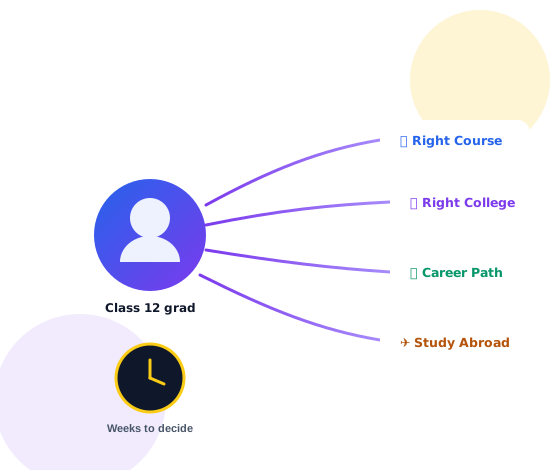
You have weeks to decide. Course, college, entrance exam results, direct admission offers, gap year, or study abroad — the after-12th window is compressed and consequential. CCO's psychometric-backed 1:1 counselling helps students and parents make the right decision under real time pressure — with founder-led sessions, transparent pricing, and 3+ months of follow-up through admission season.
What Is Career Counselling After 12th?
Career counselling after 12th is a compressed, decision-focused guidance process that helps Class 12 graduates and their parents choose the right undergraduate course, college, and career direction — using psychometric assessment, aptitude analysis, and 1:1 sessions with a certified career counsellor. Unlike career counselling done during Class 10 (which has months of runway) or Class 11 (which is about planning), after-12th counselling operates under real time pressure — entrance exam results are out, application deadlines are days away, CUET / JEE / NEET counselling rounds are actively running, and every wrong step costs an admissions cycle.
At CCO, career counselling after 12th combines a 5-framework psychometric assessment, a founder-led 90-minute 1:1 session, a personalised course-and-college roadmap, and 3+ months of follow-up support through counselling rounds and final admission decisions. During peak admissions season (May–August), the entire process can be completed in under a week.
Why the After-12th Decision Window Is the Highest-Stakes Moment in Indian Education
Class 10 stream selection matters, but Class 12 outcome decisions matter more — because the runway to fix mistakes shrinks dramatically.
The course you pick locks in 3–4 years of your degree.
Unlike Class 10 (where a wrong stream can sometimes be adjusted), a wrong undergraduate course usually means either finishing a degree you don't want or dropping and restarting — costing 2–3 years and lakhs in tuition.
Time pressure is real, not manufactured.
From Class 12 boards in March to college admissions in July–August, families are making 5–8 consequential decisions in 8–12 weeks. CUET counselling rounds, JEE choice-filling, NEET counselling, direct admission deadlines, and private-university enrolment dates all cluster into an overwhelming window.
Marks often don't match expectations.
A large share of after-12th career counselling begins with "my JEE / NEET / CUET score is lower than we hoped." Panicking into the closest available seat is the single most common — and most damaging — decision students make in this window.
Multiple offers require real trade-off analysis.
A student may have offers from a Tier-2 government engineering college, a top-3 private university, a mid-tier abroad option, and a strong DU / IPU liberal arts college — all valid, all different. Choosing well requires objective analysis, not gut feel.
Parents and students often disagree.
Post-results is when quiet disagreements become loud arguments. The Class 10 or Class 11 delay tactic ("we'll figure it out later") stops working. Every day of family conflict costs decision quality.
The coaching institute isn't a neutral advisor.
Coaching institutes are commercial businesses recommending decisions that fill their pipeline. Their advice isn't necessarily wrong — but it's conflicted.
Structured career counselling after 12th exists because this window has too many high-consequence decisions to make on family opinion alone.
The 6 Most Common After-12th Situations CCO Handles
Most students landing on this page are in one of six specific decision situations. See which one matches you.
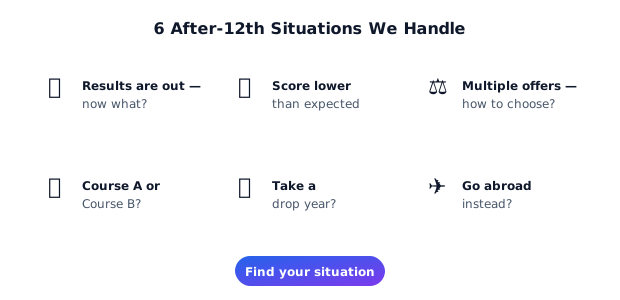
Situation 1: "Results are out — now what?"
Post-boards direction-setting. Marks are in, but no clear plan for course, college, or entrance exam strategy. Best time to engage: April–May, before CUET / JEE Advanced / NEET results.
Situation 2: "My JEE / NEET / CUET score is lower than expected."
The recalibration scenario. First choice is off the table; now what? Options include Tier-2 government colleges, top private universities, alternative courses in the same field, drop-year evaluation, or completely rethinking the direction. Panic-decisions here cause the most long-term regret.
Situation 3: "I have multiple offers — how do I choose?"
The multi-offer decision. Two engineering offers at different tiers. A DU vs Ashoka choice. An abroad admit alongside an IIT possibility. This is where structured comparison beats "gut feel" — because the wrong "gut feel" here costs 4 years.
Situation 4: "I'm confused between Course A and Course B."
The course-clarity scenario. Engineering vs Economics. MBBS vs BDS. BA Psychology vs BA Literature. BBA vs B.Com honours. Both look reasonable; both open different doors; and choosing without evidence usually ends in regret by Year 2.
Situation 5: "Should I take a drop year?"
Drop-year evaluation. Sometimes it's the right call (target career genuinely requires a specific exam retry). Sometimes it's the wrong call (dropping to chase a career that doesn't match the student anyway). Assessment plus honest conversation is what separates the two.
Situation 6: "Should I go abroad instead?"
India vs abroad. Financial ROI, career alignment, family circumstances, career market in the target country, backup plan if abroad doesn't work — all need to be weighed. Peer pressure ("everyone else is going abroad") is often the driving force here, and often the wrong one.
If you recognise your situation in this list, book a free call. If not — book anyway, and we'll help you figure out which one it actually is.
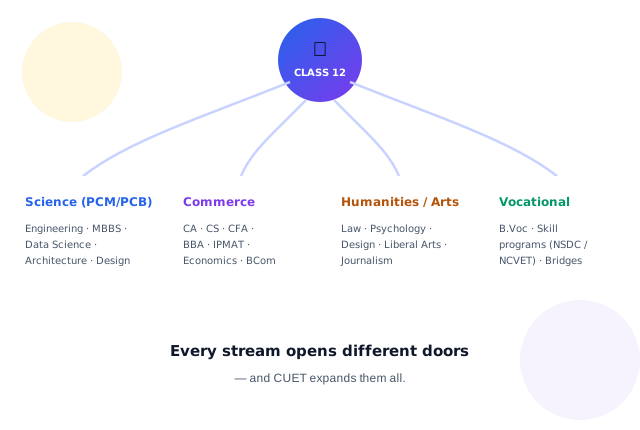
Career Options After 12th — By Stream
Class 12 stream limits some options but expands others. Here's what each stream actually opens up in 2026.
After 12th Science (PCM)
Engineering (JEE Main, JEE Advanced, BITSAT, VITEEE, private uni exams), Architecture (NATA), Pure Sciences (BSc Physics / Chemistry / Maths), Data Science, Actuarial Science, Aviation, Merchant Navy, Defence (NDA / CDS), Economics honours at top colleges (via CUET), UX / Product Design, Applied Sciences (Nanotech, Materials, Robotics), and — via CUET — non-traditional paths like Political Science or Psychology at top DU colleges.
After 12th Science (PCB)
MBBS (NEET), BDS, BAMS / BHMS / BUMS (AYUSH), Nursing (BSc), Physiotherapy, Biotechnology, Microbiology, Nutrition & Dietetics, Psychology (BA / BSc), Veterinary Sciences, Genetic Counselling, Public Health, Pharmacology, Forensic Science, and Environmental Science.
After 12th Science (PCMB)
All PCM + all PCB options. Additional flexibility to pivot late if the initial career direction changes during entrance-exam preparation.
After 12th Commerce (with Maths)
Chartered Accountancy (CA), Company Secretary (CS), CFA, IPMAT (early IIM Indore / Rohtak admission), BBA (top-tier including NMIMS, Christ, SSCBS), BCom honours at DU, Economics honours at top colleges (via CUET), BMS, Finance careers, Actuarial Science, Business Analytics, Data Analytics, and Investment Banking track.
After 12th Commerce (without Maths)
BCom (General), BBA at non-quantitative colleges, Journalism, Mass Communication, Hotel Management (IHM), Event Management, Retail Management, Aviation Management, Travel & Tourism, Fashion Communication.
After 12th Humanities / Arts
Law (CLAT / AILET / LSAT India / private university LLB integrated), Psychology (BA / BSc), Design (NIFT, NID, private universities like Srishti / Pearl), UX / UI Design, Fashion Design, Liberal Arts (Ashoka, Krea, FLAME, Symbiosis Liberal Arts, Jindal), Public Policy, Journalism & Media, Fine Arts, Sociology, Political Science, English honours, History honours, Economics honours (via CUET), Anthropology, Development Studies.
After 12th Vocational
Direct industry entry, B.Voc programs (Retail, Hospitality, IT, Financial Markets, Multimedia), skill-development programs (NSDC / NCVET aligned), and — for eligible students — bridge programs into standard undergraduate degrees.
Not sure which path fits you?
Talk to a founder-counsellor for expert, unbiased guidance — matched to your profile, not a template.
📞 Call Now — Talk to an Expert Or book your free 20-min call →7 Signs Your Current After-12th Plan Needs a Second Opinion
If two or more of these are true, book a free call before you commit to a college or course.
1. Your coaching institute is telling you which course/college to pick.
Coaching institutes are commercial businesses with pipeline incentives. Their advice is not neutral.
2. Family is pressuring you into a specific course and you're not sure.
Silent compliance now = drop-year regret later. Two-thirds of drop-year students we've counselled fall into this category.
3. You're panic-applying to 30+ colleges — or only 3.
Both signal a broken shortlisting strategy. 30 applications = no thought. 3 applications = no backup.
4. You have marks below your target range and you're spiralling.
This is precisely the moment when a structured second opinion is worth the most. Options exist that panic decisions miss.
5. Two offers on the table and you can't decide.
Multi-offer decisions look like "gut feel" problems but are actually "structured comparison" problems.
6. You're considering a drop year without a specific plan.
"I'll drop and try again" without addressing why the first attempt didn't work almost always produces a second identical result.
7. Your family has decided you should go abroad — but you haven't evaluated Indian options seriously.
Or the reverse. Peer pressure works both ways. Deserves an evidence-based check.
Two or more sound familiar?
Get an objective second opinion before you commit to a college or course.
Talk to a Career Counsellor → 📞 Or call now: +91 93193 36222How the After-12th Career Counselling Process Works — Compressed for Real Time Pressure
Under peak admissions pressure (May–August), CCO can compress the full process to under a week. Here's how.
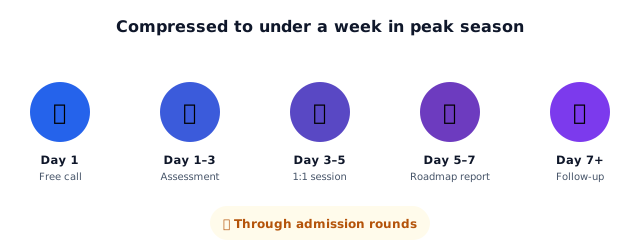
Day 1 — Free Discovery Call (Same-Day or Next-Day Booking)
20-minute video call. We understand your specific situation — marks, entrance exam results, current offers, family constraints, top-of-mind concerns.
Day 1–3 — Psychometric + Brain-Mapping Assessment
60–90 minute online assessment. Can be started immediately after the discovery call. Includes RIASEC, Big Five, aptitude clusters, Multiple Intelligences, and (for Pro / Advanced plans) brain mapping.
Day 3–5 — 90-Minute 1:1 Session With Founder Varun Vohra
Video session with student and parents. We walk through assessment results, evaluate current offers, compare 4–6 course-college combinations, and land on a specific direction with clear reasoning.
Day 5–7 — Personalised After-12th Roadmap Report
40+ page report covering: recommended course, ranked colleges (Reach / Match / Safety), entrance exam counselling-round strategy, specific application timelines, and a clear "if X happens, then Y" contingency plan.
Day 7+ — 3 Months of Active Follow-Up Through Admission Rounds
CUET counselling rounds. Choice-filling decisions. Withdrawal-and-upgrade calls. Last-minute private university offers. Confirming the final choice. This is when most families use us most.
Off-peak season (Sep–Apr): Same process, standard 10–14 day timeline.
What's Included in After-12th Career Counselling at CCO
Your first 20-minute call is free.
| Feature | Basic (₹5,000) | Pro (₹6,500) | Advanced (₹7,500) · Most Popular |
|---|---|---|---|
| Psychometric Test | ✓ | — | ✓ |
| Brain Mapping Test | — | ✓ | ✓ |
| 1:1 Counselling Sessions | 2 | 3 | 4 |
| Course + College Roadmap | ✓ | ✓ | ✓ |
| Entrance Exam & Counselling Round Guidance | ✓ | ✓ | ✓ |
| Multi-Offer Decision Session | — | ✓ | ✓ |
| Study Abroad Comparison Layer | — | Included where relevant | Included where relevant |
| Student Portal Access | — | 6 months | 1 year |
| Follow-Up Support | 3 months | 6 months | 1 year |
All sessions online over video · Parents welcome (and encouraged) to join · Session recordings shared within 24 hours
8 Costly After-12th Mistakes We See Every Season
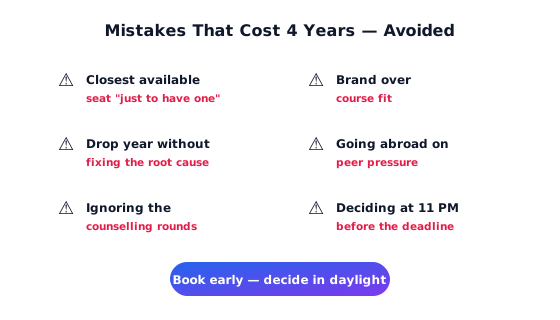
Mistake 1 — Enrolling in the closest available seat "just to have something."
"At least I'm in a college" is not a plan. Wrong-fit enrolment costs 4 years and often ends in a career switch anyway.
Mistake 2 — Choosing college brand over course fit.
A mid-tier college for the right course typically produces better outcomes than a top-tier college for the wrong course.
Mistake 3 — Taking a drop year without addressing the root cause.
If the first attempt didn't work because the target career didn't match the student's actual profile, the second attempt won't work either.
Mistake 4 — Writing off private universities on principle.
Top private universities (Ashoka, Krea, FLAME, Plaksha, Manipal, VIT, BITS, Symbiosis) offer serious merit scholarships and course flexibility. A ₹4 lakh/year sticker often becomes ₹1.5 lakh/year with aid.
Mistake 5 — Choosing abroad based on peer pressure.
"Everyone in my school is going abroad" is a terrible reason to spend ₹40 lakh–₹1 crore on an undergraduate degree.
Mistake 6 — Ignoring the counselling rounds.
CUET, DU, IPU, and JEE counselling rounds have complex choice-filling dynamics. Filling preferences without strategy usually leaves seats on the table.
Mistake 7 — Applying to only "safe" or only "reach" colleges.
Safe-only = underachieving. Reach-only = probable gap year. You need Reach + Match + Safety in every application list.
Mistake 8 — Making the decision at 11 PM the night before the deadline.
The single most avoidable mistake. Deadline-driven panic never produces good decisions. Book counselling early enough that your decisions can be made in daylight.
How to Actually Decide Course + College After 12th — The 5-Question Framework
If you use only this framework — even without CCO — you'll be ahead of most families making this decision.
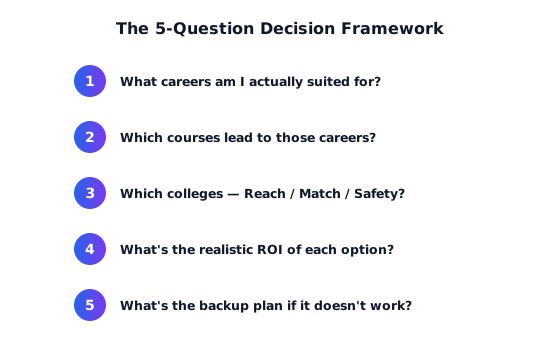
Q1. What careers am I actually suited for?
Not "what do my parents want" or "what are my friends doing." What does a scientific assessment say about your personality, interests, and aptitudes?
Q2. Which courses lead to those careers?
Sometimes there are multiple. Sometimes there's only one obvious path. Occasionally the "obvious" course isn't the best one — a Psychology BA might be a better route to Product Management than a BBA, for a specific student.
Q3. Which colleges offer those courses at my profile level?
Reach colleges: worth applying but uncertain. Match colleges: realistic. Safety colleges: near-certain. You need all three tiers.
Q4. What's the realistic ROI of each course + college combination?
Total cost (tuition + living + opportunity) vs realistic post-graduation earning trajectory. Not "starting salary" — 5-year and 10-year salary paths, which differ dramatically by course.
Q5. What's the backup plan if this doesn't work?
If Year 1 shows a mismatch, what's the switch path? Is there a related course you could pivot into? Would you drop and restart? Having a clear Plan B removes the pressure to be perfect on Plan A.
Want all five answered with your real data?
A founder-led session walks you through the full framework using your assessment — not generic advice.
Talk to a Career Counsellor → 📞 Or call now: +91 93193 36222Structured career counselling walks you through all five questions with your actual data — not generic advice.
What After-12th Families Say About CCO
"My son's JEE Main score was 40 percentile lower than we'd expected. We were in complete panic mode — considering a drop year, considering a mid-tier private engineering college, considering just enrolling him anywhere. CCO's session showed his aptitude was actually stronger in analytical-verbal than in mechanical-spatial. He pivoted to BSc Economics honours at a DU college via CUET. Two years in, he's thriving and probably headed to an IIM after."
"I had four offers: DU Economics honours, Ashoka Liberal Arts, a US undergraduate at 45 lakh/year, and Manipal Engineering. Every family member gave different advice. Varun's session laid out the actual comparison — course fit, ROI, career alignment — and DU won on all three. Best decision I made in Class 12."
"We came into the CUET counselling rounds without a clear strategy. Varun walked us through choice-filling for three separate rounds — including one where he told us to withdraw and wait for an upgrade instead of accepting the first offer. That single call saved my daughter from an admission we'd have regretted."
Career Counselling After 12th — Frequently Asked Questions
What is Career Counselling after 12th, and why is it important?
Career Counselling after 12th is a professional guidance process that helps students choose the right career, college, and course based on their interests, aptitude, personality, and future goals. Career Counselling after 12th reduces confusion, helps students avoid wrong career decisions, and creates a clear roadmap for higher education and long-term success.
Who should take Career Counselling after 12th?
Every student who has completed Class 12 can benefit from Career Counselling after 12th, whether they belong to Science, Commerce, Arts, or Humanities. Career Counselling after 12th is especially useful for students who are unsure about course selection, college admissions, entrance exams, or future career opportunities.
How does Career Counselling after 12th help in choosing the right course?
Career Counselling after 12th helps students identify courses that match their aptitude, interests, academic performance, and career aspirations. Through Career Counselling after 12th, students receive personalized recommendations instead of relying on trends, peer pressure, or incomplete information.
Can Career Counselling after 12th help me choose the right college?
Yes. Career Counselling after 12th includes guidance on selecting the best colleges based on your academic profile, entrance exam scores, budget, preferred location, placements, accreditation, and career goals. Career Counselling after 12th also helps students prepare realistic college preference lists.
Is Career Counselling after 12th useful for CUET, JEE, NEET, and other entrance exam students?
Absolutely. Career Counselling after 12th helps students understand admission options through CUET, JEE, NEET, CLAT, IPMAT, NATA, and many other entrance exams. Career Counselling after 12th also identifies alternative colleges and career paths if the preferred option is not available.
What assessments are included in Career Counselling after 12th?
Most Career Counselling after 12th programs include scientifically designed psychometric assessments that evaluate aptitude, personality, interests, learning style, emotional intelligence, and career preferences. These assessments make Career Counselling after 12th more accurate and personalized.
How long does Career Counselling after 12th take?
The duration of Career Counselling after 12th depends on the student's requirements. A complete Career Counselling after 12th process generally includes assessments, report analysis, one-on-one counselling sessions, career planning, and college guidance, which may be completed over one or more sessions.
Can Career Counselling after 12th help students who are confused between multiple career options?
Yes. Career Counselling after 12th is designed to help students compare multiple career options based on future demand, salary potential, required skills, educational pathways, and personal suitability. Career Counselling after 12th provides clarity and confidence before making important academic decisions.
Is Career Counselling after 12th available online?
Yes. Career Counselling after 12th is available through both online and offline sessions. Online Career Counselling after 12th allows students and parents to receive expert guidance from anywhere while accessing career reports, assessments, and personalized counselling through secure digital platforms.
Does Career Counselling after 12th help parents make better decisions?
Yes. Career Counselling after 12th involves parents in the decision-making process by providing data-driven insights about suitable careers, colleges, and future opportunities. Career Counselling after 12th helps families make informed decisions based on facts rather than assumptions.
What career options can be explored through Career Counselling after 12th?
Career Counselling after 12th explores thousands of career options across Engineering, Medical Sciences, Commerce, Management, Law, Design, Psychology, Data Science, Artificial Intelligence, Finance, Digital Marketing, Aviation, Hospitality, Government Careers, Entrepreneurship, and many emerging industries. Career Counselling after 12th recommends the most suitable options based on each student's unique profile.
How do I book Career Counselling after 12th?
Booking Career Counselling after 12th is simple. Students can schedule an online or offline counselling session, complete a career assessment, and meet an expert career counsellor for personalized guidance. Career Counselling after 12th helps students build a structured roadmap for college admissions, career planning, and future success.
The After-12th Window Doesn't Reward Waiting
Every year, thousands of Class 12 graduates enrol in the wrong course — because of pressure, panic, or missed deadlines. Two years later, they realise the mismatch. By then, correcting it costs a year, a degree, and often the confidence to start over.
The alternative is straightforward. Structured career counselling in a compressed, real-time-appropriate timeline. Founder-led sessions. A specific course + college roadmap. And 3+ months of follow-up support so you're not alone through counselling rounds and final choice.
Free 20-min first call. Same-day booking available during peak season. No sales pressure.
Prefer to explore first? Take the Free Career Assessment → · View Sample Career Report · See Pricing
Related pages: Career Counselling for Class 11–12 · Career Counselling for Graduates · College Admission Guidance · CUET Counselling Guidance
Book Your Free 20-Minute Counselling Call
Structured counselling in a real-time-appropriate timeline, a specific course + college roadmap, and 3+ months of follow-up so you're not alone through counselling rounds. Same-day booking available in peak season.