School Career Guidance Program in India — NEP 2020-Aligned Career Counselling for Grades 6–12
A structured, science-based career guidance program for CBSE, ICSE, IB, and international schools across India — combining career assessments, an on-campus or virtual career lab, student workshops, teacher training, and a parent orientation program. Delivered by certified career counsellors. Aligned with NEP 2020 and CBSE Career Guidance & Counselling (CGC) mandates.
What Is a School Career Guidance Program?
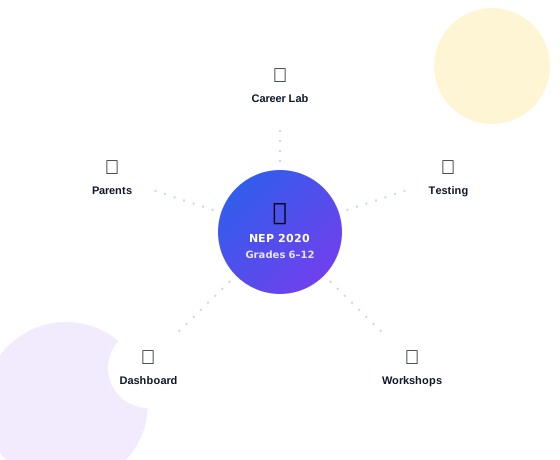
A school career guidance program is a structured, multi-year framework delivered within a school that helps students in Grades 6–12 progressively understand their interests, aptitudes, and career possibilities — combined with parent orientation, teacher training, and reporting for school leadership. Unlike ad-hoc "career day" workshops or a single visit by a counsellor, a proper career guidance program is integrated into the school calendar, tracked longitudinally per student, and aligned with the school's board (CBSE, ICSE, IB, CIE) and national policy (NEP 2020).
At CCO, a school career guidance program is delivered as an end-to-end managed engagement — you get certified career counsellors, a career lab (physical or virtual), scheduled psychometric assessments, curriculum-linked workshops, teacher training, parent programs, and dashboard reporting for the Principal and Board. Schools can start with a focused single-grade pilot or roll out a whole-school career lab across Grades 6–12.
Why Structured Career Guidance in Schools Is No Longer Optional
Career guidance in Indian schools has moved from "nice to have" to "compliance and competitive necessity." Four forces are driving that shift.
1. NEP 2020 mandates career counselling and guidance.
The National Education Policy 2020 explicitly identifies career counselling, aptitude testing, and guidance as required components of school education — starting from the middle-school stage. Schools that build structured career guidance programs now are getting ahead of accreditation and inspection requirements coming over the next 3–5 years.
2. CBSE has issued career-guidance circulars for years — most schools are still catching up.
The Central Board of Secondary Education (CBSE) has repeatedly asked affiliated schools to institutionalise career guidance and counselling (CGC) frameworks. Many schools still rely on a single overworked counsellor or occasional guest speakers. That gap is a real risk during affiliation review and — increasingly — a factor in parent enrollment decisions.
3. Parents are choosing schools partly on career-guidance strength.
Fee-paying parents in Tier 1 and Tier 2 cities now specifically ask about career guidance during admissions. Schools with a visible, structured program — with reports, dashboards, and named counsellors — win the mindshare of these parents. Schools without one lose it.
4. Class 10 stream selection and Class 12 course decisions have gotten harder.
With CUET restructuring undergraduate admissions, NEP 2020 introducing new subject-combination flexibility, and the explosion of new careers (AI, data science, UX design, sustainability, sports management, biotech), a single teacher can no longer credibly advise all students. Schools need scaled, science-based systems.
Structured career guidance programs exist to solve all four at once — with a single vendor, a defined budget, and measurable outcomes.
The 5 Components of CCO's School Career Guidance Program
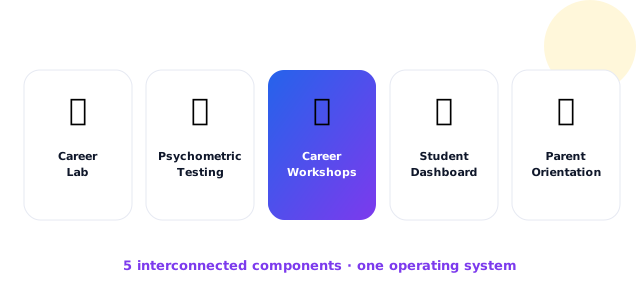
CCO delivers career guidance to schools through five interconnected components. Schools can adopt all five as an integrated program, or start with focused components based on budget and priorities.
1. Career Lab for Schools
A dedicated career lab — physical (a room on your campus) or virtual (a school-branded portal) — where students explore careers, take assessments, and access counsellor time throughout the year. The career lab is the operating "home" of the whole program.
Career Lab for Schools →2. Psychometric Testing for Schools
Structured psychometric career assessments delivered at defined grade milestones — typically Grade 8 (self-awareness), Grade 10 (stream selection), and Grade 11 (course direction). Includes personalised reports for each student, plus aggregate reports for school leadership.
Psychometric Testing for Schools →3. Career Workshops for Schools
Grade-appropriate workshops on career exploration, entrance exams, application processes, and 21st-century careers. Delivered in-school by certified career counsellors, sequenced to the academic calendar.
Career Workshops for Schools →4. Student Career Dashboard
A per-student digital dashboard with their assessment history, recommended careers, subject/stream recommendations, and progress markers. Accessible to student, parent, class teacher, and school counsellor. Longitudinal — the profile builds year on year.
Student Career Dashboard →5. Parent Orientation Program
Structured parent sessions on the school career guidance framework — because parent alignment is what makes career guidance stick or fail at home. Delivered as workshops, PTM add-ons, or scheduled parent-counsellor meetings.
Parent Orientation Program →Together, these five components turn "career guidance" from a slogan into an operating system.
What Each Stakeholder Gets From CCO's School Career Guidance Program
A successful career guidance program has to work for four different audiences at once. Here's what each one receives.
For Students (Grades 6–12)
- Age-appropriate career assessments (interest, aptitude, personality, brain mapping) sequenced to key grade milestones
- Personal career dashboard tracking their profile from Grade 6 to Grade 12
- Grade-level workshops on career exploration, exam strategy, and application processes
- Access to the career lab (physical or virtual) throughout the year
- 1:1 counsellor time at defined grade decision points (Class 10 stream, Class 12 course)
- 40+ page personalised career report at senior grades
For Parents
- Structured parent orientation on the school's career guidance framework
- Individual assessment reports for their child
- Parent access to the student career dashboard
- Optional 1:1 parent-counsellor sessions during key decision windows
- Written guidance on how to have career conversations at home
For Class Teachers & School Counsellors
- Teacher training on career conversations, assessment interpretation, and student profiling
- Access to student career dashboards for their class
- Cascade briefings after each assessment cycle
- Curriculum-linked career integration guidance (e.g., how to tie a Class 8 Science chapter to career exploration)
- Reduced load on the school counsellor — CCO owns the specialist work
For Principal, Board & School Leadership
- Aggregate reports on career-guidance program engagement, student outcomes, and parent satisfaction
- Program alignment documentation for NEP 2020, CBSE CGC, and (where relevant) IB / CIE career-guidance standards
- Affiliation-ready career guidance documentation
- A named, credentialed program lead from CCO
- Marketing collateral for admissions and open-house use ("Our career guidance program includes...")
- Quarterly review meetings with the CCO program team
How CCO's School Career Guidance Program Is Delivered
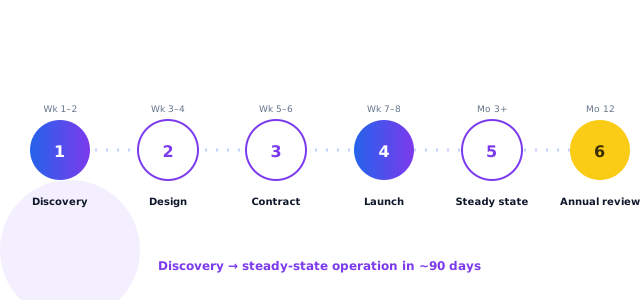
Every school engagement follows the same structured phases — from discovery through steady-state operation.
Phase 1 — Discovery & School Fit Assessment (Week 1–2)
Initial conversation with the Principal / decision-maker. We understand the school's current career-guidance state, board (CBSE / ICSE / IB / State), student count per grade, existing counsellor capacity, and specific priorities (compliance, differentiation, student outcomes, or all three).
Phase 2 — Program Design & Scope Proposal (Week 3–4)
Based on discovery, we propose a program design tailored to your school — which of the 5 components, at which grades, on what calendar, at what cost. Nothing is one-size-fits-all.
Phase 3 — Program Approval & Contract (Week 5–6)
School leadership and board approval. Contract, data-processing agreement (DPDP Act 2023 compliant), and program launch timeline.
Phase 4 — Program Launch (Week 7–8)
Teacher training, parent orientation launch, career lab setup (physical or virtual), student dashboard onboarding, first workshop delivery.
Phase 5 — Steady-State Operation (Month 3 onwards)
Scheduled assessment cycles, workshops per the academic calendar, 1:1 counsellor sessions during decision windows (Class 10 stream selection, Class 12 course selection), dashboard maintenance, monthly leadership reporting.
Phase 6 — Annual Review & Renewal (Month 12)
Full-year impact report, student and parent NPS survey, aggregate outcomes analysis, program refinement for Year 2.
How CCO's Program Aligns With NEP 2020, CBSE CGC, and IB / CIE Career Frameworks
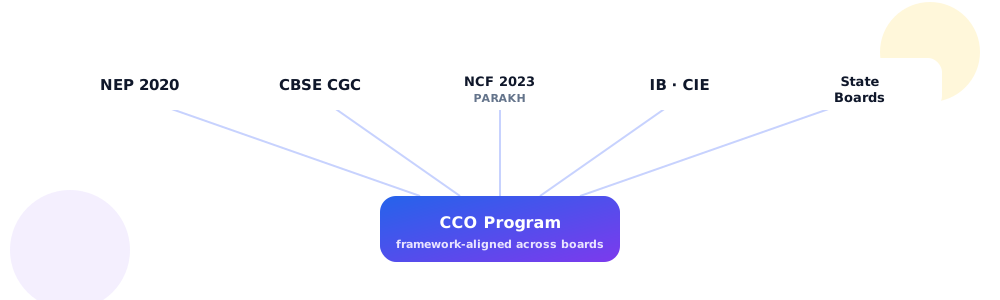
CCO's school career guidance program is designed against India's national and international curricular frameworks — so schools can point to explicit alignment during affiliation, inspection, or accreditation reviews.
NEP 2020 alignment
The National Education Policy 2020 identifies career counselling and guidance as essential across the school stages, with specific emphasis on the middle stage (Grades 6–8) for exploration and the secondary stage (Grades 9–12) for decisions. CCO's program is sequenced exactly to that architecture.
CBSE Career Guidance & Counselling (CGC) alignment
CBSE has issued repeated circulars institutionalising career guidance in affiliated schools. CCO's program provides schools with the documentation, calendar, assessment cycle, and reporting needed to demonstrate compliance during affiliation review.
NCF 2023 / PARAKH alignment
The National Curriculum Framework 2023 and the PARAKH holistic progress card structure both emphasise career awareness and 21st-century skill development. CCO's dashboard and reporting are designed to integrate with holistic progress documentation.
IB / CIE international alignment
For IB (International Baccalaureate) and CIE (Cambridge) schools, CCO's program supports the career-guidance requirements of DP, MYP, and A-Level pathways — including university counselling for international admissions.
State board flexibility
The core program adapts to any Indian state board — Maharashtra, Karnataka, Tamil Nadu, West Bengal, Rajasthan, Delhi, and others — including regional-language delivery where relevant.
Implementation Timeline — 30 / 60 / 90 Days
Most schools want to know: how fast can we get from decision to program? Here's the realistic timeline.
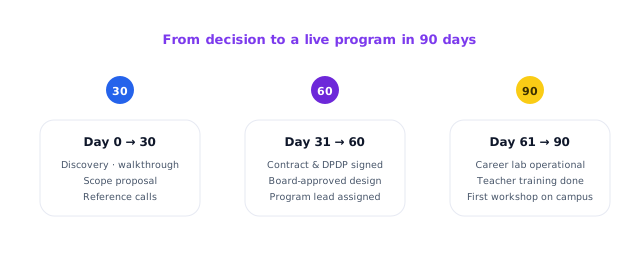
| Day 0 → Day 30 | Day 31 → Day 60 | Day 61 → Day 90 |
|---|---|---|
| Discovery calls with Principal / Head | Contract signed & DPDP data agreement executed | Career lab operational (physical or virtual) |
| Site visit or virtual campus walkthrough | Program design finalised & board approved | Teacher training delivered |
| Program scope proposal | Grade-wise calendar published | First assessment cycle launched |
| Cost & scope alignment | Student dashboard access provisioned | Parent orientation Round 1 delivered |
| Reference calls with existing school clients | CCO program lead assigned & introduced | First workshop delivered on campus |
By Day 90, a well-scoped school career guidance program is fully operational — assessments running, students onboarded, workshops delivered, teachers trained, parents oriented, and dashboard reporting live to school leadership.
Program Scale & Indicative Pricing
Every school program is scoped to the school's size, board, priorities, and budget. To give administrators a realistic anchor, here are indicative price bands seen across the Indian school career-guidance market.
Single grade (e.g., Grade 10) · Up to 100 students · Assessment + 2 workshops + parent session
Grades 8–12 · Up to 500 students · Full 5-component program
Grades 6–12 · 500–1,500 students · Full 5-component program + physical lab setup + on-campus counsellor days
Multiple campuses under one management · Central program design
Every quote is scoped after a discovery call — because the right program design depends on the school's board, existing infrastructure, and specific priorities. There are no per-student surprise fees.
The Reporting You'll Have — Every Month, Every Quarter, Every Year
School leadership doesn't want anecdotes — they want defensible reports. Here's what a CCO school engagement produces.
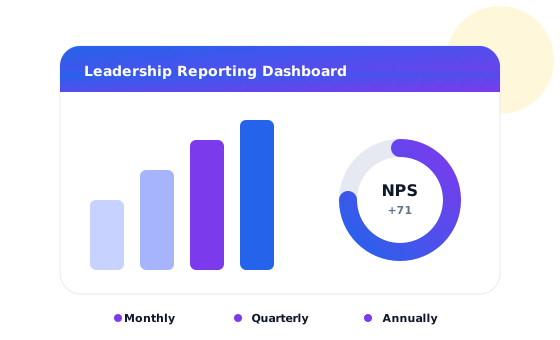
📅 Monthly
- Program engagement dashboard (student participation, assessment completion, session attendance)
- Counsellor time utilisation
- Workshop attendance and NPS
- Escalations & flagged students requiring individual attention
📊 Quarterly
- Aggregate assessment results by grade (personality, interests, aptitude patterns)
- Career-interest heatmaps by grade and section
- Parent orientation engagement metrics
- Program alignment tracker (NEP 2020, CBSE CGC checklist)
🏆 Annually
- Full-year impact report for the Board
- Student career-decision outcomes (Class 10 stream distribution, Class 12 course direction, Class 12 admission outcomes where available)
- Parent NPS
- Teacher NPS
- Year-over-year longitudinal analysis
- Program recommendations for the coming year
These reports are affiliation-ready, board-meeting-ready, and admissions-marketing-ready.
Illustrative Case Studies — School Career Guidance in Action
(Replace with actual school partner case studies as they become available. These illustrate program-outcome shape.)
Case A — Mid-Sized CBSE School, Delhi NCR (Grades 6–12)
Situation: Single overworked school counsellor, no structured career program, growing parent enquiries during admissions.
Program: Full 5-component program launched over 90 days.
Year 1 outcomes: 100% Grade 10 students completed the psychometric assessment cycle. Parent NPS on the program: +71. School counsellor's workload on individual career questions dropped by ~60% — because parents were now getting answers from the CCO team and dashboard.
Case B — ICSE School, Bangalore (Grades 8–12)
Situation: Strong academic school looking for a differentiator during admissions season.
Program: Focused on assessment + parent orientation + Class 12 admission guidance.
Year 1 outcomes: Marketing team used the program in open-house presentations. Admissions department reported career guidance as one of the top-3 parent-cited reasons for enrolment that year.
Case C — International School (IB / CIE), Pune (Grades 6–12)
Situation: International student body preparing for global university admissions.
Program: Career lab + psychometric testing + study-abroad orientation for Grades 11–12.
Year 1 outcomes: Grade 12 batch received 1:1 abroad-application counselling; 80% of students received offers from their top-3 target universities.
Ask for a reference call with a current school partner during your discovery conversation.
Data Privacy, DPDP Act 2023, and Student Data Protection
School career guidance programs process sensitive minor-student data — psychometric results, behavioural patterns, parent contact information. Under the Digital Personal Data Protection (DPDP) Act 2023 in India, that data requires specific safeguards.
🔒 CCO's data commitments to school partners:
- Explicit parent consent captured for every minor before any data collection
- Data processing agreement signed with the school as data fiduciary
- All student data encrypted at rest and in transit
- Data used only for the school's career-guidance program — never sold, shared, or used for marketing
- Assessment data retention aligned to the child's school journey; deletion on request
- Auditable access logs for school leadership
- ISO-aligned information security practices
Full data privacy documentation is provided as part of the contract kit.
How to Evaluate Career Guidance Vendors for Your School — A 10-Point Checklist
If you're comparing CCO with other career-guidance vendors for schools (Mindler, Edumilestones, iDreamCareer, or others), use this checklist during your evaluation.
- Framework alignment — Is the program explicitly mapped to NEP 2020, CBSE CGC, NCF 2023, and (if relevant) IB / CIE frameworks?
- Certified counsellors — Are the delivering counsellors certified? Ask for credentials.
- Assessment science — Which specific psychometric frameworks are used? RIASEC, Big Five, and aptitude testing should all be named.
- Longitudinal tracking — Does each student have a career profile that builds across grades — or is every assessment a standalone report?
- Reporting quality — Ask to see sample monthly, quarterly, and annual reports for existing school partners.
- Teacher enablement — Is teacher training included, or does the vendor treat teachers as passive attendees?
- Parent inclusion — Is there a defined parent orientation program? (Programs without parent engagement fail more often than not.)
- DPDP compliance — Ask specifically about data handling, consent, retention, and the data-processing agreement.
- Pricing transparency — Is there a defensible pricing framework, or does the price change with negotiation pressure?
- Reference calls — Ask to speak with two current school partners. Vendors who resist this are hiding something.
We're happy to have you use this checklist to evaluate CCO — and to walk through our answers together in a discovery call.
What Principals & School Leaders Say About Structured Career Guidance
(Placeholder testimonials — replace with actual named school partner quotes.)
"The single biggest impact wasn't on students — it was on parent conversations. Once the program was in place, parents stopped calling the school demanding career advice. They started calling the CCO counsellor. That freed our teachers to teach."
"We evaluated three vendors. CCO was the only one that walked in with a program design tailored to our school's grade structure — not a template pitched at every school in India. That's what won us over."
"As a Board member, what I care about is defensible reporting. CCO's monthly and quarterly reports have made the career-guidance conversation in our Board meetings substantive for the first time."
School Career Guidance Program — Frequently Asked Questions
1. What is a School Career Guidance Program?
A School Career Guidance Program is a structured career development initiative that helps students discover their interests, strengths, aptitude, personality, and future career opportunities. A School Career Guidance Program combines psychometric assessments, career counselling, parent engagement, teacher training, and career awareness activities to help students make informed academic and career decisions.
2. Why is a School Career Guidance Program important for students?
A School Career Guidance Program helps students understand their abilities, explore suitable career options, choose the right subjects, and plan their education with confidence. By introducing career awareness early, a School Career Guidance Program reduces confusion, improves decision-making, and prepares students for future academic and professional success.
3. Is a School Career Guidance Program aligned with NEP 2020?
Yes. A School Career Guidance Program supports the vision of the National Education Policy (NEP) 2020 by encouraging career awareness, multidisciplinary learning, informed subject selection, and holistic student development. Many schools implement a School Career Guidance Program to strengthen their career education framework in line with NEP recommendations.
4. Which classes are covered under a School Career Guidance Program?
A School Career Guidance Program is typically designed for students from Grades 6 to 12. The programme introduces career awareness in middle school, supports stream selection in secondary school, and provides career planning, college guidance, and higher education counselling for senior secondary students.
5. Which school boards can implement a School Career Guidance Program?
A School Career Guidance Program can be implemented in CBSE, ICSE, CISCE, IB, Cambridge (IGCSE & A-Level), and State Board schools. The School Career Guidance Program is customised to align with the academic structure and counselling needs of each board.
6. What does a School Career Guidance Program include?
A comprehensive School Career Guidance Program generally includes psychometric assessments, one-to-one career counselling, career exploration workshops, stream selection guidance, college and course planning, parent orientation sessions, teacher training, career reports, and ongoing student support.
7. Does a School Career Guidance Program include psychometric assessments?
Yes. Most School Career Guidance Programs include scientifically validated psychometric assessments that evaluate aptitude, personality, interests, learning styles, and career preferences. These assessments help students make evidence-based academic and career decisions.
8. Can parents participate in a School Career Guidance Program?
Yes. Parent involvement is an important part of a School Career Guidance Program. Parents receive career assessment reports, attend orientation sessions, participate in counselling discussions, and work with career counsellors to support their child's educational and career journey.
9. How is a School Career Guidance Program different from having a school counsellor?
A School Career Guidance Program complements the work of a school counsellor by providing specialised career assessments, structured career planning, expert career counsellors, parent engagement, teacher training, and institution-wide reporting. While school counsellors often manage multiple responsibilities, a School Career Guidance Program focuses specifically on career development.
10. Can a School Career Guidance Program be customised for our school?
Yes. A School Career Guidance Program can be customised based on your school's board, student strength, grade levels, academic goals, available infrastructure, and counselling requirements. Schools may begin with a pilot programme for selected grades before expanding across the institution.
11. Can a School Career Guidance Program be conducted online?
Yes. A School Career Guidance Program can be delivered through online, offline, or hybrid formats. Schools can conduct career assessments, counselling sessions, parent workshops, teacher training, and career webinars either on campus or through secure digital platforms.
12. How long does it take to implement a School Career Guidance Program?
The implementation timeline for a School Career Guidance Program depends on the size of the school and the scope of services. Most School Career Guidance Programs can be planned, customised, and launched within a few weeks after finalising the programme requirements.
13. What are the benefits of implementing a School Career Guidance Program?
A School Career Guidance Program improves student confidence, supports informed subject selection, increases parent satisfaction, strengthens career awareness, enhances school value proposition, and helps schools prepare students for higher education and future careers through structured guidance.
14. How much does a School Career Guidance Program cost?
The cost of a School Career Guidance Program depends on the number of students, grades covered, programme components, counselling sessions, psychometric assessments, and implementation model. Schools typically receive a customised proposal after discussing their specific requirements and objectives.
15. How do schools get started with a School Career Guidance Program?
Getting started with a School Career Guidance Program begins with an initial consultation to understand your school's goals, student population, and counselling requirements. Based on this discussion, a customised implementation plan, programme structure, and rollout timeline are prepared for your institution.
16. Why should schools invest in a School Career Guidance Program?
Schools should invest in a School Career Guidance Program because students today face more career choices than ever before. A structured School Career Guidance Program helps students make informed decisions, improves educational outcomes, supports parents, strengthens the school's academic reputation, and prepares learners for success in a rapidly changing world.
Schedule a School Program Enquiry
Share your school's basic details, current career-guidance status, and priorities. A CCO program lead will schedule a discovery call within 2 working days — with no pressure to commit.
- Discovery call is free
- Program design is customised to your board & grades
- DPDP-compliant data handling
- References from current school partners on request
Turn "We Should Do Career Guidance" Into an Actual Program This Year
NEP 2020 has raised the bar. Parents are asking harder questions. CBSE has moved career guidance from optional to expected. The schools building structured career guidance programs now will be the ones leading the market in 3 years.
CCO builds those programs — tailored to your school, aligned with your board, priced to your scale, and delivered by certified counsellors.
Discovery call is free. Program design is customised. No pressure, no template pitches.
Or explore the components first: Career Lab for Schools · Psychometric Testing for Schools · Career Workshops for Schools · Student Career Dashboard · Parent Orientation Program
Turn "we should do career guidance" into a program this year.
Free discovery call · customised program design · no template pitches.